Fabre Valeria, Cosgrove Sara E, Lessa Fernanda C, Patel Twisha S, Aleman Washington R, Aquiles Bowen, Arauz Ana B, Barberis Maria F, Bangher Maria Del Carmen, Bernachea Maria P, Bernan Marisa L, Blanco Isabel, Cachafeiro Antonio, Castañeda Ximena, Castillo Sebastián, Colque Angel M, Contreras Rosa, Cornistein Wanda, Correa Silvia Mabel, Correal Tovar Paola Carolina, Costilla Campero Gustavo, Esquivel Clara, Ezcurra Cecilia, Falleroni Leandro A, Fernandez Johana, Ferrari Sandra, Frassone Natalia, Garcia Cruz Carlos, Garzón Maria Isabel, Gomez Quintero Carlos H, Gonzalez José A, Guaymas Lucrecia, Guerrero-Toapanta Fausto, Lambert Sandra, Laplume Diego, Lazarte Paola R, Lemir César G, Lopez Angelica, Lopez Itzel L, Martinez Guadalupe, Maurizi Diego M, Melgar Mario, Mesplet Florencia, Morales Pertuz Carlos, Moreno Cristina, Moya Luciana Gabriela, Nuccetelli Yanina, Núñez Glendys, Paez Hugo, Palacio Belén, Pellice Florencia, Pereyra Maria L, Pirra Luz S, Raffo Carla Lorena, Reino Choto Fanny, Vence Reyes Ligia, Ricoy Gerardo, Rodriguez Gonzalez Polo, Rodriguez Viviana, Romero Federico, Romero Juan J, Sadino Graciela, Sandoval Nancy, Silva Mirta G, Smud Astrid, Soria Virginia, Stanek Vanina, Torralvo Maria Jose, Urueña Alejandra M, Videla Hugo, Valle Marisol, Vera Amate Perez Silvia, Vergara-Samur Hernan, Villamandos Silvina, Villarreal Olmedo, Viteri Alejandra, Warley Eduardo, Quiros Rodolfo E
Division of Infectious Diseases, Department of Medicine, Johns Hopkins University School of Medicine, Baltimore, Maryland, USA.
International Infection Control Branch, Division of Healthcare Quality Promotion, National Center for Emerging and Zoonotic Infectious Diseases, Centers for Disease Control and Prevention, Atlanta, Georgia, USA.
Open Forum Infect Dis. 2024 Oct 11;11(11):ofae620. doi: 10.1093/ofid/ofae620. eCollection 2024 Nov.
The objective of this study was to identify antibiotic stewardship (AS) opportunities in Latin American medical-surgical intensive care units (MS-ICUs) and general wards (Gral-wards).
We conducted serial cross-sectional point prevalence surveys in MS-ICUs and Gral-wards in 41 Latin American hospitals between March 2022 and February 2023. Patients >18 years of age in the units of interest were evaluated for antimicrobial use (AU) monthly (MS-ICUs) or quarterly (Gral-wards). Antimicrobial data were collected using a standardized form by the local AS teams and submitted to the coordinating team for analysis.
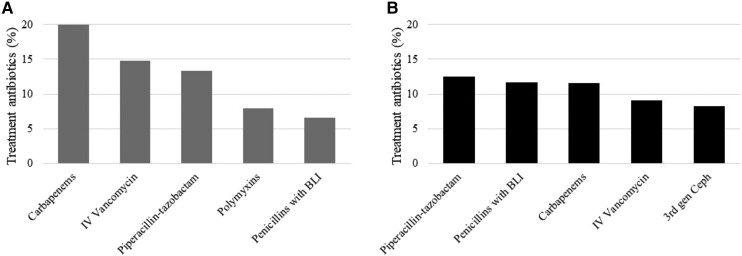
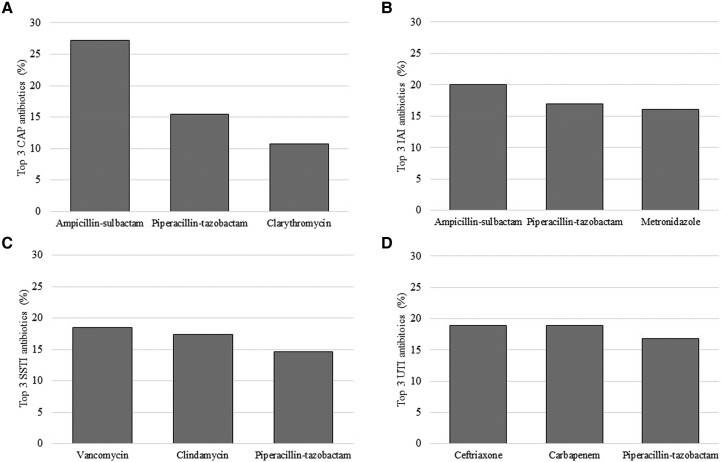
We evaluated AU in 5780 MS-ICU and 7726 Gral-ward patients. The hospitals' median bed size (interquartile range) was 179 (125-330), and 52% were nonprofit. The aggregate AU prevalence was 53.5% in MS-ICUs and 25.5% in Gral-wards. Most (88%) antimicrobials were prescribed to treat infections, 7% for surgical prophylaxis and 5% for medical prophylaxis. Health care-associated infections led to 63% of MS-ICU and 38% of Gral-ward AU. Carbapenems, piperacillin-tazobactam, intravenous (IV) vancomycin, and ampicillin-sulbactam represented 50% of all AU to treat infections. A minority of IV vancomycin targeted therapy was associated with documented methicillin-resistant infection or therapeutic drug monitoring. In both units, 17% of antibiotics prescribed as targeted therapy represented de-escalation, while 24% and 15% in MS-ICUs and Gral-wards, respectively, represented an escalation of therapy. In Gral-wards, 32% of antibiotics were used without a microbiologic culture ordered. Half of surgical prophylaxis antibiotics were prescribed after the first 24 hours.
Based on this cohort, areas to improve AU in Latin American hospitals include antibiotic selection, de-escalation, duration of therapy, and dosing strategies.
本研究的目的是确定拉丁美洲内科-外科重症监护病房(MS-ICU)和普通病房(Gral-ward)中抗生素管理(AS)的机会。
2022年3月至2023年2月期间,我们在41家拉丁美洲医院的MS-ICU和Gral-ward进行了系列横断面现患率调查。对相关科室中年龄大于18岁的患者每月(MS-ICU)或每季度(Gral-ward)进行抗菌药物使用(AU)评估。抗菌药物数据由当地的AS团队使用标准化表格收集,并提交给协调团队进行分析。
我们评估了5780例MS-ICU患者和7726例Gral-ward患者的AU情况。医院的床位中位数(四分位间距)为179(125 - 330),52%为非营利性医院。MS-ICU的总体AU患病率为53.5%,Gral-ward为25.5%。大多数(88%)抗菌药物用于治疗感染,7%用于手术预防,5%用于医疗预防。医疗保健相关感染导致MS-ICU中63%的AU以及Gral-ward中38%的AU。碳青霉烯类、哌拉西林-他唑巴坦、静脉注射(IV)万古霉素和氨苄西林-舒巴坦占所有用于治疗感染的AU的50%。少数IV万古霉素靶向治疗与记录在案的耐甲氧西林感染或治疗药物监测相关。在两个科室中,作为靶向治疗开出的抗生素中有17%代表降阶梯治疗,而在MS-ICU和Gral-ward中分别有24%和15%代表治疗升级。在Gral-ward中,32%的抗生素在未进行微生物培养医嘱的情况下使用。一半的手术预防用抗生素在最初24小时后开出。
基于该队列研究,拉丁美洲医院中改善AU的领域包括抗生素选择、降阶梯治疗、治疗持续时间和给药策略。