Department of Gastroenterology and Hepatology, University Medical Centre Groningen, University of Groningen, Groningen, The Netherlands.
Department of Laboratory Medicine, University Medical Centre Groningen, University of Groningen, Groningen, The Netherlands.
Mol Biol Rep. 2024 Nov 4;51(1):1116. doi: 10.1007/s11033-024-10027-4.
End-stage liver diseases (ESLDs) are a significant global health challenge due to their high prevalence and severe health impacts. Despite the severe outcomes associated with ESLDs, therapeutic options remain limited. Targeting the activation of hepatic stellate cells (HSCs), key drivers of extracellular matrix accumulation during liver injury presents a novel therapeutic approach. In ESLDs patients, branched-chain amino acids (BCAAs, leucine, isoleucine and valine) levels are decreased, and supplementation has been proposed to attenuate liver fibrosis and improve regeneration. However, their effects on HSCs require further investigation.
To evaluate the efficacy of BCAAs and their metabolites, branched-chain α-keto acids (BCKAs), in modulating HSCs activation in human and rat models.
Primary HSCs from rats and cirrhotic and non-cirrhotic human livers, were cultured and treated with BCAAs or BCKAs to assess their effects on both preventing (from day 1 of isolation) and reversing (from day 7 of isolation) HSCs activation.
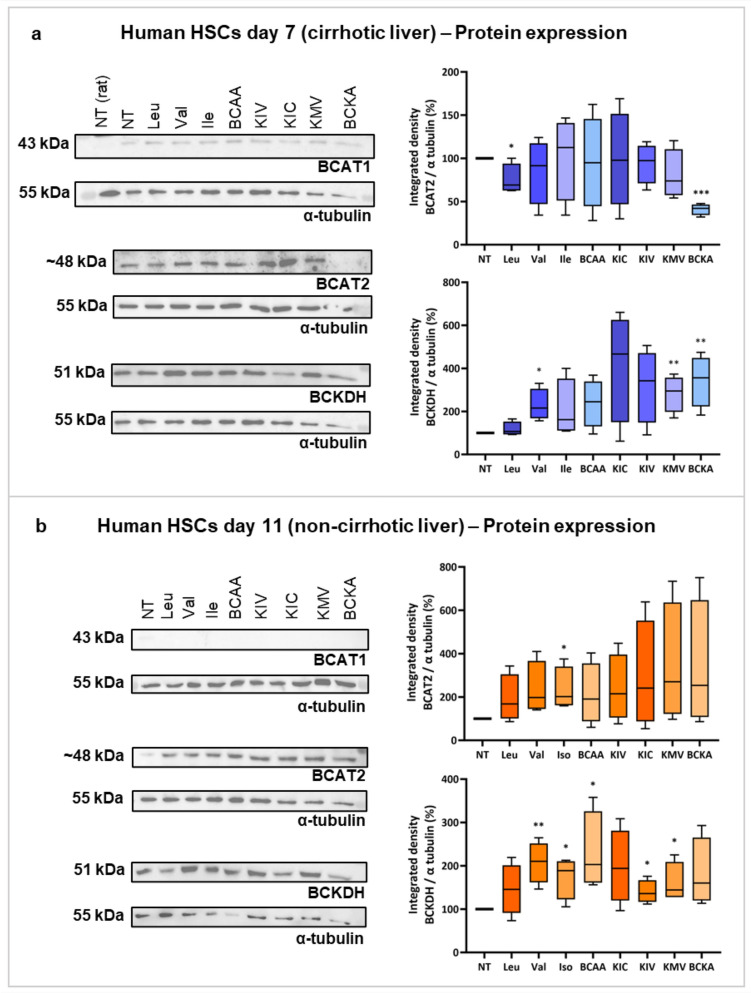
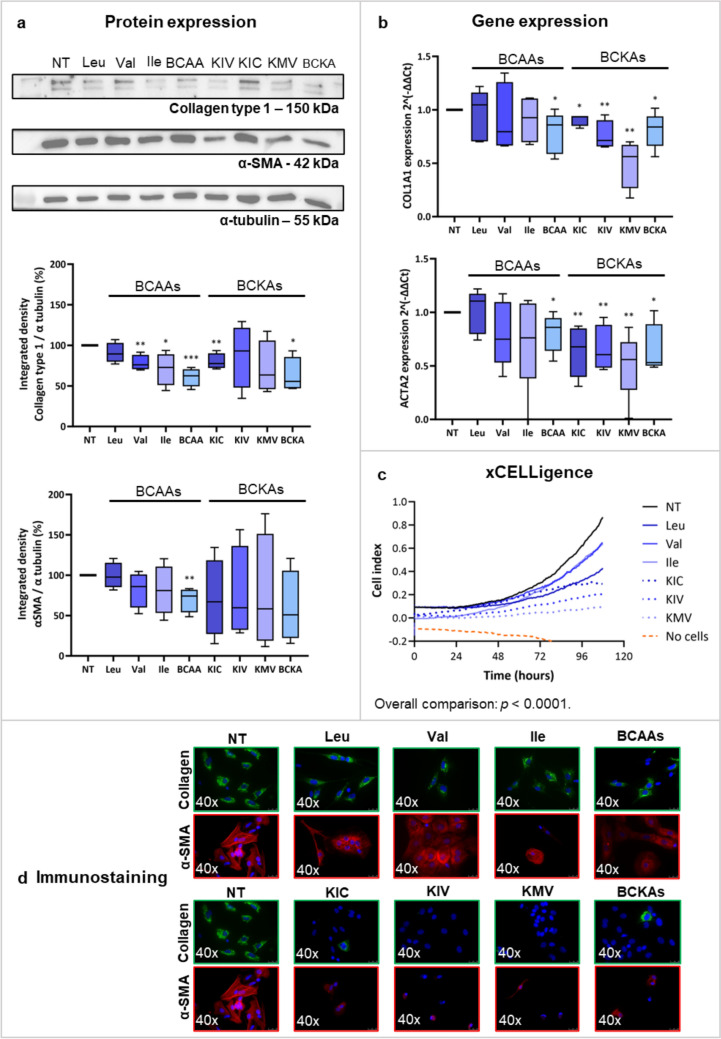
In rat HSCs, leucine and BCKAs significantly reduced fibrotic markers and cell proliferation. In human HSCs, the metabolite of isoleucine decreased cell proliferation around 85% and increased the expression of branched-chain ketoacid dehydrogenase. The other metabolites also showed antifibrotic effects in HSCs from non-cirrhotic human livers.
BCAAs and their respective metabolites inhibit HSC activation with species-specific responses. Further research is needed to understand how BCAAs influence liver fibrogenesis. BCKAs supplementation could be a strategic approach for managing ESLDs, considering the nutritional status and amino acid profiles of patients.
终末期肝病(ESLDs)是一个全球性的健康挑战,因为它们的高患病率和严重的健康影响。尽管与 ESLDs 相关的治疗选择仍然有限,但针对肝星状细胞(HSCs)的激活是一种新的治疗方法。在 ESLDs 患者中,支链氨基酸(BCAAs,亮氨酸、异亮氨酸和缬氨酸)水平降低,补充支链氨基酸已被提出用于减轻肝纤维化和改善再生。然而,它们对 HSCs 的影响需要进一步研究。
评估支链氨基酸(BCAAs)及其代谢物支链α-酮酸(BCKAs)在调节人和大鼠模型中 HSCs 激活的疗效。
培养大鼠和肝硬化及非肝硬化人原代 HSCs,并分别用 BCAAs 或 BCKAs 处理,以评估它们在预防(从分离的第 1 天开始)和逆转(从分离的第 7 天开始)HSCs 激活方面的作用。
在大鼠 HSCs 中,亮氨酸和 BCKAs 显著降低了纤维化标志物和细胞增殖。在人 HSCs 中,异亮氨酸的代谢物使细胞增殖减少了约 85%,并增加了支链酮酸脱氢酶的表达。其他代谢物也显示出对非肝硬化人 HSCs 的抗纤维化作用。
BCAAs 及其各自的代谢物以种属特异性的方式抑制 HSC 激活。需要进一步研究以了解 BCAAs 如何影响肝纤维化。考虑到患者的营养状况和氨基酸谱,BCKAs 的补充可能是管理 ESLDs 的一种策略。