Zheng Jenny L, Li Ying, Hogue Grant, Johnson Megan, Anari Jason B, Regan Maia D, Baldwin Keith D
Division of Orthopaedic Surgery, Children's Hospital of Philadelphia, Perelman School of Medicine at the University of Pennsylvania, Philadelphia, PA, USA.
Department of Orthopaedic Surgery, C.S. Mott Children's Hospital, University of Michigan Health, Ann Arbor, MI, USA.
Spine Deform. 2025 Mar;13(2):351-359. doi: 10.1007/s43390-024-00995-9. Epub 2024 Nov 4.
Adolescent idiopathic scoliosis (AIS) is a common diagnosis managed by pediatric orthopedic surgeons with nonoperative radiographic monitoring representing a cornerstone of treatment. Differences in practices and techniques for obtaining radiographic studies contribute to variation, cost of care, and hamper data aggregation. We surveyed several large organizations dedicated to children's orthopedics or scoliosis care to obtain a consensus for radiographic evaluation of AIS.
A REDCap-based survey was developed across four institutions and beta-tested by staff and fellows from a single institution. The finalized survey was distributed to members of POSNA, PSSG, and SOSORT, and shared on social media. Participants were asked to rank the importance of various datapoints in radiographic assessment of the spinal deformity, skeletal maturity, and study indications during initial, subsequent, preoperative, and final office visits for AIS. Response rate for the overall group was 26%.
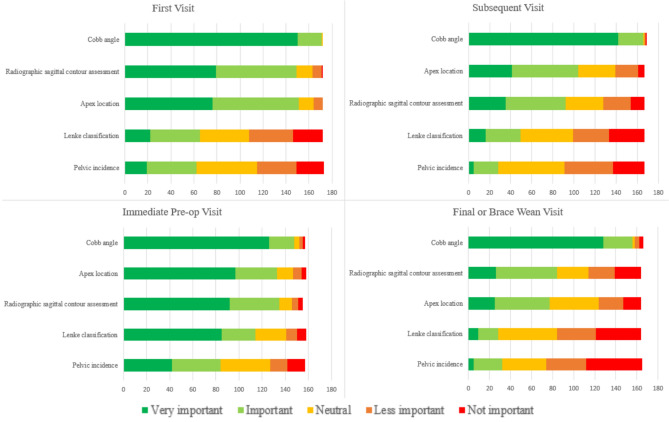
Cobb angle was considered the most important (> 94%) radiographic index across all time points. For positioning, 46% of respondents favored arms bent touching clavicles as the ideal positioning for X-rays, and another 24% favored arms down with palms forward (Table 2). The majority of respondents obtain lateral X-rays at the first visit (99%) and at the preoperative visit (70%). At the preoperative visit, sagittal contour (86%), apex location (85%), and Lenke classification (73%) were considered important factors to record. Flexibility studies are primarily obtained at the preoperative visit (89%) and 81% of respondents prefer bending films as the flexibility technique of choice. Regarding measures of skeletal maturity, Sanders bone age was considered to be the most important by over 70% of respondents across initial, subsequent, preoperative and brace wean visits (Fig. 2). MRIs were obtained routinely by 34% of respondents and only when the patient had a concerning symptom or finding for 67% of respondents.
Despite large variations in radiographic examination of AIS, large areas of agreement were found. It is important to establish standards for positioning patients, evaluating skeletal maturity, and obtaining assessments including lateral views, flexibility studies, and advanced imaging. Establishing common practices for radiographic evaluation of AIS will allow for less variation in care and for critical questions to be answered through registry formation and large multicenter data collection.
This study establishes current practitioner opinion on the radiographic evaluation of the AIS patient. Minimum data sets are useful for data aggregation and answering research questions in the face of data variability.
Level V.
青少年特发性脊柱侧凸(AIS)是儿科骨科医生常见的诊断疾病,非手术影像学监测是治疗的基石。获取影像学研究的方法和技术差异导致了差异、护理成本,并阻碍了数据汇总。我们调查了几个致力于儿童骨科或脊柱侧凸护理的大型组织,以就AIS的影像学评估达成共识。
在四个机构开展了一项基于REDCap的调查,并由一个机构的工作人员和研究员进行了预测试。最终确定的调查分发给了POSNA、PSSG和SOSORT的成员,并在社交媒体上分享。参与者被要求对脊柱畸形、骨骼成熟度的影像学评估以及AIS初次、后续、术前和最终门诊就诊时的研究指征中各种数据点的重要性进行排名。整个群体的回复率为26%。
在所有时间点,Cobb角被认为是最重要的(>94%)影像学指标。对于体位摆放,46%的受访者倾向于双臂弯曲触碰锁骨作为X线检查的理想体位,另有24%的受访者倾向于双臂下垂手掌向前(表2)。大多数受访者在初次就诊(99%)和术前就诊(70%)时获取侧位X线片。在术前就诊时,矢状面轮廓(86%)、顶点位置(85%)和Lenke分型(73%)被认为是重要的记录因素。柔韧性研究主要在术前就诊时进行(89%),81%的受访者更喜欢弯曲位片作为柔韧性检查的首选技术。关于骨骼成熟度的测量,超过70%的受访者在初次、后续、术前和支具撤除就诊时认为Sanders骨龄是最重要的(图2)。34%的受访者常规进行MRI检查,67%的受访者仅在患者有可疑症状或发现时进行检查。
尽管AIS的影像学检查存在很大差异,但仍发现了广泛的共识领域。为患者体位摆放、评估骨骼成熟度以及获取包括侧位片、柔韧性研究和高级影像学检查在内的评估建立标准非常重要。建立AIS影像学评估的通用方法将减少护理差异,并通过建立登记系统和进行大型多中心数据收集来回答关键问题。
本研究确立了当前从业者对AIS患者影像学评估的观点。面对数据变异性,最小数据集对于数据汇总和回答研究问题很有用。
V级。

