Department of Environmental Studies, New York University, New York, NY 10003.
Water and Development Research Group, Aalto University, Espoo 02150, Finland.
Proc Natl Acad Sci U S A. 2024 Nov 12;121(46):e2405758121. doi: 10.1073/pnas.2405758121. Epub 2024 Nov 4.
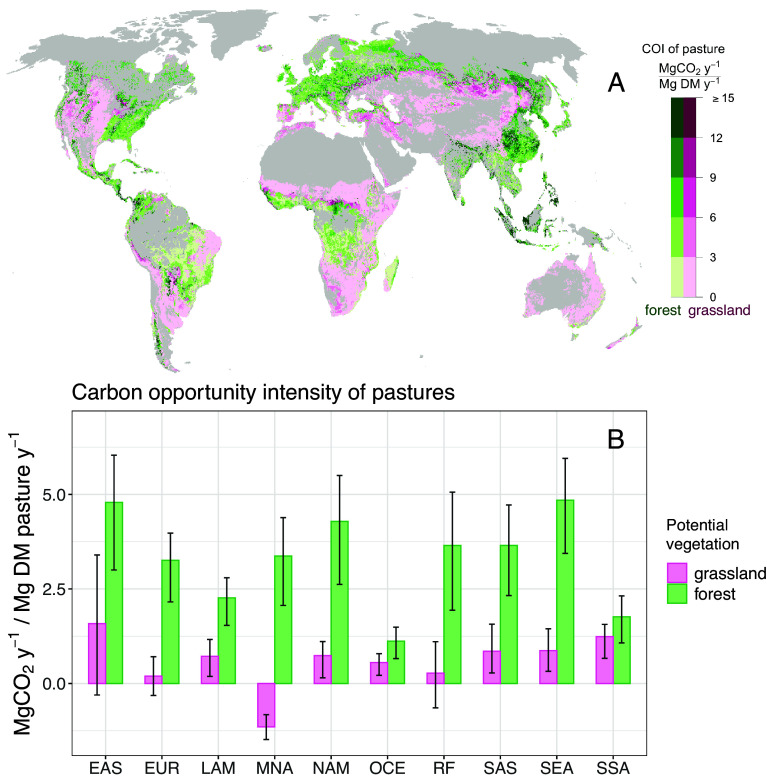
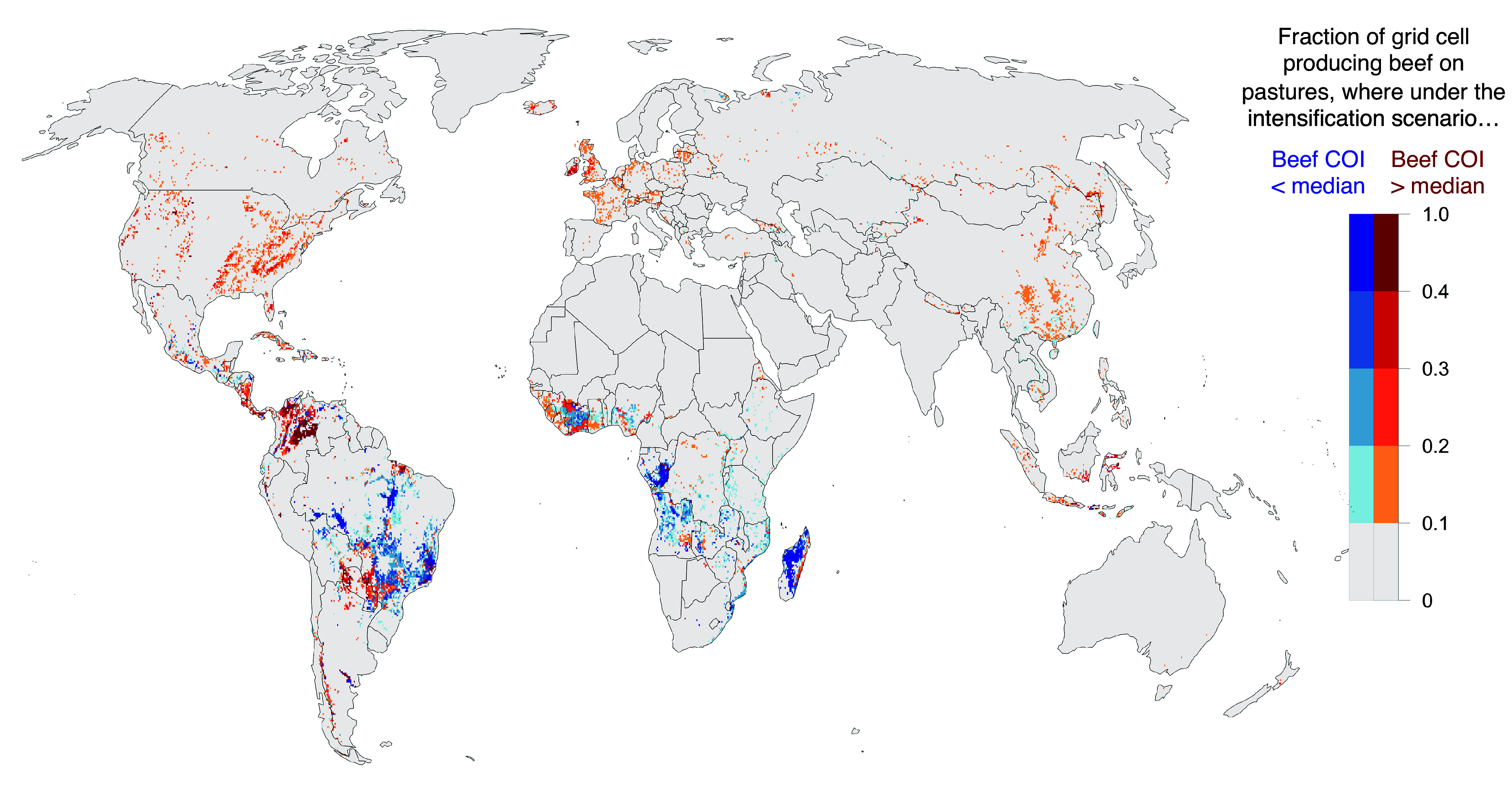
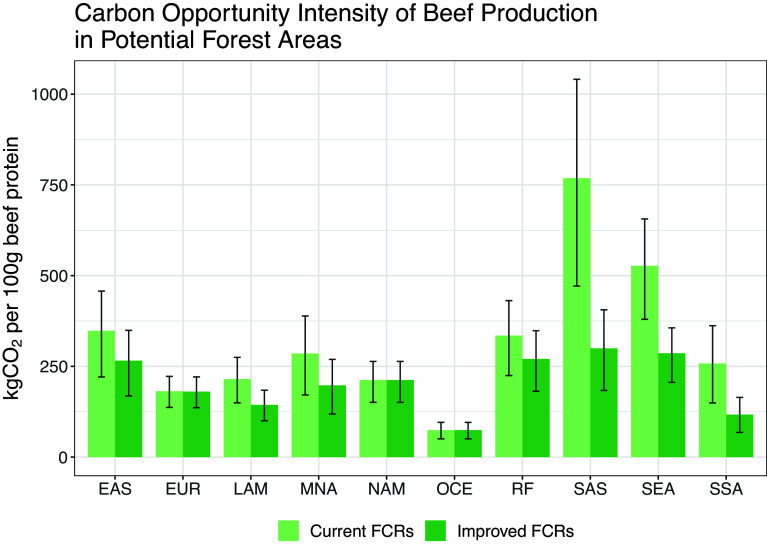
Pastures, on which ruminant livestock graze, occupy one third of the earth's surface. Removing livestock from pastures can support climate change mitigation through carbon sequestration in regrowing vegetation and recovering soils, particularly in potentially forested areas. However, this would also decrease food and fiber production, generating a tradeoff with pasture productivity and the ruminant meat production pastures support. We evaluate the magnitude and distribution of this tradeoff globally, called the "carbon opportunity intensity" of pastures, at a 5-arcminute resolution. We find that removing beef-producing cattle from high-carbon intensity pastures could sequester 34 (22 to 43) GtC i.e. 125 (80 to 158) GtCO into ecosystems, which is an amount greater than global fossil CO emissions from 2021-2023. This would lead to only a minor loss of 13 (9 to 18)% of the global total beef production on pastures, predominantly within high- and upper-middle-income countries. If areas with low-carbon intensity pastures and less efficient beef production simultaneously intensified their beef production to 47% of OECD levels, this could fully counterbalance the global loss of beef production. The carbon opportunity intensity can inform policy approaches to restore ecosystems while minimizing food losses. Future work should aim to provide higher-resolution estimates for use at local and farm scales, and to incorporate a wider set of environmental indicators of outcomes beyond carbon.
牧场是反刍家畜的栖息地,占据了地球表面的三分之一。从牧场上移走家畜可以通过重新生长的植被和恢复的土壤固碳来支持气候变化缓解,特别是在潜在的森林地区。然而,这也会减少食物和纤维的生产,与牧场生产力和牧场支持的反刍动物肉类生产之间产生权衡。我们以 5 弧分的分辨率评估了这种权衡的全球规模和分布,称为牧场的“碳机会强度”。我们发现,从高碳强度牧场上移走生产牛肉的牛可以将 34(22 至 43)GtC 即 125(80 至 158)GtCO 固存到生态系统中,这一数量大于 2021-2023 年全球化石 CO 排放总量。这将导致牧场上全球牛肉总产量仅减少 13(9 至 18)%,主要集中在高收入和上中等收入国家。如果低碳强度牧场和效率较低的牛肉生产地区同时将其牛肉产量提高到经合组织水平的 47%,则可以完全抵消全球牛肉产量的损失。碳机会强度可以为恢复生态系统的政策方法提供信息,同时尽量减少食物损失。未来的工作应旨在提供更高分辨率的估计值,以用于本地和农场规模,并纳入更广泛的环境指标,以衡量除碳以外的结果。