Emergency Medicine, Linping Campus, The Second Affiliated Hospital of Zhejiang University School of Medicine, Hangzhou, Zhejiang, China.
Respiratory Medicine, Linping Campus, The Second Affiliated Hospital of Zhejiang University School of Medicine, Hangzhou, Zhejiang, China.
Medicine (Baltimore). 2024 Nov 1;103(44):e40033. doi: 10.1097/MD.0000000000040033.
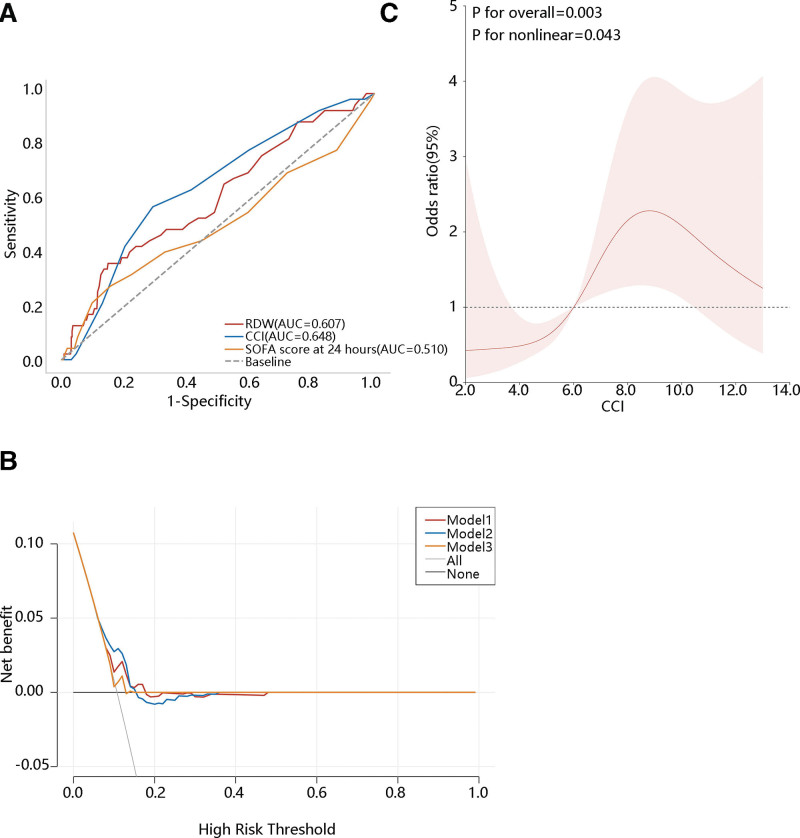
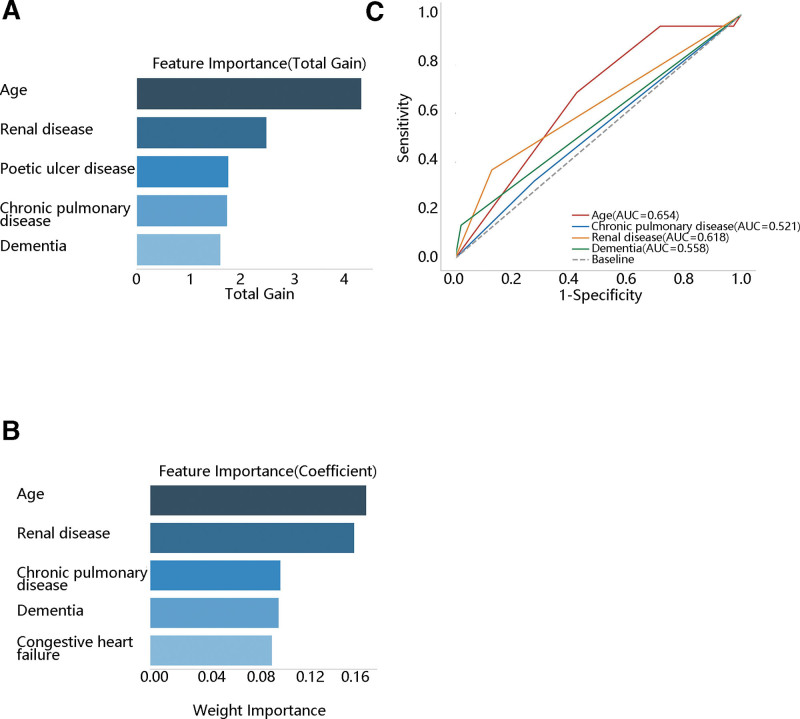
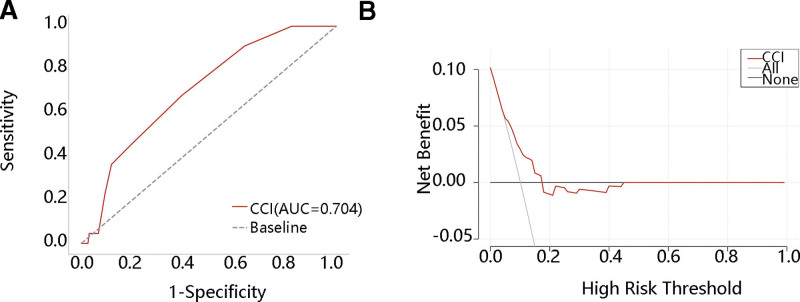
The purpose of this study was to investigate the value of the Charlson comorbidity index (CCI) in predicting intensive care unit (ICU) readmission in aortic aneurysm (AA) patients. Patient information came from the Medical Information Mart for Intensive Care- IV (MIMIC-IV) database. The relationship between CCI and ICU readmission was analyzed by restricted cubic spline, generalized linear regression, trend analysis, and hierarchical analysis. The clinical value of CCI in predicting ICU readmission was analyzed by receiver operating characteristic curve, decision curve analysis, XGBoost regression, and random forest regression. A total of 523 patients with AA were enrolled in the study. Patients with AA who were readmitted to the ICU had higher width of red blood cell distribution width (RDW) and higher CCI. CCI had better performance and clinical net benefit for predicting ICU readmission than RDW. An independent nonlinear relationship was found between CCI and ICU readmission. The trend analysis suggested that the risk of ICU readmission increased with higher CCI scores. The hierarchical analysis showed that their association was mainly found in surgery requirement populations regardless of AA types. Further, CCI was found to have better clinical value in predicting ICU readmission of thoracic aortic aneurysm (TAA) patients undergoing surgery. Age, renal disease, chronic lung disease, and dementia were important components of CCI in predicting ICU readmission of TAA patients undergoing surgery. CCI was independently associated with the ICU readmission of AA patients in a positive relationship and had more favorable prediction performance in TAA patients who underwent surgery.
本研究旨在探讨 Charlson 合并症指数(CCI)在预测主动脉瘤(AA)患者重症监护病房(ICU)再入院中的价值。患者信息来自医疗信息集市重症监护-IV(MIMIC-IV)数据库。通过限制立方样条、广义线性回归、趋势分析和层次分析来分析 CCI 与 ICU 再入院之间的关系。通过接收者操作特征曲线、决策曲线分析、XGBoost 回归和随机森林回归分析 CCI 在预测 ICU 再入院中的临床价值。共纳入 523 例 AA 患者。入住 ICU 的 AA 患者的红细胞分布宽度(RDW)较宽,CCI 较高。CCI 在预测 ICU 再入院方面的性能和临床净获益均优于 RDW。CCI 与 ICU 再入院之间存在独立的非线性关系。趋势分析表明,CCI 评分越高,ICU 再入院的风险越高。层次分析表明,无论 AA 类型如何,CCI 与 ICU 再入院的关联主要存在于需要手术的人群中。此外,CCI 在预测接受手术的胸主动脉瘤(TAA)患者 ICU 再入院方面具有更好的临床价值。CCI 在预测接受手术的 TAA 患者 ICU 再入院中的年龄、肾病、慢性肺部疾病和痴呆等重要组成部分。CCI 与 AA 患者的 ICU 再入院呈正相关,与接受手术的 TAA 患者的预测性能更优。