Vine Jacob, Lee John H, Balaji Lakshman, Grossestreuer Anne V, Morton Andrea, Peradze Natia, Antony Nivedha, Berlin Noa, Kravitz Max S, Leland Shannon B, Berg Katherine, Moskowitz Ari, Donnino Michael W, Liu Xiaowen
Center for Resuscitation Science, Beth Israel Deaconess Medical Center, 330 Brookline Ave, Boston, MA, 02215, USA.
Department of Emergency Medicine, Beth Israel Deaconess Medical Center, 330 Brookline Ave, Boston, MA, 02215, USA.
Intensive Care Med Exp. 2024 Nov 4;12(1):97. doi: 10.1186/s40635-024-00673-0.
Diabetic ketoacidosis (DKA) is a potentially life-threatening disorder associated with severe alterations in metabolism and acid-base status. Mitochondrial dysfunction is associated with diabetes and its complications. Thiamine and coenzyme Q10 (CoQ10) are important factors in aerobic metabolism. In this study, we measured cellular oxygen consumption rates (OCRs) and the effects of in vitro administration of thiamine and CoQ10 on OCRs in patients with DKA versus healthy controls.
Blood samples were collected from a prospective cohort of patients with DKA and from controls. Cellular OCRs were measured in peripheral blood mononuclear cells (PBMC) without treatment and after treatment with thiamine, CoQ10, or both. The mitochondrial profile was measured using an XFe96 Extracellular Flux Analyzer and XF Cell Mito Stress Test Kit (Seahorse Bioscience). A linear quantile mixed model was used to compare OCRs and estimate treatment effects.
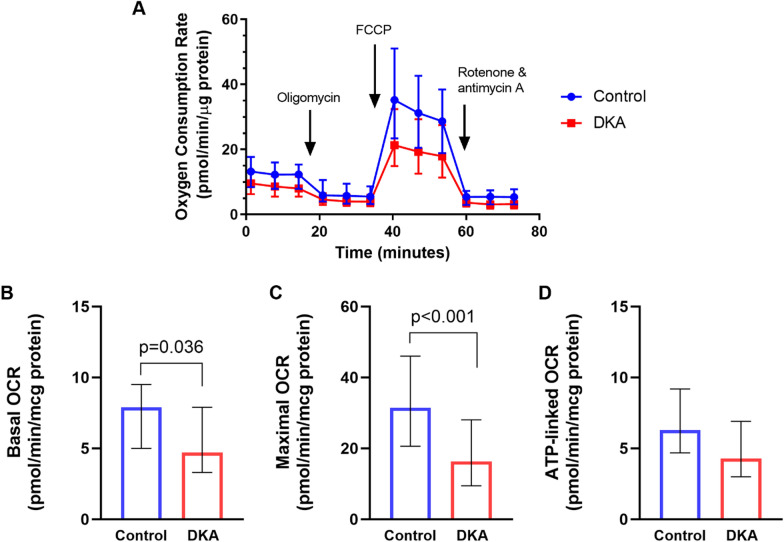
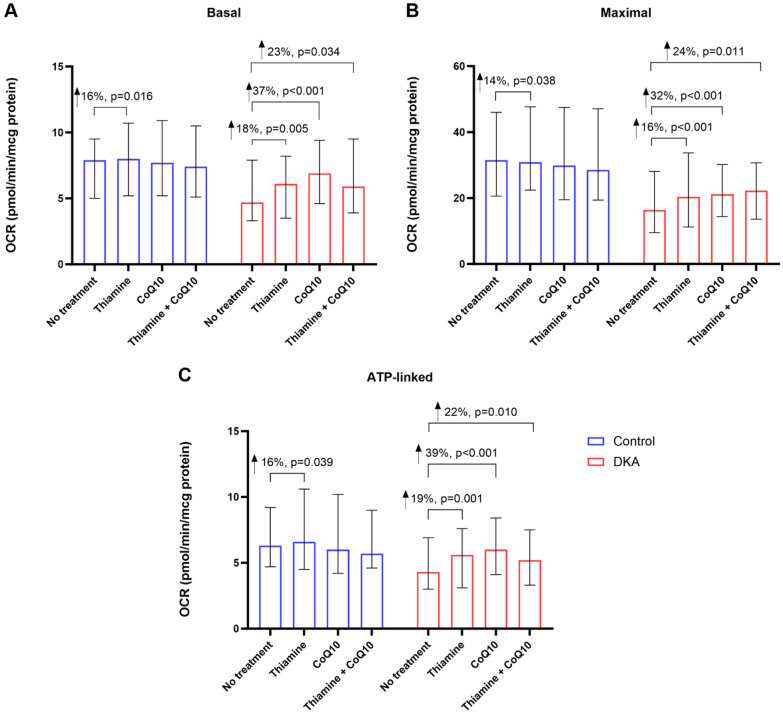
A total of 62 patients with DKA and 48 controls were included in the study. The median basal and maximal OCRs were lower in the DKA group than in the control group (basal: 4.7 [IQR: 3.3, 7.9] vs. 7.9 [5.0, 9.5], p = 0.036; maximal: 16.4 [9.5, 28.1] vs. 31.5 [20.6, 46.0] pmol/min/µg protein, p < 0.001). In DKA samples, basal and maximal OCRs were significantly increased when treated with thiamine, CoQ10, or both. In controls, basal and maximal OCR were significantly increased only with thiamine treatment.
Mitochondrial metabolic profiles of patients with DKA demonstrated lower cellular oxygen consumption when compared to healthy controls. Oxygen consumption increased significantly in cells of patients with DKA treated with thiamine or CoQ10. These results suggest that thiamine and CoQ10 could potentially have therapeutic benefits in DKA via their metabolic effects on mitochondrial cellular respiration.
糖尿病酮症酸中毒(DKA)是一种潜在的危及生命的疾病,与代谢和酸碱状态的严重改变相关。线粒体功能障碍与糖尿病及其并发症有关。硫胺素和辅酶Q10(CoQ10)是有氧代谢中的重要因素。在本研究中,我们测量了DKA患者与健康对照者的细胞氧消耗率(OCR),以及体外给予硫胺素和CoQ10对OCR的影响。
从DKA患者的前瞻性队列和对照者中采集血样。在未处理以及用硫胺素、CoQ10或两者处理后的外周血单核细胞(PBMC)中测量细胞OCR。使用XFe96细胞外通量分析仪和XF细胞线粒体应激测试试剂盒(Seahorse Bioscience)测量线粒体概况。使用线性分位数混合模型比较OCR并估计治疗效果。
本研究共纳入62例DKA患者和48例对照者。DKA组的基础和最大OCR中位数低于对照组(基础:4.7[四分位间距:3.3,7.9]对7.9[5.0,9.5],p = 0.036;最大:16.4[9.5,28.1]对31.5[20.6,46.0] pmol/min/μg蛋白,p < 0.001)。在DKA样本中,用硫胺素、CoQ10或两者处理后,基础和最大OCR显著增加。在对照者中,仅硫胺素处理可使基础和最大OCR显著增加。
与健康对照者相比,DKA患者的线粒体代谢概况显示细胞氧消耗较低。用硫胺素或CoQ10处理的DKA患者细胞中的氧消耗显著增加。这些结果表明,硫胺素和CoQ10可能通过其对线粒体细胞呼吸代谢的影响而对DKA具有潜在治疗益处。