Sundell Jesper, Rekic Dinko, Melin Johanna, Johansson Susanne, Ebrahimi Ahmad, Dota Corina, Parkinson Joanna
Clinical Pharmacology and Quantitative Pharmacology, Clinical Pharmacology and Safety Sciences, BioPharmaceuticals R&D, AstraZeneca, Gothenburg, Sweden.
Lund University, Lund, Sweden.
CPT Pharmacometrics Syst Pharmacol. 2025 Feb;14(2):292-301. doi: 10.1002/psp4.13272. Epub 2024 Nov 5.
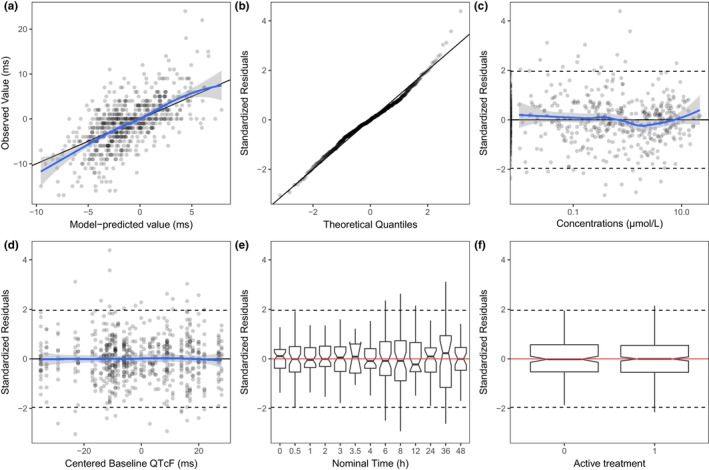
Balcinrenone (AZD9977) is a selective mineralocorticoid receptor modulator in development in combination with dapagliflozin for treatment of heart failure with impaired kidney function and chronic kidney disease. A prespecified concentration-QT analysis was performed based on data from a phase I single ascending dose study prospectively designed as a thorough QT study substitute. Oral single doses of balcinrenone of 5-800 mg, plus fractionated doses of 800 and 1200 mg, were evaluated in 62 healthy male participants. Time-matched 12-lead digital electrocardiogram and plasma concentrations were measured pre-dose and up to 48 h postdose in the participants. Analysis was performed using a linear mixed-effect model, where baseline-adjusted Fridericia-corrected QT interval (ΔQTcF) was a dependent variable and time-matched balcinrenone concentration an independent variable. The model fit was deemed adequate by evaluation of goodness-of-fit plots, and the slope of the concentration-ΔQTcF relationship was nonsignificant (-0.003 ms/μmol/L; 95% confidence interval [CI]: -0.181, 0.176). The high clinical exposure scenario was defined as the maximum concentration (2.156 μmol/L) following the highest expected therapeutic dose (40 mg once daily) under fed conditions and in presence of a strong cytochrome P450 3A4 inhibitor. Estimated baseline-adjusted and placebo-corrected QTcF interval (ΔΔQTcF) at this concentration was 0.35 ms (90% CI: -1.29, 2.00). Furthermore, the upper 90% ΔΔQTcF CI was estimated to be below the threshold of regulatory concern of 10 ms at all observed concentrations (up to 16.7 μmol/L). Hence, it can be concluded that balcinrenone does not induce QTcF prolongation at the high clinical exposure scenario.
巴氯烯酮(AZD9977)是一种正在研发的选择性盐皮质激素受体调节剂,与达格列净联合用于治疗肾功能受损的心力衰竭和慢性肾病。基于一项前瞻性设计作为全面QT研究替代方案的I期单剂量递增研究的数据,进行了预先设定的浓度-QT分析。在62名健康男性受试者中评估了口服单剂量5-800mg的巴氯烯酮,以及800mg和1200mg的分次剂量。在受试者给药前和给药后长达48小时测量了时间匹配的12导联数字心电图和血浆浓度。使用线性混合效应模型进行分析,其中基线校正的弗里德里西亚校正QT间期(ΔQTcF)是因变量,时间匹配的巴氯烯酮浓度是自变量。通过评估拟合优度图认为模型拟合良好,浓度-ΔQTcF关系的斜率无统计学意义(-0.003ms/μmol/L;95%置信区间[CI]:-0.181,0.176)。高临床暴露场景定义为在进食条件下且存在强效细胞色素P450 3A4抑制剂时,最高预期治疗剂量(每日一次40mg)后的最大浓度($2.156\mu mol/L$)。在此浓度下估计的基线校正和安慰剂校正的QTcF间期(ΔΔQTcF)为0.35ms(90%CI:-1.29,2.00)。此外,在所有观察到的浓度(高达$16.7\mu mol/L$)下,90%的ΔΔQTcF CI上限估计低于监管关注阈值10ms。因此,可以得出结论,在高临床暴露场景下巴氯烯酮不会诱导QTcF延长。