Verinumbe Tarfa, Lucas Gregory M, Zook Katie, Weir Brian, Landry Miles, Page Kathleen R, Sherman Susan G, Falade-Nwulia Oluwaseun
Johns Hopkins University School of Medicine, Division of Infectious Diseases, Baltimore, MD 21205, USA.
Johns Hopkins University Bloomberg School of Public Health, Department of Health, Behavior and Society, Baltimore, MD 21205, USA.
Drug Alcohol Depend Rep. 2024 Oct 8;13:100288. doi: 10.1016/j.dadr.2024.100288. eCollection 2024 Dec.
Perceived HIV risk may impact willingness to initiate PrEP among people who inject drugs (PWID).
We analyzed baseline data from PrEP eligible PWID in Baltimore, MD. Risk perception was assessed by PWID relative to the average risk of their age group categorized as: higher-than, lower-than, or about average. Participants were informed of PrEP for HIV prevention and asked about their willingness to use daily PrEP. Associations of PrEP indication (categorized as injection risk only vs any sexual risk), perceived HIV risk and non-willingness to use PrEP was assessed using generalized linear models.
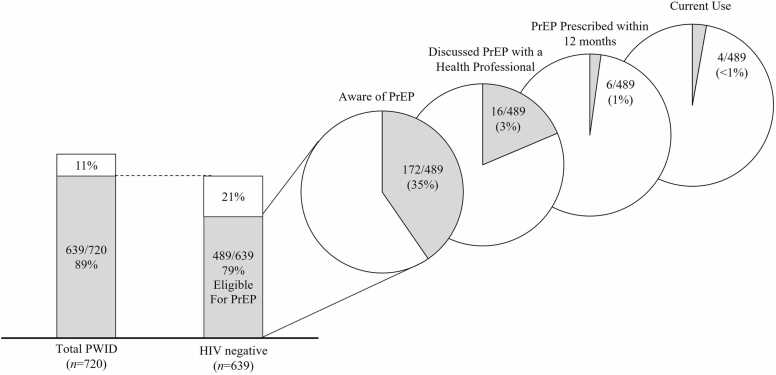
Among 489 participants, 61 % were male, 66 % were Black and mean age was 46 years. One-third (35 %) of the participants were aware of PrEP and <1 % had used PrEP in the prior 30 days. Overall, 30 % of PWID reported lower-than-average perceived HIV risk and 18 % reported non-willingness to use PrEP. Participants with injection risk only were more likely (aOR: 2.75; 95 %CI: 1.60 - 4.73) to report having lower-than-average perceived HIV risk compared to those with any sexual risk. Participants with lower-than-average perceived risk were more likely to report non-willingness to use PrEP compared to those with higher perceived risk (adjusted PR: 1.91; 95 %CI: 1.18 - 3.10).
A considerable proportion of PWID eligible for PrEP reported having low risk of HIV acquisition despite being eligible for PrEP. Consistent and tailored PrEP messaging that addresses drug use HIV risk perception may be critical to increasing PrEP uptake among PWID.
感知到的艾滋病毒风险可能会影响注射吸毒者(PWID)开始使用暴露前预防(PrEP)的意愿。
我们分析了马里兰州巴尔的摩符合PrEP条件的注射吸毒者的基线数据。通过注射吸毒者相对于其年龄组平均风险的感知风险进行评估,分为:高于、低于或约为平均水平。向参与者介绍了用于艾滋病毒预防的PrEP,并询问他们每天使用PrEP的意愿。使用广义线性模型评估PrEP适应症(仅归类为注射风险与任何性风险)、感知到的艾滋病毒风险与不愿意使用PrEP之间的关联。
在489名参与者中,61%为男性,66%为黑人,平均年龄为46岁。三分之一(35%)的参与者知晓PrEP,且在过去30天内<1%的人使用过PrEP。总体而言,30%的注射吸毒者报告其感知到的艾滋病毒风险低于平均水平,18%的人报告不愿意使用PrEP。与有任何性风险的参与者相比,仅具有注射风险的参与者更有可能(调整后的比值比:2.75;95%置信区间:1.60 - 4.73)报告其感知到的艾滋病毒风险低于平均水平。与感知风险较高的参与者相比,感知风险低于平均水平的参与者更有可能报告不愿意使用PrEP(调整后的风险比:1.91;95%置信区间:1.18 - 3.10)。
相当一部分符合PrEP条件但有艾滋病毒感染风险的注射吸毒者报告其感染艾滋病毒的风险较低,尽管他们符合PrEP条件。针对吸毒者艾滋病毒风险认知的一致且量身定制的PrEP信息传递对于提高注射吸毒者对PrEP的接受度可能至关重要。