Scaletti Cristina, Pratesi Sara, Bellando Randone Silvia, Di Pietro Linda, Campochiaro Corrado, Annunziato Francesco, Matucci Cerinic Marco
Department of Experimental and Clinical Medicine, University of Florence, Florence, Italy.
Flow Cytometry Diagnostic Center and Immunotherapy, University Hospital Careggi, Florence, Italy.
Clin Exp Immunol. 2025 Jan 21;219(1). doi: 10.1093/cei/uxae098.
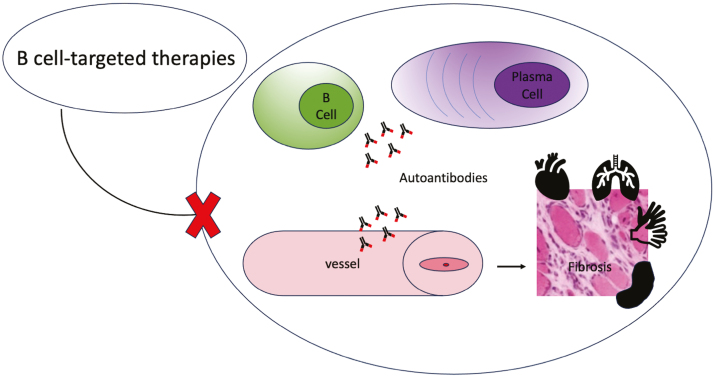
Systemic sclerosis (SSc) is considered a rare autoimmune disease in which there are alterations of both the innate and adaptive immune response resulting in the production of autoantibodies. Abnormalities of the immune system compromise the normal function of blood vessels leading to a vasculopathy manifested by Raynaud's phenomenon, an early sign of SSc . As a consequence of this reactive picture, the disease can evolve leading to tissue fibrosis. Several SSc-specific autoantibodies are currently known and are associated with specific clinical manifestations and prognosis. Although the pathogenetic role of these autoantibodies is still unclear, their production by B cells and plasma cells suggests the importance of these cells in the development of SSc. This review narratively examines B-cell dysfunctions and their role in the pathogenesis of SSc and discusses B-cell-targeted therapies currently used or potentially useful for the management of end-organ complications.
系统性硬化症(SSc)被认为是一种罕见的自身免疫性疾病,其固有免疫和适应性免疫反应均发生改变,导致自身抗体产生。免疫系统异常损害血管的正常功能,导致以雷诺现象为表现的血管病变,这是SSc的早期体征。由于这种反应性表现,该疾病会进展并导致组织纤维化。目前已知几种SSc特异性自身抗体,它们与特定的临床表现和预后相关。尽管这些自身抗体的致病作用仍不清楚,但B细胞和浆细胞产生这些抗体表明这些细胞在SSc发病机制中的重要性。本综述叙述性地研究了B细胞功能障碍及其在SSc发病机制中的作用,并讨论了目前用于或可能用于治疗终末器官并发症的B细胞靶向疗法。