He Feng, Zhou Zhaocai, Zhao Sheng, Li Wenchuan, Lian Xingji, Yu Jianwen, Lin Zhengmei, Song Zhi, Chen Wei, Li Jianbo
Department of Nephrology, Guangzhou First People's Hospital, The Second Affiliated Hospital, School of Medicine, South China University of Technology, Guangzhou, China.
Hospital of Stomatology, Guanghua School of Stomatology, Guangdong Provincial Key Laboratory of Stomatology, Sun Yat-sen University, Guangzhou, China.
J Clin Lab Anal. 2024 Dec;38(23):e25118. doi: 10.1002/jcla.25118. Epub 2024 Nov 5.
Overweight and obesity is a risk factor for hypertension. Malignant hypertension (MHT) is the most severe form of hypertension, and thrombotic microangiopathy (TMA), one of its complications, has been linked to significant renal outcomes. However, the impact of overweight and obesity on renal prognosis in MHT patients with TMA is not well understood.
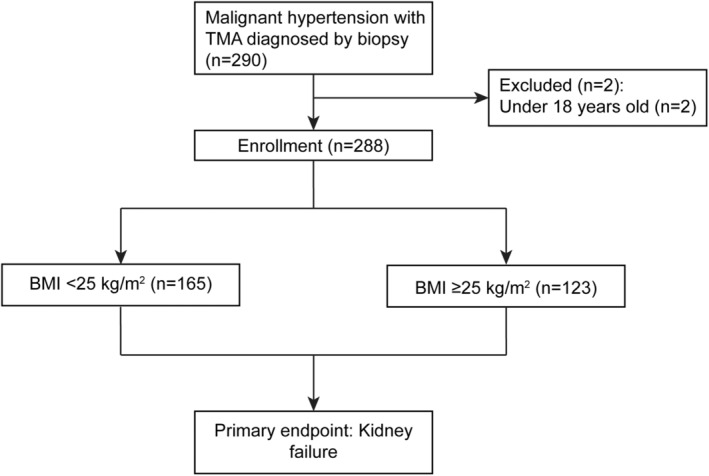
This was a prospective cohort enrolled 288 MHT patients with renal TMA from 2008 to 2023. The clinical and histopathological characteristics were recorded based on body mass index (BMI, < 25 and ≥ 25 kg/m). The outcome was the incidence of kidney failure. The associations of BMI with kidney failure were examined in logistic regression models.
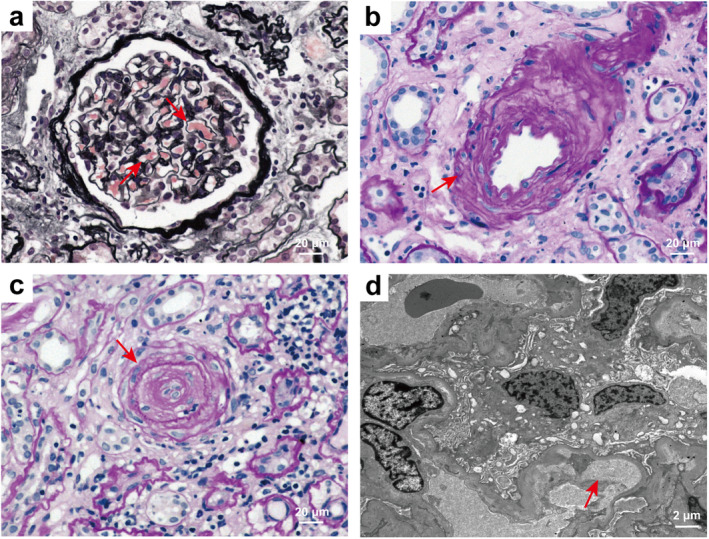
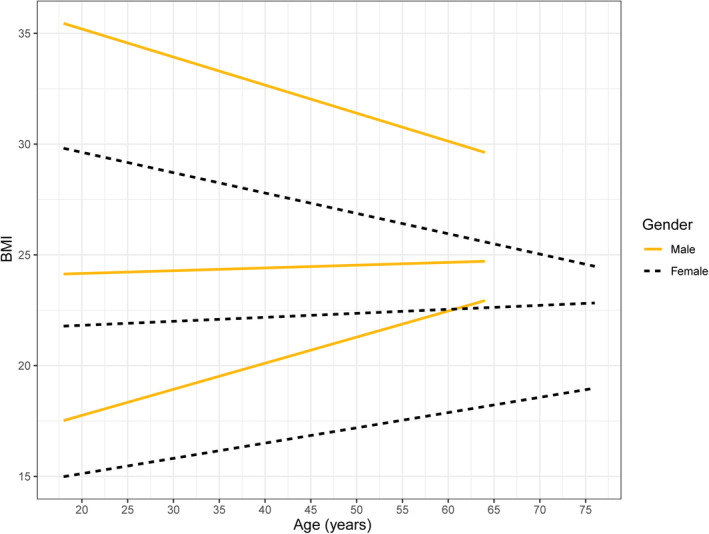
Among 288 patients, 180 (62.5%) progressed to kidney failure, including 113 (68.5%) patients with BMI < 25 kg/m. Participants with obesity had higher levels of hemoglobin, estimated glomerular filtration rate and C3, but lower levels of serum creatinine and IgA nephropathy. BMI ≥ 25 kg/m was associated with a better outcome of kidney failure in MHT patients with TMA (odd ratios [ORs]: 0.49 [95% confidence interval (CI): 0.27-0.91], p = 0.025). Male, uric acid, onion skin lesions, and global sclerosis ratio were correlated with higher risk of kidney failure; serum albumin and treatment with renin-angiotensin system blockers were related to lower risk of kidney failure.
In MHT patients with renal TMA, normal-weight rather than overweight was found to associate with a worse renal prognosis. Management efforts for MHT may be directed toward controlling body weight within a reasonable range for patients.
超重和肥胖是高血压的危险因素。恶性高血压(MHT)是高血压最严重的形式,其并发症之一血栓性微血管病(TMA)与严重的肾脏预后相关。然而,超重和肥胖对合并TMA的MHT患者肾脏预后的影响尚不清楚。
这是一项前瞻性队列研究,纳入了2008年至2023年的288例合并肾脏TMA的MHT患者。根据体重指数(BMI,<25和≥25kg/m)记录临床和组织病理学特征。结局指标是肾衰竭的发生率。在逻辑回归模型中检查BMI与肾衰竭的关联。
在288例患者中,180例(62.5%)进展为肾衰竭,其中BMI<25kg/m的患者有113例(68.5%)。肥胖参与者的血红蛋白、估计肾小球滤过率和C3水平较高,但血清肌酐和IgA肾病水平较低。BMI≥25kg/m与合并TMA的MHT患者更好的肾衰竭结局相关(比值比[ORs]:0.49[95%置信区间(CI):0.27-0.91],p=0.025)。男性、尿酸、洋葱皮样病变和全球硬化率与更高的肾衰竭风险相关;血清白蛋白和肾素-血管紧张素系统阻滞剂治疗与更低的肾衰竭风险相关。
在合并肾脏TMA的MHT患者中,体重正常而非超重与更差的肾脏预后相关。对于MHT的管理措施可能应致力于将患者体重控制在合理范围内。