GENUD Toledo Research Group, Universidad de Castilla-La Mancha, Toledo, Spain.
CIBER of Frailty and Healthy Aging (CIBERFES), Madrid, Spain.
J Cachexia Sarcopenia Muscle. 2023 Apr;14(2):1019-1032. doi: 10.1002/jcsm.13184. Epub 2023 Feb 14.
Maximum muscle power (P ) is a biomarker of physical performance in all ages. No longitudinal studies have assessed the effects of aging on P obtained from the torque-velocity (T-V) relationship, which should be considered the 'gold standard'. This study evaluated the longitudinal changes in the T-V relationship and P of the knee-extensor muscles in young, middle-aged, and older adults after 10 years of follow-up.
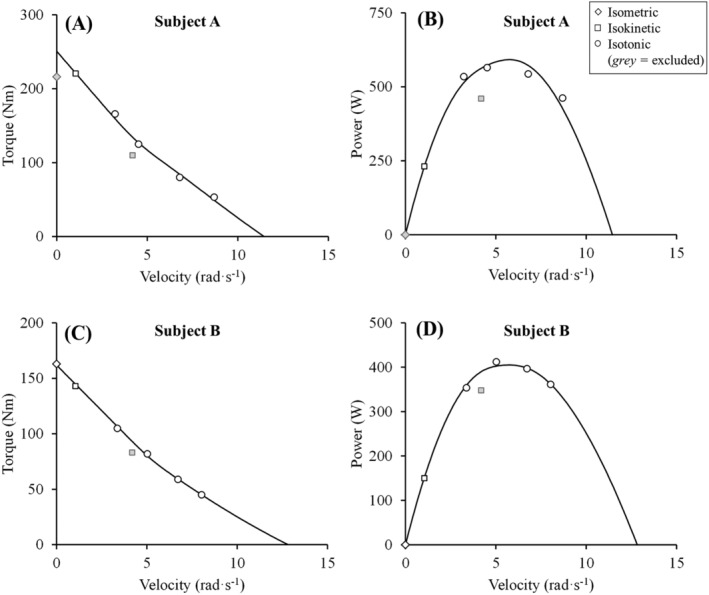
Four hundred eighty-nine subjects (311 men and 178 women; aged 19-68 years) were tested at baseline and after a 10-year follow-up. Anthropometric data, daily protein intake, physical activity level (PAL), and knee-extension muscle function (isometric, isokinetic, and isotonic) were evaluated. A novel hybrid equation combining a linear and a hyperbolic (Hill-type) region was used to obtain the T-V relationship and P of the participants, who were grouped by sex and age (young: 20-40 years; middle-aged: 40-60 years; and old: ≥60 years). Linear mixed-effect models were used to assess effects of time, sex, and age on T-V parameters, P , and body mass index (BMI). Additional analyses were performed to adjust for changes in daily protein intake and PAL.
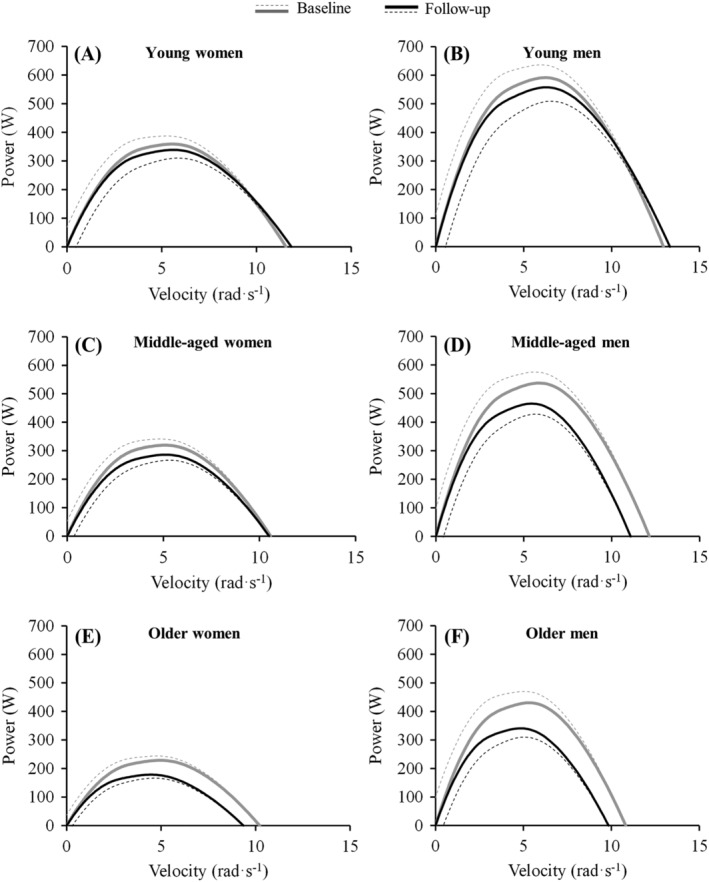
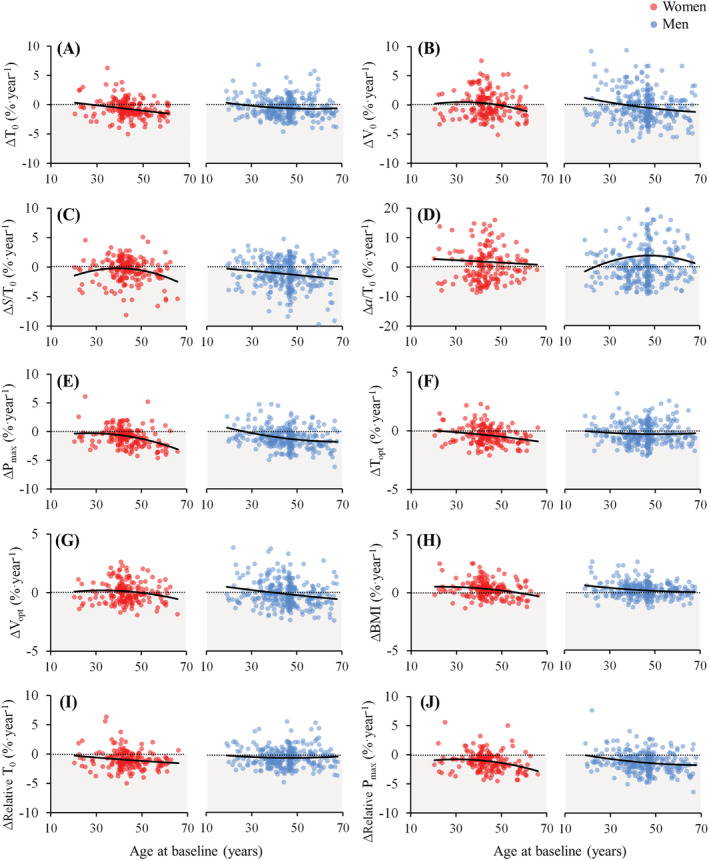
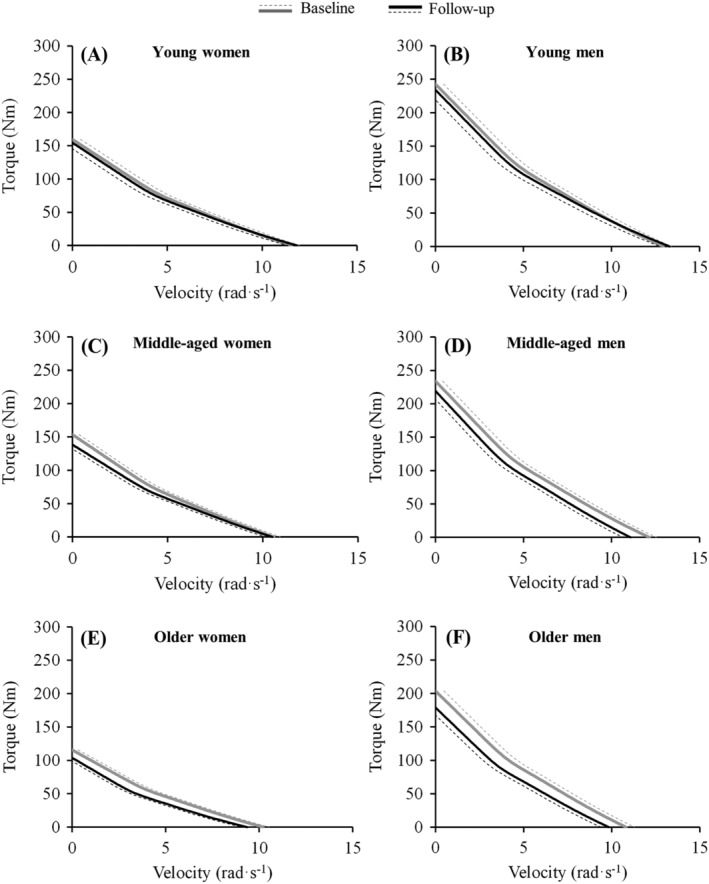
P decreased in young men (-0.6% per year; P < 0.001), middle-aged men and women (-1.1% to -1.4% per year; P < 0.001), and older men and women (-2.2% to -2.4% per year; P ≤ 0.053). These changes were mainly related to decrements in torque at P at early age and to decrements in both torque and velocity at P at older age. BMI increased among young and middle-aged adults (0.2% to 0.5% per year; P < 0.001), which led to greater declines in relative P in those groups. S/T , that is, the linear slope of the T-V relationship relative to maximal torque, exhibited a significant decline over time (-0.10%T ·rad·s per year; P < 0.001), which was significant among middle-aged men and old men and women (all P < 0.05). Annual changes in PAL index were significantly associated to annual changes in P (P = 0.017), so the overall decline in P was slightly attenuated in the adjusted model (-5.26 vs. -5.05 W per year; both P < 0.001).
P decreased in young, middle-aged, and older adults after a 10-year follow-up. The early declines in P seemed to coincide with declines in force, whereas the progressive decline at later age was associated with declines in both force and velocity. A progressively blunted ability to produce force, especially at moderate to high movement velocities, should be considered a specific hallmark of aging.
最大肌肉力量(P)是所有年龄段身体表现的生物标志物。没有纵向研究评估过衰老对从扭矩-速度(T-V)关系中获得的 P 的影响,而 T-V 关系应被视为“金标准”。本研究评估了在 10 年随访后,年轻、中年和老年人的膝关节伸肌的 T-V 关系和 P 的纵向变化。
489 名受试者(311 名男性和 178 名女性;年龄 19-68 岁)在基线和 10 年随访时接受了测试。评估了人体测量数据、每日蛋白质摄入量、体力活动水平(PAL)和膝关节伸肌功能(等长、等速和等张)。使用一种新的混合方程,结合线性和双曲线(希尔型)区域,获得参与者的 T-V 关系和 P,参与者按性别和年龄分组(年轻:20-40 岁;中年:40-60 岁;老年:≥60 岁)。使用线性混合效应模型评估时间、性别和年龄对 T-V 参数、P 和体重指数(BMI)的影响。还进行了额外的分析,以调整每日蛋白质摄入量和 PAL 的变化。
年轻男性(每年减少 0.6%;P<0.001)、中年男性和女性(每年减少 1.1%至 1.4%;P<0.001)以及老年男性和女性(每年减少 2.2%至 2.4%;P≤0.053)的 P 减少。这些变化主要与早期 P 时的扭矩减少以及 P 时的扭矩和速度减少有关。年轻和中年成年人的 BMI 增加(每年增加 0.2%至 0.5%;P<0.001),这导致这些人群的相对 P 下降更大。S/T,即 T-V 关系相对于最大扭矩的线性斜率,随着时间的推移呈显著下降趋势(每年减少 0.10%T·rad·s;P<0.001),在中年男性和老年男性和女性中具有显著意义(均 P<0.05)。PAL 指数的年变化与 P 的年变化显著相关(P=0.017),因此,在调整模型中,P 的总体下降幅度略有减弱(每年减少 5.26 与 5.05 W;均 P<0.001)。
在 10 年随访后,年轻、中年和老年成年人的 P 减少。P 的早期下降似乎与力量下降同时发生,而后期的渐进性下降与力量和速度的下降都有关。在中等至较高运动速度下,力量产生能力的逐渐减弱,特别是在中等至较高运动速度下,应被视为衰老的一个特定特征。