Gonzalez-Ortiz Fernando, Karikari Thomas K, Taylor-Te Vruchte Danielle, Shepherd Dawn, Kirsebom Bjørn-Eivind, Fladby Tormod, Platt Frances, Blennow Kaj
Department of Psychiatry and Neurochemistry, Institute of Neuroscience and Physiology, the Sahlgrenska Academy at the University of Gothenburg, Mölndal, 43180, Sweden.
Clinical Neurochemistry Laboratory, Sahlgrenska University Hospital, Mölndal, 43180, Sweden.
Brain Commun. 2024 Oct 25;6(6):fcae375. doi: 10.1093/braincomms/fcae375. eCollection 2024.
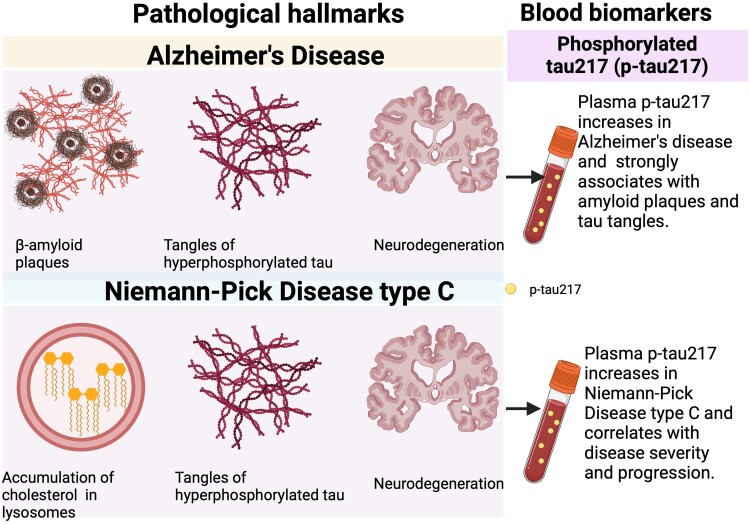
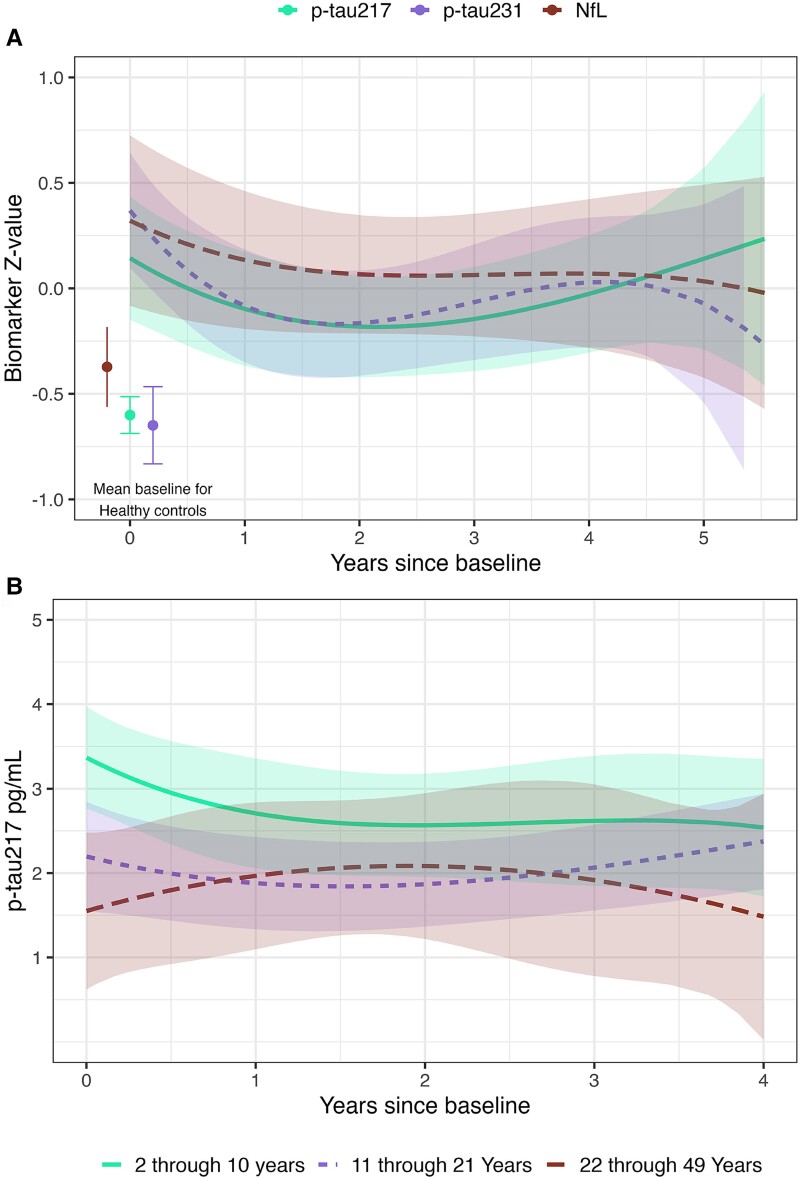
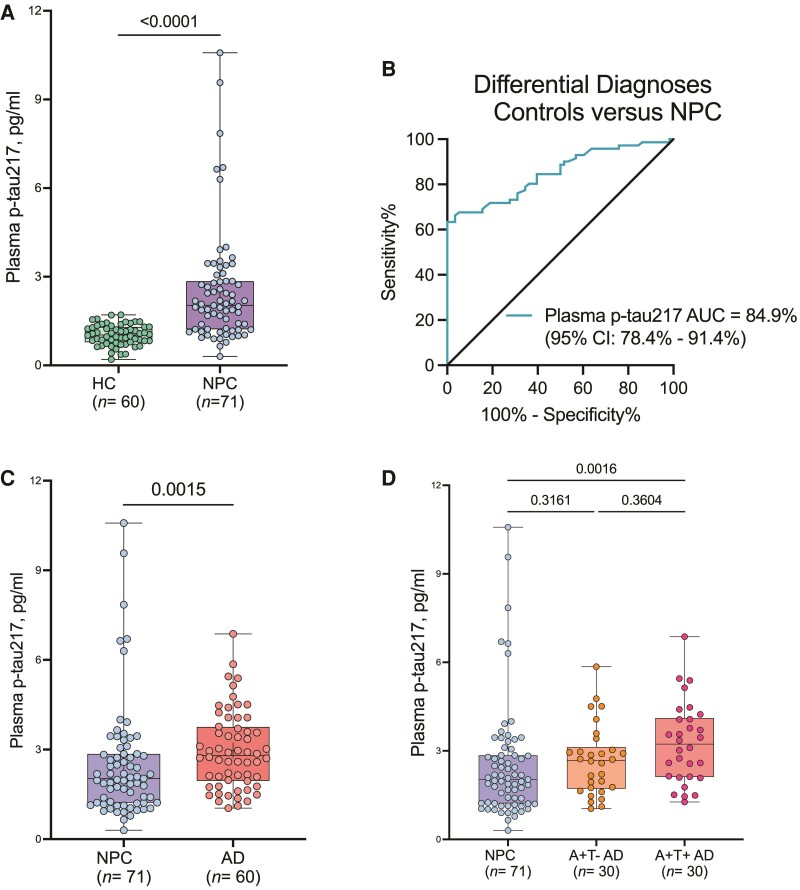
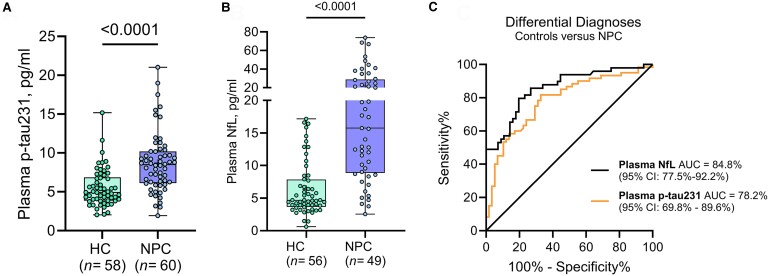
Niemann-Pick disease type C and Alzheimer's disease are distinct neurodegenerative disorders that share the presence of neurofibrillary tangle pathology. In this multicentre study, we measured plasma phosphorylated-tau217 in controls ( = 60), Niemann-Pick disease type C ( = 71) and Alzheimer's disease ( = 30 positive for amyloid and negative for tau in CSF [AT] and = 30 positive for both [AT]). Annual Severity Increment Score and Lysotracker measurements were evaluated in the Niemann-Pick disease type C group to estimate the rate of progression and lysosomal enlargement, respectively. In the cross-sectional analysis, plasma phosphorylated-tau217 was increased in Niemann-Pick disease type C compared with controls (2.52 ± 1.93 versus 1.02 ± 0.34 pg/mL, respectively, < 0.001) and inversely correlated with age at disease onset ( = -0.54, < 0.001). In the longitudinal analysis, plasma phosphorylated-tau217 was associated with disease progression determined by Annual Severity Increment Score ( = 0.48, < 0.001) and lysosomal enlargement ( = 0.26, = 0.004). We found no differences between AT Alzheimer's disease and Niemann-Pick disease type C (2.67 ± 1.18 versus 2.52 ± 1. 93 pg/mL, = 0.31); however, AT Alzheimer's disease had significantly higher levels than Niemann-Pick disease type C (3.26 ± 1.36 versus 2.52 ± 1.93 pg/mL, = 0.001). Our findings suggest that plasma p-tau217 can increase in brain disorders with isolated tau pathology. Plasma p-tau217 associations with disease progression and severity make it a potential marker in Niemann-Pick disease type C.
尼曼-匹克病C型和阿尔茨海默病是不同的神经退行性疾病,但都存在神经原纤维缠结病理。在这项多中心研究中,我们测量了对照组(n = 60)、尼曼-匹克病C型(n = 71)和阿尔茨海默病(脑脊液中淀粉样蛋白阳性且tau蛋白阴性的30例[AT]以及两者均阳性的30例[AT])血浆中磷酸化tau217的水平。对尼曼-匹克病C型组进行年度严重程度增量评分和溶酶体示踪剂测量,分别以评估疾病进展速率和溶酶体增大情况。在横断面分析中,与对照组相比,尼曼-匹克病C型患者血浆磷酸化tau217升高(分别为2.52±1.93与1.02±0.34 pg/mL,P < 0.001),且与发病年龄呈负相关(r = -0.54,P < 0.001)。在纵向分析中,血浆磷酸化tau217与由年度严重程度增量评分确定的疾病进展相关(r = 0.48,P < 0.001)以及溶酶体增大相关(r = 0.26,P = 0.004)。我们发现淀粉样蛋白阳性且tau蛋白阴性的阿尔茨海默病组与尼曼-匹克病C型组之间无差异(2.67±1.18与2.52±1.93 pg/mL,P = 0.31);然而,淀粉样蛋白和tau蛋白均阳性的阿尔茨海默病组水平显著高于尼曼-匹克病C型组(3.26±1.36与2.52±1.93 pg/mL,P = 0.001)。我们的研究结果表明,在仅存在tau病理的脑部疾病中血浆p-tau217可能升高。血浆p-tau217与疾病进展和严重程度的关联使其成为尼曼-匹克病C型的一个潜在标志物。