Fionda Bruno, Pagliara Monica Maria, Sammarco Maria Grazia, Pastore Francesco, Giannuzzi Federico, Cuffaro Giovanni, Leoni Flavia Quaranta, Tagliaferri Luca, Savino Gustavo
Dipartimento di Diagnostica per Immagini e Radioterapia Oncologica, Fondazione Policlinico Universitario "A. Gemelli" IRCCS, Rome, Italy.
Ocular Oncology Unit, Fondazione Policlinico Universitario "A. Gemelli" IRCCS, Rome, Italy.
Transl Oncol. 2025 Jan;51:102160. doi: 10.1016/j.tranon.2024.102160. Epub 2024 Nov 5.
To evaluate the clinicopathological characteristics and the effectiveness of post-operative high-dose-rate (HDR) interventional radiotherapy (IRT - brachytherapy) in managing advanced ocular surface squamous neoplasia (OSSN) and eyelid tumors.
Nineteen patients with advanced malignancies affecting the ocular surface (stage ≥ T2) and eyelids (staging ≥ T3) were enrolled. Post-operative HDR-IRT treatment followed surgery after multidisciplinary discussion. In our series a total dose of 49 Gy was administered in 14 fractions of 3.5 Gy each, 2 doses per day. Local disease control is the study's main outcome. Death rate, total survival, disease-free survival, and toxicity are secondary outcomes.
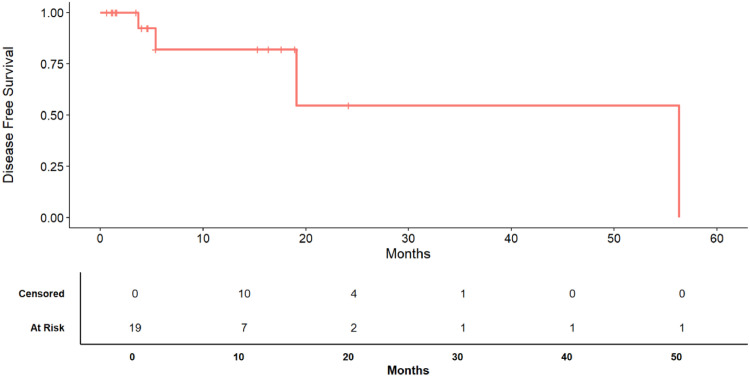
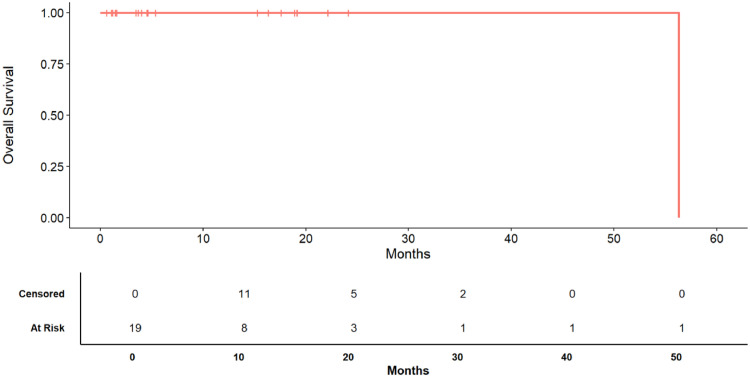
Local recurrence was observed in 4 cases, 2 were conjunctival melanomas and 2 were conjunctival squamous cell carcinoma. The median OS was 56.3 months. The 12, 24 and 36 months survival rate was respectively 100.00% (IQR: 100.00% - 100.00%), 100.00% (IQR: 100.00% - 100.00%), 100.00% (IQR: 100.00% - 100.00%) respectively . The median DFS was 56.3 months. The 12, 24 and 36 months disease survival rate was respectively 85.71% (IQR: 69.21% - 100.00%), 68.57% (IQR: 42.11% - 100.00%), 68.57% (IQR: 42.11% - 100.00%) respectively. In eyelid tumors, madarosis and eyelid abnormalities are the main side effects, while in OSSNs, dry eye symptoms are frequently reported.
Postoperative HDR-IRT has been effective in advanced eyelid cancers control. More challenging appears instead an effective treatment of advanced OSSNs, particularly conjunctival melanomas. Multicenter studies are needed to get a larger patient sample and to evaluate different radiotherapy dosages by different histologic and T types of tumors.
评估术后高剂量率(HDR)介入放疗(IRT - 近距离放疗)在治疗晚期眼表鳞状细胞癌(OSSN)和眼睑肿瘤方面的临床病理特征及有效性。
纳入19例患有影响眼表(≥T2期)和眼睑(≥T3期)的晚期恶性肿瘤患者。多学科讨论后,术后进行HDR - IRT治疗。在我们的系列研究中,总剂量49 Gy分14次给予,每次3.5 Gy,每天2次。局部疾病控制是本研究的主要结局。死亡率、总生存期、无病生存期和毒性反应是次要结局。
4例出现局部复发,2例为结膜黑色素瘤,2例为结膜鳞状细胞癌。中位总生存期为56.3个月。12、24和36个月生存率分别为100.00%(四分位间距:100.00% - 100.00%)、100.00%(四分位间距:100.00% - 100.00%)、100.00%(四分位间距:100.00% - 100.00%)。中位无病生存期为56.3个月。12、24和36个月疾病生存率分别为85.71%(四分位间距:69.21% - 100.00%)、68.57%(四分位间距:42.11% - 100.00%)、68.57%(四分位间距:42.11% - 100.00%)。在眼睑肿瘤中,睫毛脱落和眼睑异常是主要副作用,而在OSSN中,干眼症状较为常见。
术后HDR - IRT对晚期眼睑癌的控制有效。然而,对晚期OSSN,尤其是结膜黑色素瘤进行有效治疗似乎更具挑战性。需要开展多中心研究以获得更大的患者样本,并评估针对不同组织学类型和T分期肿瘤的不同放疗剂量。