Department of Internal Medicine and Medical Specialties (DIMI), University of Genova, Genova, Italy.
Unit of Nephrology, Dialysis and Transplantation, IRCCS Ospedale Policlinico San Martino, Genova, Italy.
Sci Rep. 2024 Nov 6;14(1):26886. doi: 10.1038/s41598-024-77720-z.
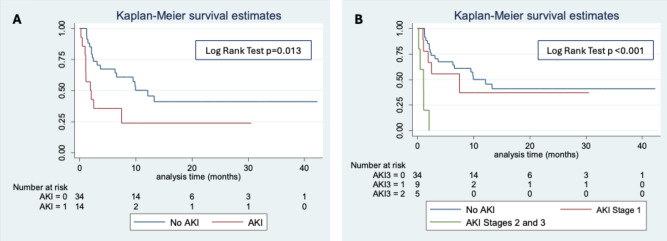
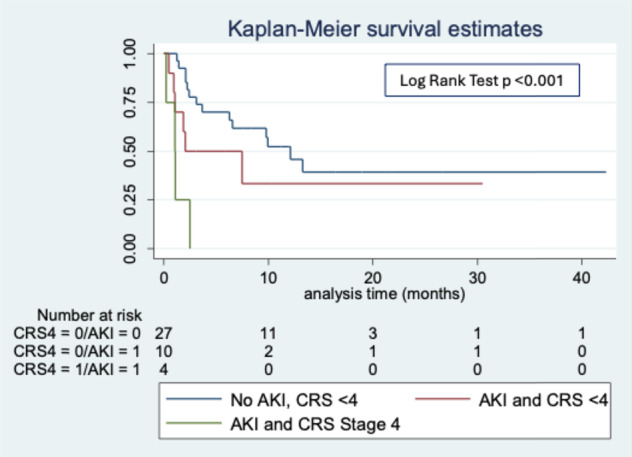
Chimeric antigen receptor T-cell (CAR-T) therapy has revolutionized the treatment of hematologic malignancies, yet it carries significant risks, including acute kidney injury (AKI). In this study, we investigated the risk factors and clinical impact of AKI in patients undergoing CAR-T cell therapy. This retrospective study involved hematologic patients treated with CAR-T therapy. Clinical and laboratory data were collected, and clinical outcomes were monitored during follow-up after CAR-T infusion. AKI was defined according to KDIGO criteria. The outcome measures included early mortality, overall survival (OS), and disease-free survival (DFS). Among the 48 patients analyzed, 14 (29%) developed AKI, with a mean onset of 6 days after CAR-T infusion. The risk of AKI was associated with baseline performance status (OR 8.65, IC95% 6.2-12, p = 0.032) and the development of severe cytokine release syndrome post-therapy (OR 16.4 95%CI 1.9-138.5, p = 0.01). Patients with AKI more frequently required intensive care. Furthermore, severe AKI was independently associated with worse clinical outcomes, including reduced OS and DFS (HR 18.2, 95%CI 2.6-27.3, p = 0.003). Additionally, patients who developed AKI post-CAR-T therapy were more likely to progress to chronic kidney disease during follow-up. In conclusion, frail patients undergoing CAR-T therapy are at an increased risk of developing AKI, which can significantly affect both short- and long-term outcomes. Preventive strategies and early recognition of AKI are essential in these patients.
嵌合抗原受体 T 细胞(CAR-T)疗法彻底改变了血液系统恶性肿瘤的治疗方法,但它也存在重大风险,包括急性肾损伤(AKI)。在这项研究中,我们研究了接受 CAR-T 细胞治疗的患者中 AKI 的危险因素和临床影响。这项回顾性研究涉及接受 CAR-T 治疗的血液系统患者。收集了临床和实验室数据,并在 CAR-T 输注后随访期间监测临床结局。AKI 根据 KDIGO 标准定义。主要结局指标包括早期死亡率、总生存率(OS)和无疾病生存率(DFS)。在分析的 48 例患者中,有 14 例(29%)发生 AKI,CAR-T 输注后平均发病时间为 6 天。AKI 的风险与基线表现状态(OR 8.65,95%CI 6.2-12,p=0.032)和治疗后严重细胞因子释放综合征的发生(OR 16.4,95%CI 1.9-138.5,p=0.01)相关。发生 AKI 的患者更频繁地需要重症监护。此外,严重 AKI 与更差的临床结局独立相关,包括降低的 OS 和 DFS(HR 18.2,95%CI 2.6-27.3,p=0.003)。此外,在 CAR-T 治疗后发生 AKI 的患者在随访期间更有可能进展为慢性肾脏病。总之,接受 CAR-T 治疗的虚弱患者发生 AKI 的风险增加,这会显著影响短期和长期结局。在这些患者中,预防策略和早期识别 AKI 至关重要。