Esposito Pasquale, Cappadona Francesca, Marengo Marita, Fiorentino Marco, Fabbrini Paolo, Quercia Alessandro Domenico, Garzotto Francesco, Castellano Giuseppe, Cantaluppi Vincenzo, Viazzi Francesca
Department of Internal Medicine, University of Genova, Genova, Italy.
Division of Nephrology, Dialysis and Transplantation, IRCCS Ospedale Policlinico San Martino, Genova, Italy.
Clin Kidney J. 2024 Jul 22;17(8):sfae231. doi: 10.1093/ckj/sfae231. eCollection 2024 Aug.
Acute kidney injury (AKI) during hospitalization is associated with increased complications and mortality. Despite efforts to standardize AKI management, its recognition in clinical practice is limited.
To assess and characterize different patterns of AKI diagnosis, we collected clinical data, serum creatinine (sCr) levels, comorbidities and outcomes from adult patients using the Hospital Discharge Form (HDF). AKI diagnosis was based on administrative data and according to Kidney Disease: Improving Global Outcomes (KDIGO) criteria by evaluating sCr variations during hospitalization. Additionally, patients were categorized based on the timing of AKI onset.
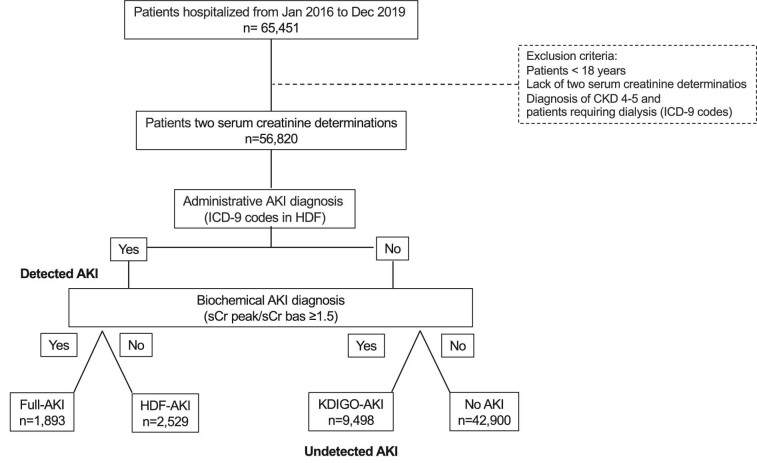
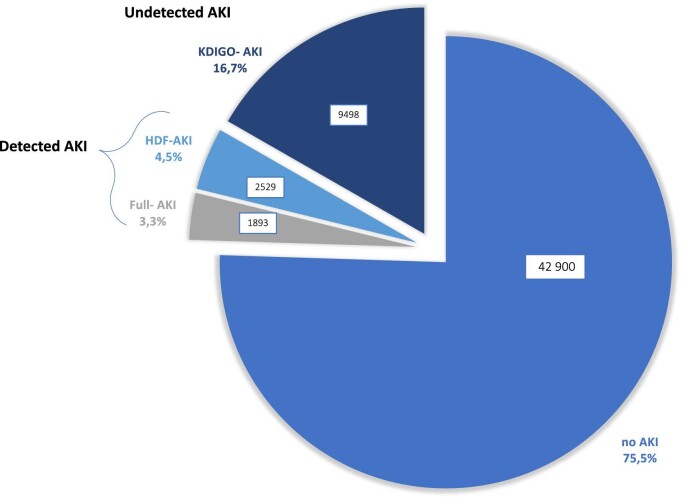
Among 56 820 patients, 42 900 (75.5%) had no AKI, 1893 (3.3%) had AKI diagnosed by sCr changes and coded in the HDF (full-AKI), 2529 (4.4%) had AKI reported on the HDF but not meeting sCr-based criteria (HDF-AKI) and 9498 (16.7%) had undetected AKI diagnosed by sCr changes but not coded in the HDF (KDIGO-AKI). Overall, AKI incidence was 24.5%, with a 68% undetection rate. Patients with KDIGO-AKI were younger and had a higher proportion of females, lower comorbidity burden, milder AKI stages, more frequent admissions to surgical wards and lower mortality compared with full-AKI patients. All AKI groups had worse outcomes than those without AKI, and AKI, even if undetected, was independently associated with mortality risk. Patients with AKI at admission had different profiles and better outcomes than those developing AKI later.
AKI recognition in hospitalized patients is highly heterogeneous, with a significant prevalence of undetection. This variability may be affected by patients' characteristics, AKI-related factors, diagnostic approaches and in-hospital patient management. AKI remains a major risk factor, emphasizing the importance of ensuring proper diagnosis for all patients.
住院期间的急性肾损伤(AKI)与并发症增加及死亡率上升相关。尽管人们努力使AKI管理标准化,但其在临床实践中的识别情况仍很有限。
为评估和描述AKI诊断的不同模式,我们使用医院出院表格(HDF)收集了成年患者的临床数据、血清肌酐(sCr)水平、合并症及转归情况。AKI诊断基于管理数据,并根据改善全球肾脏病预后组织(KDIGO)标准,通过评估住院期间sCr的变化来确定。此外,患者根据AKI发病时间进行分类。
在56820例患者中,42900例(75.5%)无AKI,1893例(3.3%)因sCr变化诊断为AKI并在HDF中编码(完全性AKI),2529例(4.4%)在HDF上报告有AKI但不符合基于sCr的标准(HDF-AKI),9498例(16.7%)通过sCr变化诊断为未被发现的AKI但未在HDF中编码(KDIGO-AKI)。总体而言,AKI发生率为24.5%,漏诊率为68%。与完全性AKI患者相比,KDIGO-AKI患者更年轻,女性比例更高,合并症负担更低,AKI分期更轻,入住外科病房更频繁,死亡率更低。所有AKI组的转归均比无AKI组差,且AKI即使未被发现,也与死亡风险独立相关。入院时即有AKI的患者与后来发生AKI的患者情况不同,且转归更好。
住院患者中AKI的识别情况高度异质,漏诊率很高。这种变异性可能受患者特征、AKI相关因素、诊断方法及住院患者管理的影响。AKI仍然是一个主要危险因素,强调了确保对所有患者进行正确诊断的重要性。