Department of Neurosurgery, Binzhou Medical University Hospital, Binzhou, Shandong, China.
Department of Endocrinology, Binzhou Medical University Hospital, Binzhou, NO. 661, Huanghe 2nd Road, Binzhou, Shandong, 256603, China.
BMC Neurol. 2024 Nov 6;24(1):432. doi: 10.1186/s12883-024-03940-5.
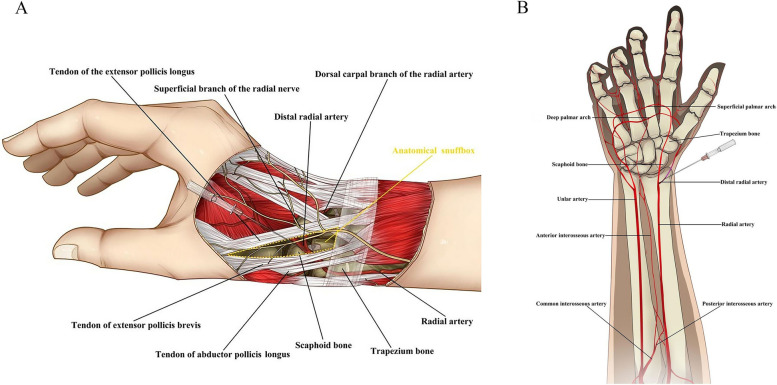
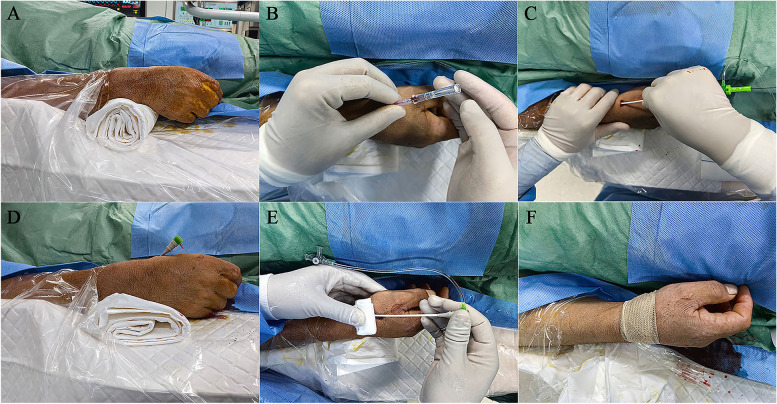
To determine the risk factors for puncture-related complications after the distal transradial approach (dTRA) for cerebrovascular angiography and neuroendovascular intervention and to explore the incidence and potential mechanisms of procedural failure and puncture-related complications.
From February to November 2023, 62 patients underwent dTRA in our department. Demographic, clinical, and procedural data were collected retrospectively. Postoperative puncture-related complications were defined as a syndrome of major hematoma, minor hematoma, arterial spasm/occlusion, arteriovenous fistula, pseudoaneurysm, and neuropathy. Univariate and multivariate logistic regressions were performed to identify significant factors contributing to puncture-related complications.
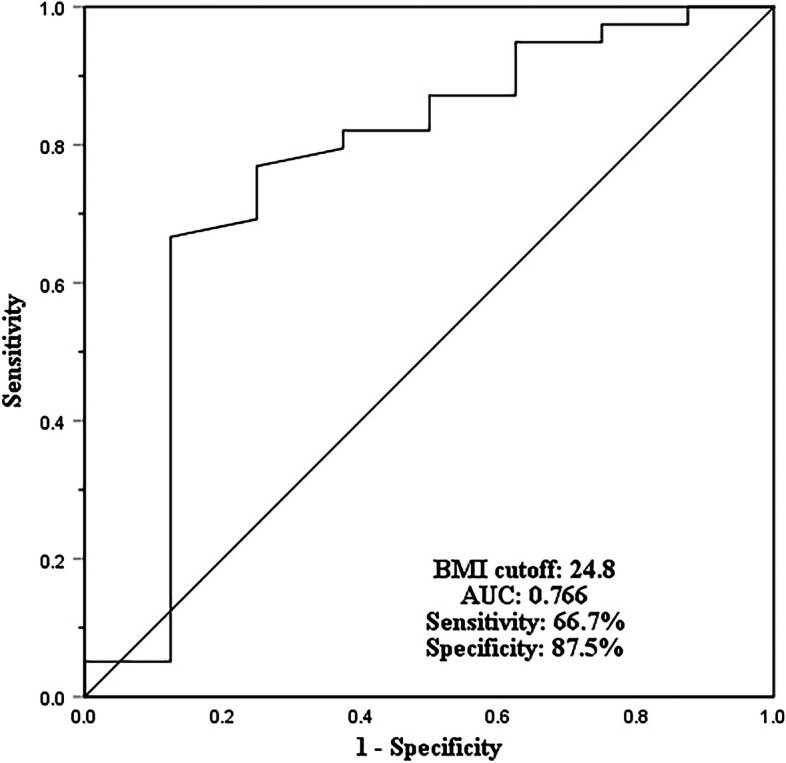
Forty-five diagnostic cerebral angiograms and 17 neurointerventions were performed or attempted with dTRA in 62 patients. Procedural success was achieved via dTRA in 47 (75.8%) patients, whereas 15 (24.2%) required conversion to other approaches. Reasons for failure included puncture failure (n = 8), inability to cannulate due to arterial spasm (n = 6), and inadequate catheter support of the left vertebral artery (n = 1). 17.0% (8/47) of patients had postoperative puncture-related complications. Minor hematoma occurred in 8.5% (4/47) of patients, arterial spasm/occlusion in 6.3% (3/47), and neuropathy in 2.1% (1/47). No major complications were observed. On stepwise multivariable regression analysis, BMI (OR = 0.70, 95%CI 0.513 to 0.958; p = 0.026) was an independent risk factor for puncture-related complications, with a cut-off of 24.8 kg/m (sensitivity 66.7% and specificity 87.5%).
Our cohort is the first study of risk factors for puncture-related complications after neurointerventional interventions with dTRA. This study has shown that a low BMI (< 24.8 kg/m) is independently associated with the development of puncture-related complications.
确定经桡动脉远端入路(dTRA)进行脑血管造影和神经介入治疗后穿刺相关并发症的危险因素,并探讨操作失败和穿刺相关并发症的发生率及潜在机制。
2023 年 2 月至 11 月,我科 62 例患者行 dTRA。回顾性收集患者的人口统计学、临床和手术资料。术后穿刺相关并发症定义为:大血肿、小血肿、动脉痉挛/闭塞、动静脉瘘、假性动脉瘤和神经病变综合征。采用单变量和多变量逻辑回归分析确定与穿刺相关并发症相关的显著因素。
62 例患者中,45 例行诊断性脑血管造影,17 例行神经介入治疗,均采用 dTRA。47 例(75.8%)患者通过 dTRA 成功完成操作,15 例(24.2%)患者需要转为其他入路。失败的原因包括穿刺失败(n=8)、动脉痉挛导致无法插管(n=6)以及左椎动脉导管支撑不足(n=1)。47 例患者中,术后穿刺相关并发症发生率为 17.0%(8/47)。47 例患者中,小血肿发生率为 8.5%(4/47),动脉痉挛/闭塞发生率为 6.3%(3/47),神经病变发生率为 2.1%(1/47)。未观察到重大并发症。多变量逐步回归分析显示,BMI(OR=0.70,95%CI 0.513 至 0.958;p=0.026)是穿刺相关并发症的独立危险因素,BMI 截断值为 24.8kg/m(敏感性 66.7%,特异性 87.5%)。
本研究首次分析了经桡动脉远端入路神经介入治疗后穿刺相关并发症的危险因素,表明 BMI(<24.8kg/m)较低与穿刺相关并发症的发生独立相关。