Department of Obstetric and Gynecological Nursing, Faculty of Nursing, Mahidol University, Bangkok, Thailand.
BMC Pregnancy Childbirth. 2024 Nov 6;24(1):723. doi: 10.1186/s12884-024-06921-1.
Vaginal Birth after Cesarean Birth (VBAC) is a birth mode recommended for reducing repeat cesarean which potentially contributes to adverse outcomes. However, VBAC is not normally practiced in some countries. Providers are an important part of the decision-making process on modes of birth among pregnant individuals. Providers' perspective on VBAC can influence whether they support or avoid conducting VBAC. This review aimed to explore providers' perspective on VBAC.
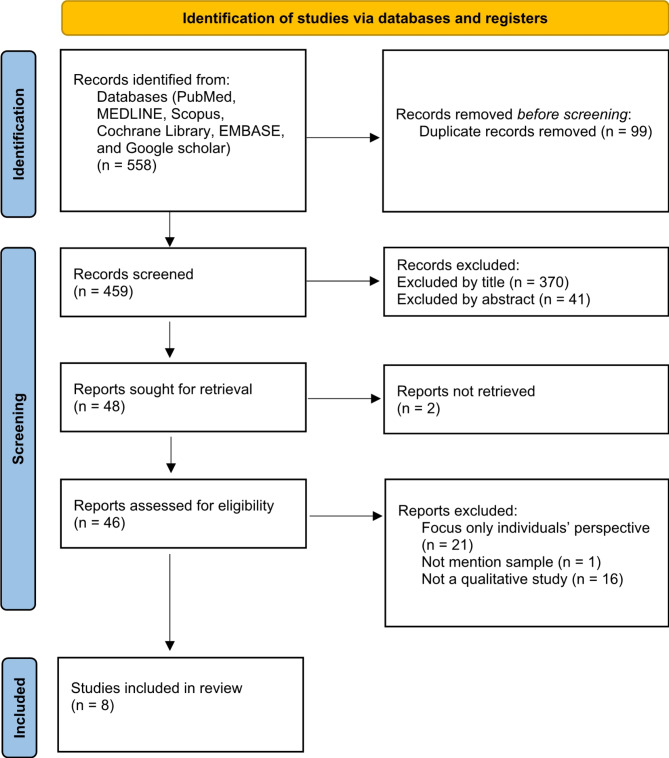
The comprehensive search was conducted from six databases including PubMed, MEDLINE, Scopus, Cochrane Library, EMBASE, and Google scholar. The studies published in English between 2013 and 2023 were review. The Medical Subject Heading terms for VBAC and perspective were used to search. The eligible studies were selected by the PRISMA flow chart. The initial search yielded 558 articles. After excluding duplicates, articles not retrieved for full-text, and not meeting inclusion and exclusion criteria, eight articles were recruited. Quality appraisal of the studies was performed by the tool of the Joanna Briggs Institute. The meta-aggregation approach was applied to synthesize the findings.
Eight qualitative articles were included in this review, and six themes were developed including (1) different recognition of VBAC, (2) differences of willingness level of conducting Trial of Labor after Cesarean (TOLAC) (the approach attempting to have VBAC), (3) skills and resources needed when performing TOLAC, (4) protocol for recruiting candidacy and TOLAC management, (5) final decision making on VBAC, and (6) onset and duration of providing TOLAC information.
Providers play an important role in influencing individuals' decision on modes of birth. Providers' positive recognition and willingness of conducting TOLAC potentially impact successful VBAC rate. However, the lawsuit caused by adverse outcomes from TOLAC/VBAC is a main reason for choosing repeat cesarean.
PROSPERO registration number of this systematic review: CRD42023427662.
剖宫产后阴道分娩(VBAC)是一种推荐的分娩方式,可以减少重复剖宫产,从而降低潜在的不良结局。然而,在一些国家,VBAC 通常不被采用。在孕妇的分娩方式决策过程中,医疗服务提供者是一个重要的组成部分。医疗服务提供者对 VBAC 的看法会影响他们是否支持或避免进行 VBAC。本综述旨在探讨医疗服务提供者对 VBAC 的看法。
从 6 个数据库(PubMed、MEDLINE、Scopus、Cochrane 图书馆、EMBASE 和 Google Scholar)进行全面检索,检索时间为 2013 年至 2023 年期间发表的英文文章。使用 VBAC 和观点的医学主题词进行搜索。根据 PRISMA 流程图选择合格的研究。最初的搜索产生了 558 篇文章。排除重复文章、未全文检索的文章以及不符合纳入和排除标准的文章后,共纳入 8 篇文章。使用 Joanna Briggs 研究所的工具对研究进行质量评估。采用元聚合方法综合研究结果。
本综述纳入了 8 篇定性文章,总结出 6 个主题,包括:(1)对 VBAC 的不同认识;(2)进行剖宫产术后试产(TOLAC)意愿水平的差异(尝试 VBAC 的方法);(3)进行 TOLAC 时所需的技能和资源;(4)招募候选人和 TOLAC 管理的方案;(5)VBAC 的最终决策;(6)提供 TOLAC 信息的开始和持续时间。
医疗服务提供者在影响个人分娩方式决策方面发挥着重要作用。医疗服务提供者对 TOLAC 的积极认可和意愿可能会影响 VBAC 的成功率。然而,TOLAC/VBAC 不良结局引起的诉讼是选择重复剖宫产的主要原因。
本系统综述的 PROSPERO 注册号为:CRD42023427662。