Division of Medical Oncology, The Ohio State University Comprehensive Cancer Center, 410 W 10th Ave., Columbus, OH, 43210, USA.
Department of Radiation Oncology, The Ohio State University Comprehensive Cancer Center, 410 W 10th Ave., Columbus, OH, 43210, USA.
Breast Cancer Res. 2024 Nov 6;26(1):153. doi: 10.1186/s13058-024-01906-6.
Breast cancer, one of the most common forms of cancer, is associated with the highest cancer-related mortality among women worldwide. In comparison to other types of breast cancer, patients diagnosed with the triple-negative breast cancer (TNBC) subtype have the worst outcome because current therapies do not produce long-lasting responses. Hence, innovative therapies that produce persisting responses are a critical need. We previously discovered that hyperactivating purinergic receptors (P2RXs) by increasing extracellular adenosine triphosphate (eATP) concentrations enhances TNBC cell lines' response to chemotherapy. Heparan sulfate inhibits multiple extracellular ATPases, so it is a molecule of interest in this regard. In turn, heparanase degrades polysulfated polysaccharide heparan sulfate. Importantly, previous work suggests that breast cancer and other cancers express heparanase at high levels. Hence, as heparan sulfate can inhibit extracellular ATPases to facilitate eATP accumulation, it may intensify responses to chemotherapy. We postulated that heparanase inhibitors would exacerbate chemotherapy-induced decreases in TNBC cell viability by increasing heparan sulfate in the cellular microenvironment and hence, augmenting eATP.
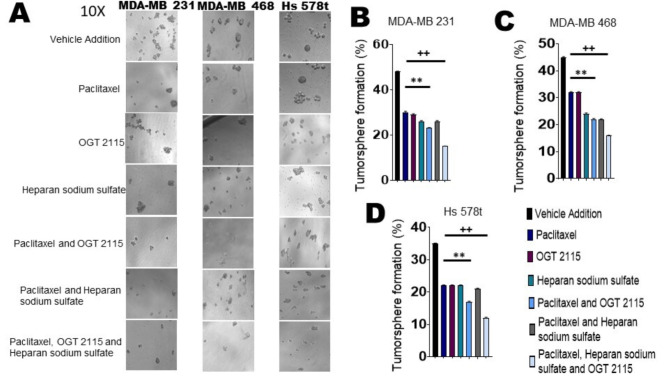
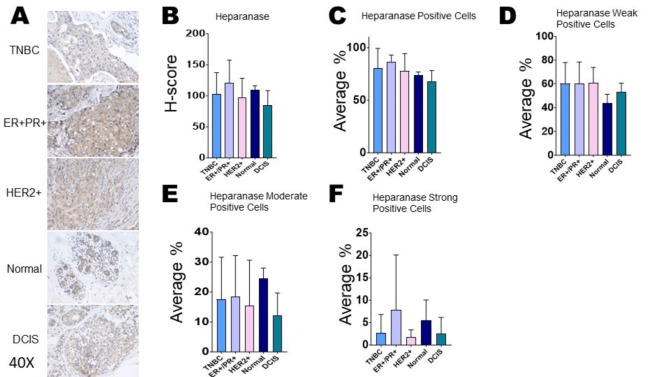
We treated TNBC cell lines MDA-MB 231, Hs 578t, and MDA-MB 468 and non-tumorigenic immortal mammary epithelial MCF-10A cells with paclitaxel (cytotoxic chemotherapeutic) with or without the heparanase inhibitor OGT 2115 and/or supplemental heparan sulfate. We evaluated cell viability and the release of eATP. Also, we compared the expression of heparanase protein in cell lines and tissues by immunoblot and immunohistochemistry, respectively. In addition, we examined breast-cancer-initiating cell populations using tumorsphere formation efficiency assays on treated cells.
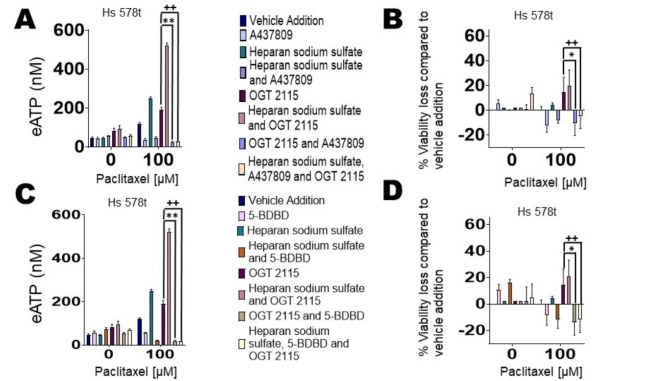
We found that combining heparanase inhibitor OGT 2115 with chemotherapy decreased TNBC cell viability and tumorsphere formation through increases in eATP and activation of purinergic receptors as compared to TNBC cells treated with single-agent paclitaxel.
Our data shows that by preventing heparan sulfate breakdown, heparanase inhibitors make TNBC cells more susceptible to chemotherapy by enhancing eATP concentrations.
乳腺癌是最常见的癌症之一,也是全球女性癌症相关死亡率最高的癌症。与其他类型的乳腺癌相比,诊断为三阴性乳腺癌(TNBC)亚型的患者预后最差,因为目前的治疗方法无法产生持久的反应。因此,产生持久反应的创新疗法是当务之急。我们之前发现,通过增加细胞外三磷酸腺苷(eATP)浓度来超激活嘌呤能受体(P2RXs),可增强 TNBC 细胞系对化疗的反应。硫酸乙酰肝素抑制多种细胞外 ATP 酶,因此它是这方面的一个感兴趣的分子。反过来,肝素酶降解多硫酸化多糖硫酸乙酰肝素。重要的是,以前的工作表明,乳腺癌和其他癌症高表达肝素酶。因此,由于硫酸乙酰肝素可以抑制细胞外 ATP 酶以促进 eATP 积累,它可能会增强对化疗的反应。我们假设肝素酶抑制剂通过增加细胞微环境中的硫酸乙酰肝素来加剧化疗诱导的 TNBC 细胞活力下降,从而增加 eATP。
我们用紫杉醇(细胞毒性化疗药物)处理 TNBC 细胞系 MDA-MB 231、Hs 578t 和 MDA-MB 468 以及非致瘤性永生化乳腺上皮 MCF-10A 细胞,并用或不用肝素酶抑制剂 OGT 2115 和/或补充硫酸乙酰肝素处理。我们评估了细胞活力和 eATP 的释放。此外,我们分别通过免疫印迹和免疫组织化学比较了细胞系和组织中肝素酶蛋白的表达。此外,我们使用处理过的细胞的肿瘤球形成效率测定法检查了乳腺癌起始细胞群。
与单独用紫杉醇处理的 TNBC 细胞相比,我们发现联合使用肝素酶抑制剂 OGT 2115 和化疗通过增加 eATP 和嘌呤能受体的激活,降低了 TNBC 细胞活力和肿瘤球形成。
我们的数据表明,通过防止硫酸乙酰肝素分解,肝素酶抑制剂通过增强 eATP 浓度使 TNBC 细胞对化疗更敏感。