Sumi Toshiyuki, Ikeda Takumi, Arioka Kotomi, Sakuma Yuji, Yamaguchi Miki, Ishigooka Taiki, Matsuura Keigo, Yamada Yuichi, Chiba Hirofumi
Department of Pulmonary Medicine, Hakodate Goryoukaku Hospital, Hakodate, Japan.
Department of Respiratory Medicine and Allergology, Sapporo Medical University School of Medicine, Sapporo, Japan.
Transl Lung Cancer Res. 2024 Oct 31;13(10):2847-2852. doi: 10.21037/tlcr-24-444. Epub 2024 Oct 28.
Lung cancer remains the primary cause of cancer-related mortality globally, treated using immune checkpoint inhibitors (ICIs), which are introducing new therapeutic potential and complexities, including severe immune-related adverse events (irAEs) and rare fistula formation. The interaction between coronavirus disease 2019 (COVID-19) and ICIs further complicates treatment outcomes, occasionally leading to spontaneous tumor regression, suggesting potential immune response modulation by COVID-19. This report elucidates a unique case of non-small cell lung cancer (NSCLC) managed with these challenges, highlighting the delicate balance required for modern oncological care.
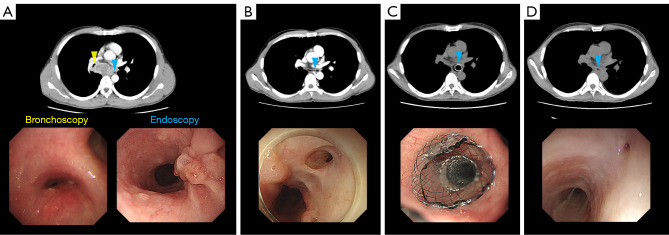
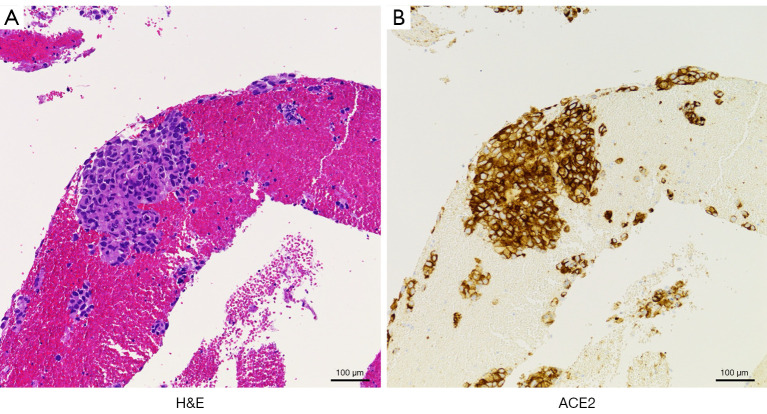
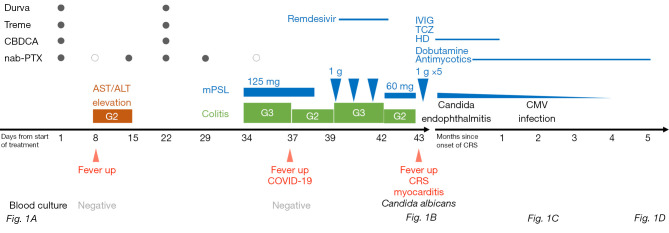
A 44-year-old male patient with stage IIIC NSCLC, no driver mutations such as those in epidermal growth-factor receptor () or anaplastic lymphoma kinase () genes, and a tumor proportion score of <1% experienced multiple complications after ICI plus chemotherapy. The treatment regimen comprised durvalumab, tremelimumab, carboplatin, and nab-paclitaxel. The patient experienced multiple complications including: (I) esophageal mediastinal fistula; (II) severe irAEs such as grade 3 colitis; (III) COVID-19 and infections; (IV) cytokine release syndrome; and (V) myocarditis. Treatment interventions included high-dose steroids, antifungal therapy, mechanical support in the intensive care unit, and hemodialysis. The patient showed remarkable tumor regression and recovery from acute adverse events with eventual tumor resolution and closure of the esophageal mediastinal fistula. Tumor cells were positive for angiotensin-converting enzyme 2, and severe acute respiratory syndrome coronavirus 2 (SARS-CoV-2) may have infected tumor cells and caused an antitumor effect as an oncolytic virus.
Clinicians should be aware that COVID-19 might be associated with the development of severe irAEs and unexpectedly enhanced antitumor effects. The findings also suggest new fields of study regarding the interaction between viral infection and tumor immune response, which may inform future therapeutic approaches.
肺癌仍是全球癌症相关死亡的主要原因,采用免疫检查点抑制剂(ICI)进行治疗,这带来了新的治疗潜力和复杂性,包括严重的免疫相关不良事件(irAE)和罕见的瘘管形成。2019冠状病毒病(COVID-19)与ICI之间的相互作用使治疗结果更加复杂,偶尔会导致肿瘤自发消退,提示COVID-19可能对免疫反应有调节作用。本报告阐述了一例应对这些挑战的非小细胞肺癌(NSCLC)独特病例,突出了现代肿瘤治疗所需的微妙平衡。
一名44岁的男性IIIC期NSCLC患者,无表皮生长因子受体()或间变性淋巴瘤激酶()基因等驱动突变,肿瘤比例评分<1%,在接受ICI加化疗后出现多种并发症。治疗方案包括度伐利尤单抗、曲美木单抗、卡铂和白蛋白结合型紫杉醇。患者出现了多种并发症,包括:(I)食管纵隔瘘;(II)严重的irAE,如3级结肠炎;(III)COVID-19和感染;(IV)细胞因子释放综合征;以及(V)心肌炎。治疗干预措施包括大剂量类固醇、抗真菌治疗、重症监护病房的机械支持和血液透析。患者肿瘤显著消退,急性不良事件得到恢复,最终肿瘤消退,食管纵隔瘘闭合。肿瘤细胞血管紧张素转换酶2呈阳性,严重急性呼吸综合征冠状病毒2(SARS-CoV-2)可能感染了肿瘤细胞,并作为溶瘤病毒产生了抗肿瘤作用。
临床医生应意识到,COVID-19可能与严重irAE 的发生及意外增强的抗肿瘤作用有关。这些发现还提示了关于病毒感染与肿瘤免疫反应相互作用的新研究领域,可能为未来的治疗方法提供参考。