Joseph Gary, Branas Charles C, Rupnarain Sandra, Riutort Monica, Morrison Christopher N
Institute of Health Science Education (Georgetown Public Hospital Corporation), Georgetown, Guyana.
College of Medical Sciences, University of Guyana, Georgetown, Guyana.
Lancet Reg Health Am. 2024 Oct 23;39:100920. doi: 10.1016/j.lana.2024.100920. eCollection 2024 Nov.
Intimate partner violence (IPV) against women is a global health issue and a breach of human rights. However, the literature lacks understanding of how socioeconomic and geographic disparities influence women's attitudes toward IPV in Guyana over time. This study aimed to assess trends in women's attitudes about IPV in Guyana.
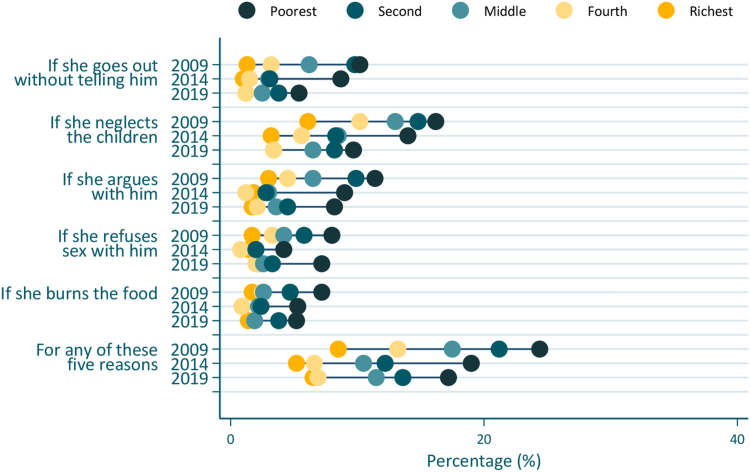
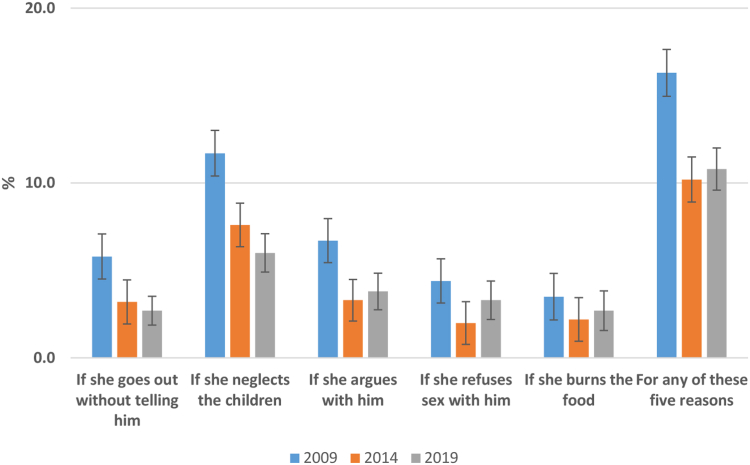
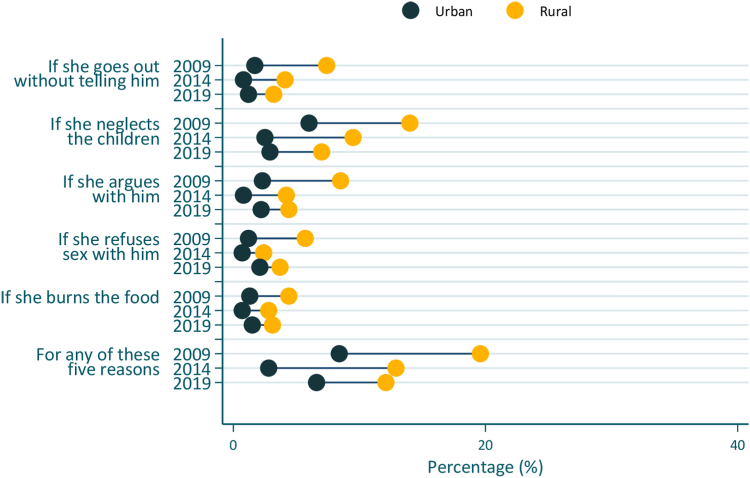
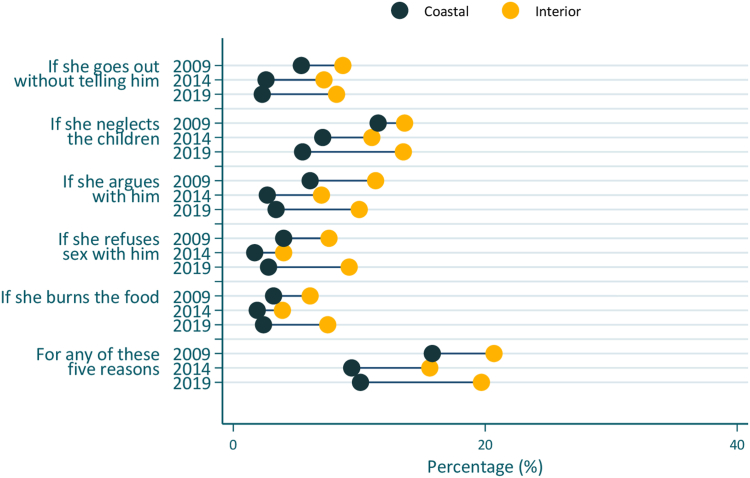
Data from three nationally representative surveys from 2009, 2014 to 2019 were analysed. The prevalence of women's attitudes about IPV was assessed, specifically in response to going out without telling their partners, neglecting their children, arguing with their partner, refusing sex with their partner, or burning food prepared for family meals. A series of stratified subgroup analyses were also completed. We assessed trends in IPV using the slope index of inequality (SII) and the concentration index of inequality (CIX). We used multilevel mixed-effects logistic regression to assess factors associated with women's attitudes justifying IPV.
The prevalence of women's attitudes justifying IPV for any of the five reasons declined from 16.4% (95% CI: 15.1-17.8) in 2009 to 10.8% (95% CI: 9.7-12.0) in 2019. Marked geographic and socioeconomic inequalities were observed among subgroups. The SII for any of the five reasons decreased from -20.02 to -14.28, while the CIX remained constant over time. Key factors associated with women's attitudes about IPV were area of residence, sex of the household head, marital status, respondent's level of education, wealth index quintile, and the frequency of reading newspapers/magazines.
From 2009 to 2019, Guyana was able to reduce women's attitudes justifying IPV against women by 34.1% and shortened subgroup inequalities. However, the prevalence remained high in 2019, with persisted inequalities among subgroups. Effective strategies, including the use of media to raise awareness, promotion of community-based approaches, and educational campaigns focusing on geographic and socioeconomic disparities, are essential for continuing to reduce the prevalence of IPV and associated inequalities.
The study was funded in part by the National Institutes of Health, Fogarty International Center grant number D43TW012189.
针对女性的亲密伴侣暴力是一个全球健康问题,也是对人权的侵犯。然而,文献中缺乏对社会经济和地理差异如何随时间影响圭亚那女性对亲密伴侣暴力态度的理解。本研究旨在评估圭亚那女性对亲密伴侣暴力态度的趋势。
分析了2009年、2014年至2019年三次全国代表性调查的数据。评估了女性对亲密伴侣暴力态度的流行情况,特别是针对未经伴侣告知就外出、忽视子女、与伴侣争吵、拒绝与伴侣发生性行为或烧焦为家人准备的食物等情况。还完成了一系列分层亚组分析。我们使用不平等斜率指数(SII)和不平等集中指数(CIX)评估亲密伴侣暴力的趋势。我们使用多层次混合效应逻辑回归来评估与女性为亲密伴侣暴力行为辩解的态度相关的因素。
因上述五个原因中任何一个而为亲密伴侣暴力行为辩解的女性比例从2009年的16.4%(95%置信区间:15.1 - 17.8)降至2019年的10.8%(95%置信区间:9.7 - 12.0)。亚组之间存在明显的地理和社会经济不平等。五个原因中任何一个的SII从 - 20.02降至 - 14.28,而CIX随时间保持不变。与女性对亲密伴侣暴力态度相关的关键因素包括居住地区、户主性别、婚姻状况、受访者教育水平、财富指数五分位数以及阅读报纸/杂志的频率。
从2009年到2019年,圭亚那能够将女性为针对女性的亲密伴侣暴力行为辩解的态度降低34.1%,并缩小亚组间的不平等。然而,2019年这一比例仍然很高,亚组间的不平等依然存在。有效的策略,包括利用媒体提高认识、推广基于社区的方法以及针对地理和社会经济差异开展教育活动,对于持续降低亲密伴侣暴力的发生率和相关不平等至关重要。
本研究部分由美国国立卫生研究院福格蒂国际中心资助,资助编号为D43TW012189。