Department of Economics, Howard University, Washington, USA.
Department of Population and Health, University of Cape Coast, Cape Coast, Ghana.
BMC Womens Health. 2023 Aug 27;23(1):451. doi: 10.1186/s12905-023-02611-w.
The World Health Organization (WHO) has cited domestic violence as an urgent global maternal and child health priority. Gender differences in the acceptance of wife-beating have not been explored at the multi-country level in sub-Saharan Africa (SSA) where the occurrence of wife-beating (36%) is greater than the global average (30%). It is against this backdrop that we examine the gender differences in the acceptance of wife beating in SSA.
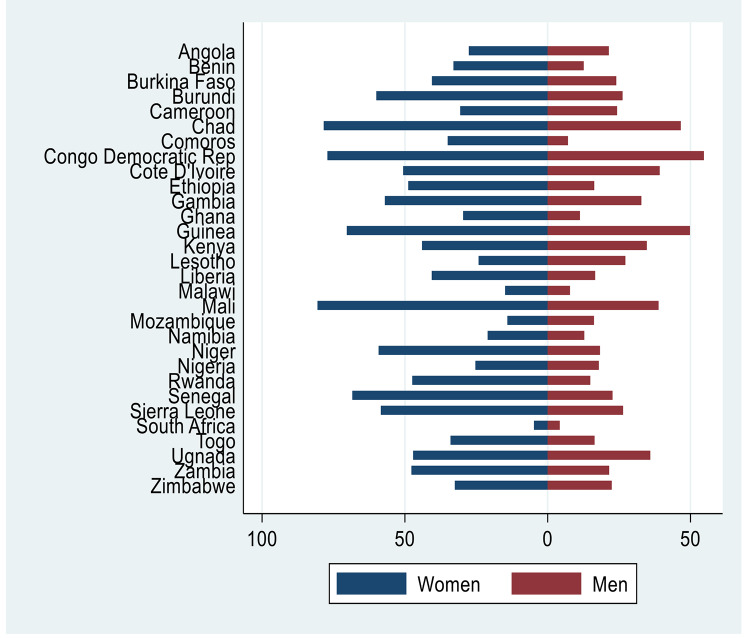
We used Demographic and Health Survey data from 30 SSA countries. Acceptance of wife beating among women and men was the principal outcome variable of interest. We employed Multiple correspondence analysis and logistic regression model as the primary estimation methods for this study. The descriptive statistics show that women had a higher acceptance rate (44%) of wife beating than men (25%). For the women sample, Mali, Democratic Republic of Congo, Chad, and Guinea had higher rates of acceptance of the wife beating (80.6%, 78.4%, 77.1% and 70.3% respectively) For the men, only Guinea had an acceptance rate above 50 percent.
We found that all else equal, women's acceptance of wife beating is higher for male-headed households than for female-headed households. Women without formal education were 3.1 times more likely to accept wife beating than those with higher education. Men with no formal education were 2.3 times more likely to accept wife beating than men with higher education. We found that polygamous women were comparable to polygamous men. Polygamous women were 1.2 times more likely to accept wife beating than those in monogamous marriages. Women were 1.2 times more likely to accept wives beating if they had extramarital relationships. Contrarily, men who engaged in extramarital affairs were 1.5 times more likely to justify wife beating. We also found that women's acceptance of wife beating decreases as they age. Men who decide on major household purchases and spending decisions on their earnings are more likely to accept wife beating. Corollary, women with similar gender and employment roles also accept wife beating. Finally, exposure to mass media is significantly associated with lower acceptance of wife beating for women and men.
We conclude that women have a higher acceptance rate of wife beating than men in SSA. Acceptance of wife beating differs significantly by country. Given the same level of education, women are more likely to accept wife beating than men. If women and men have similar levels of employment and gender roles, acceptance of wife beating is higher when men make major household purchasing decisions and and it is still higher even when the woman makes these decisions. Acceptance of wife beating is higher among young women and men, the uneducated, those in polygamous marriages, women, and men who engage in extra marital affairs, poor households and in rural areas. The findings indicate the need for policies and programs by SSA countries to truncate the high acceptance rate of wife beating, especially among women.
世界卫生组织(WHO)将家庭暴力列为紧急全球母婴健康优先事项。在子非斯卫生组织(WHO),性别差异在接受妻子殴打方面尚未得到探讨,那里发生的妻子殴打(36%)高于全球平均水平(30%)。正是在这种背景下,我们研究了撒哈拉以南非洲(SSA)地区接受妻子殴打方面的性别差异。
我们使用了来自 30 个撒哈拉以南非洲国家的人口与健康调查数据。女性和男性对妻子殴打行为的接受程度是本研究的主要关注结果变量。我们采用多元对应分析和逻辑回归模型作为本研究的主要估计方法。描述性统计数据显示,女性对妻子殴打行为的接受率(44%)高于男性(25%)。对于女性样本,马里、刚果民主共和国、乍得和几内亚的妻子殴打行为接受率更高(分别为 80.6%、78.4%、77.1%和 70.3%)。对于男性,只有几内亚的接受率超过 50%。
我们发现,在其他条件相同的情况下,男性当家的家庭中,女性对妻子殴打行为的接受率高于女性当家的家庭。没有接受正规教育的女性比接受过高等教育的女性更有可能接受妻子殴打行为。没有接受正规教育的男性比接受过高等教育的男性更有可能接受妻子殴打行为。我们发现,多配偶的女性与多配偶的男性相当。多配偶的女性比一夫一妻制婚姻中的女性更有可能接受妻子殴打行为。如果女性有婚外情,她们更有可能接受妻子殴打行为。相反,有婚外情的男性更有可能为妻子殴打行为辩护。我们还发现,随着女性年龄的增长,她们对妻子殴打行为的接受程度会降低。对家庭大宗采购做出决定并以收入进行支出决策的男性更有可能接受妻子殴打行为。因此,具有类似性别和就业角色的女性也会接受妻子殴打行为。最后,接触大众媒体与女性和男性对妻子殴打行为的接受程度呈显著负相关。
我们的结论是,在撒哈拉以南非洲地区,女性对妻子殴打行为的接受率高于男性。对妻子殴打行为的接受程度因国家而异。在接受相同教育水平的情况下,女性比男性更有可能接受妻子殴打行为。如果女性和男性具有相似的就业和性别角色,那么男性做出家庭大宗采购决策时,接受妻子殴打行为的可能性更高,即使女性做出这些决策,这种可能性仍然更高。年轻的女性和男性、未受过教育的人、多配偶婚姻中的人、有婚外情的女性和男性、贫困家庭和农村地区的人更容易接受妻子殴打行为。研究结果表明,撒哈拉以南非洲国家需要制定政策和方案,以减少对妻子殴打行为的高度接受率,尤其是对女性而言。