Li Xiao, Cui Mengna, Xu Long, Guo Qie
Department of Clinical Pharmacy, The Affiliated Hospital of Qingdao University, Qingdao, Shandong, China.
Front Oncol. 2024 Oct 24;14:1483660. doi: 10.3389/fonc.2024.1483660. eCollection 2024.
Sorafenib, a multikinase inhibitor, is currently the standard treatment for advanced liver cancer. However, its application has become limited by the development of drug resistance. We intended to explore the mechanisms underlying the development of sorafenib resistance, therefore identifying an effective strategy to overcome sorafenib resistance remain challenges.
Here, the follow-up of liver cancer patients undergoing sorafenib therapy, as well as animal tumor challenge and treatment were performed. The sorafenib-resistant liver cancer cell lines Huh7/SOR and HepG2/SOR were also established. miRNA and mRNA microarray analyses, TargetScan prediction, dual luciferase reporter assay, RNA pull-down assay, co-mmunoprecipitation (Co-IP) and pull-down assays, a transcription factor-specific NRF2 assay, an iron detection assay, a lipid peroxidation quantification assay, a ROS measurement assay, and GSH/GSSG and GSH-px standard quantitative assays were used.
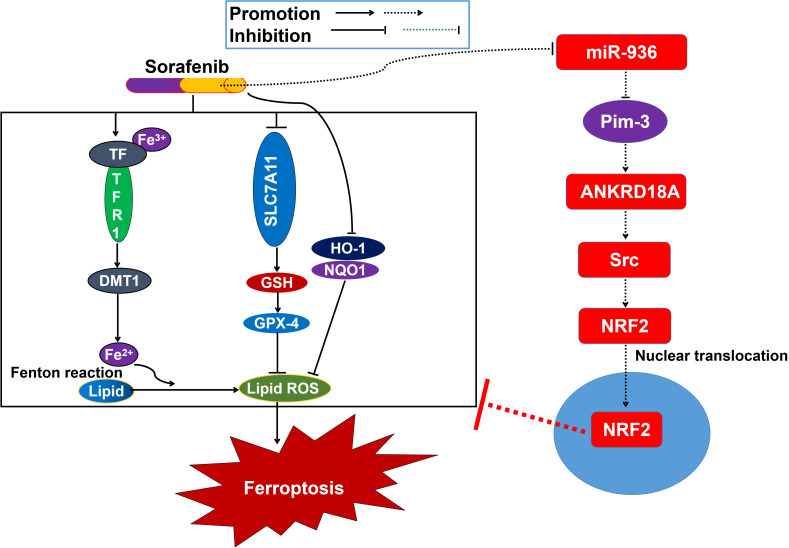
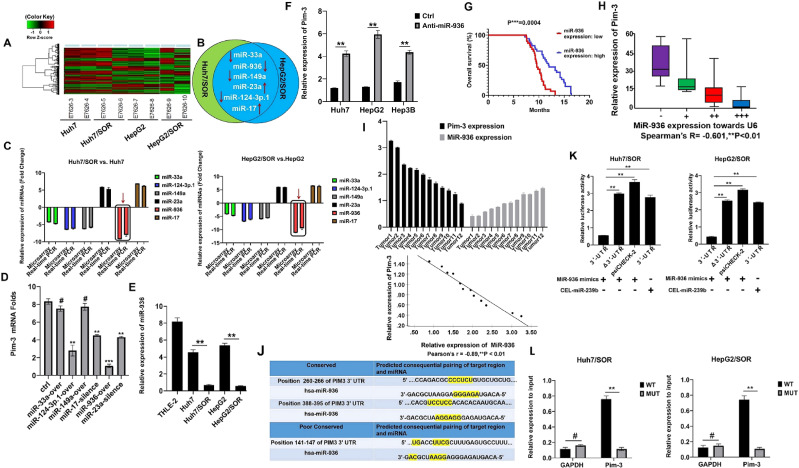
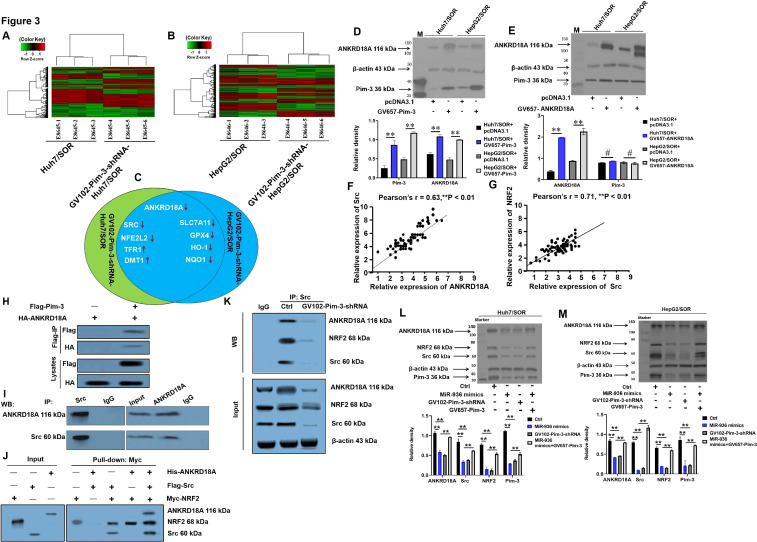
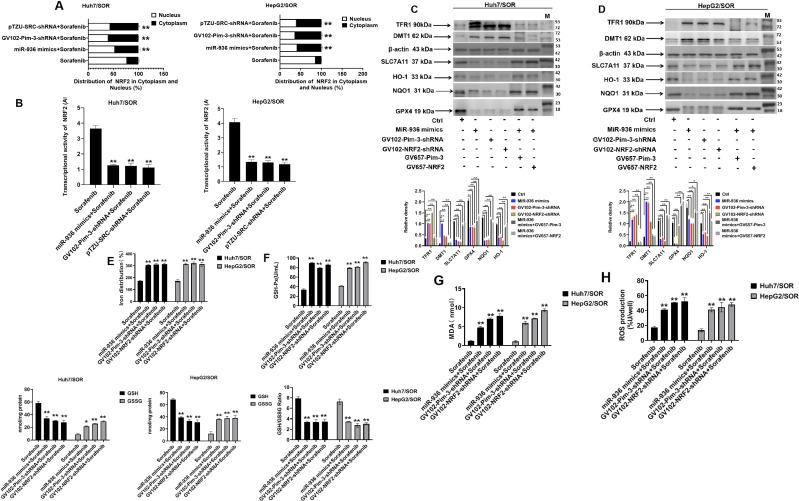
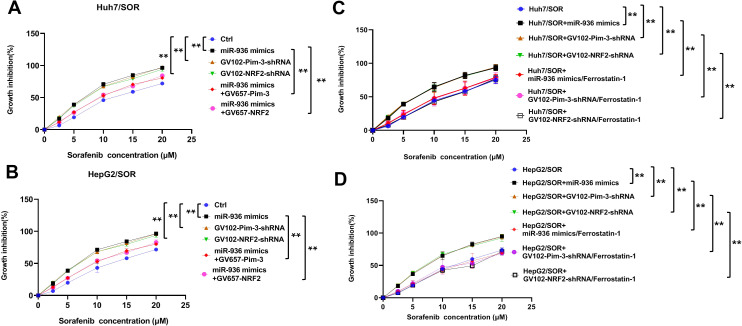
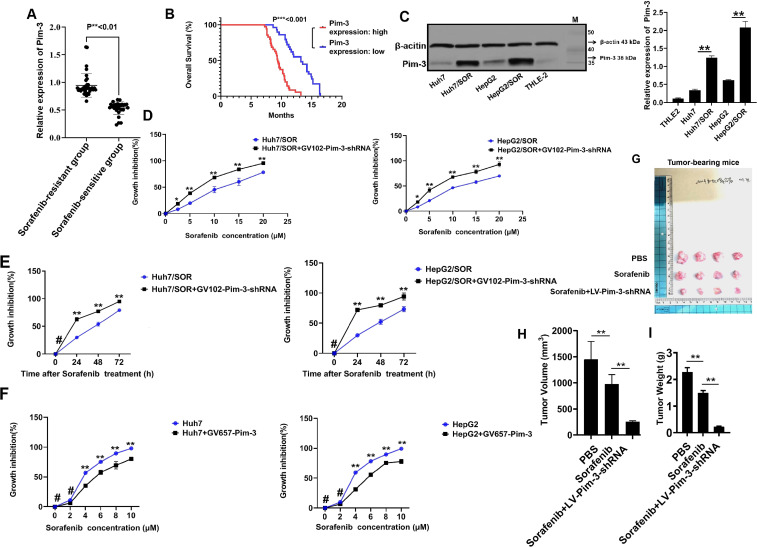
We showed that upregulation of the provirus-integrating site for Moloney murine leukemia virus 3 (Pim-3) predicted poor response and unsatisfactory prognosis in sorafenib-treated liver cancer patients. Similarly, Pim-3 expression was positively associated with sorafenib resistance in liver cancer cells. Furthermore, microRNA-936 (miR-936) targeted the 3'-noncoding region (3'-UTR) of Pim-3 but exhibited lower expression in sorafenib-resistant liver cancer cells than in their parental cells. The high expression of Pim-3 mediated by miR-936 insufficiency activated the ANKRD18A/Src/NRF2 pathway which rearranged the expression of the indicated markers involved in iron distribution and lipid peroxidation homeostasis. MiR-936 overexpression and GV102-Pim-3-shRNA significantly attenuated the activity of the ANKRD18A/Src/NRF2 pathway to decrease the expression of Ankyrin repeat domain-containing protein 18A (ANKRD18A), Src, and Nuclear factor (erythroid-derived 2)-like 2 (NRF2), especially decreasing NRF2 nuclear retention and transcriptional activity. The transcriptional activity of NRF2 prompted cell ferroptosis because the transfection of miR-936 mimics, GV102-Pim-3-shRNA and GV102-NRF2-shRNA plasmid increased the expression of transferrin receptor 1 (TFR1) and divalent metal transporter 1 (DMT1) but decreased the expression of solute carrier family 7 member 11 (SLC7A11), glutathione peroxidase 4 (GPX4), quinone oxidoreductase 1 (NQO1), and heme oxygenase-1 (HO-1), thus facilitating the accumulation of intracellular Fe, lipid peroxides, and reactive oxygen species (ROS) but reducing the glutathione (GSH) level. Moreover, the elevated expression of Pim-3, resulting from the absence of miR-936 enhances sorafenib resistance in liver cancer by inhibiting cell ferroptosis.
Pim-3 can be regarded as a target in the treatment of sorafenib-resistant liver cancer.
索拉非尼是一种多激酶抑制剂,目前是晚期肝癌的标准治疗药物。然而,其应用已因耐药性的产生而受到限制。我们旨在探索索拉非尼耐药性产生的机制,因此确定克服索拉非尼耐药性的有效策略仍然是一项挑战。
在此,我们对接受索拉非尼治疗的肝癌患者进行了随访,并进行了动物肿瘤挑战和治疗。还建立了索拉非尼耐药的肝癌细胞系Huh7/SOR和HepG2/SOR。使用了miRNA和mRNA微阵列分析、TargetScan预测、双荧光素酶报告基因检测、RNA下拉检测、免疫共沉淀(Co-IP)和下拉检测、转录因子特异性NRF2检测、铁检测、脂质过氧化定量检测、ROS测量检测以及GSH/GSSG和GSH-px标准定量检测。
我们发现莫洛尼鼠白血病病毒3(Pim-3)原病毒整合位点的上调预示着索拉非尼治疗的肝癌患者反应不佳且预后不理想。同样,Pim-3表达与肝癌细胞中的索拉非尼耐药性呈正相关。此外,微小RNA-936(miR-936)靶向Pim-3 的3'非编码区(3'-UTR),但在索拉非尼耐药的肝癌细胞中的表达低于其亲本细胞。miR-936不足介导的Pim-3高表达激活了ANKRD18A/Src/NRF2通路,该通路重新排列了参与铁分布和脂质过氧化稳态的指示标志物的表达。miR-936过表达和GV102-Pim-3-shRNA显著减弱了ANKRD18A/Src/NRF2通路的活性,从而降低了含锚蛋白重复结构域蛋白18A(ANKRD18A)、Src和核因子(红细胞衍生2)样2(NRF2)的表达,尤其是降低了NRF2的核保留和转录活性。NRF2的转录活性促使细胞发生铁死亡,因为miR-936模拟物、GV102-Pim-3-shRNA和GV102-NRF2-shRNA质粒的转染增加了转铁蛋白受体1(TFR1)和二价金属转运蛋白1(DMT1)的表达,但降低了溶质载体家族7成员11(SLC7A11)、谷胱甘肽过氧化物酶4(GPX4)、醌氧化还原酶1(NQO1)和血红素加氧酶-1(HO-1)的表达,从而促进了细胞内铁、脂质过氧化物和活性氧(ROS)的积累,但降低了谷胱甘肽(GSH)水平。此外,由于缺乏miR-936导致的Pim-3表达升高通过抑制细胞铁死亡增强了肝癌对索拉非尼的耐药性。
Pim-3可被视为治疗索拉非尼耐药肝癌的一个靶点。