Brigadoi Giulia, Gres Emelyne, Barbieri Elisa, Liberati Cecilia, Rossin Sara, Chiusaroli Lorenzo, Demarin Giulia Camilla, Tesser Francesca, Maestri Linda, Tirelli Francesca, Carrara Elena, Tacconelli Evelina, Bressan Silvia, Giaquinto Carlo, Da Dalt Liviana, Donà Daniele
Division of Pediatric Infectious Diseases, Department for Women's and Children's Health, University of Padua, Via Giustiniani 3, 35128 Padua, Italy.
CERPOP, UMR 1295, Inserm, University of Toulouse 3, Toulouse, France.
JAC Antimicrob Resist. 2024 Nov 6;6(6):dlae181. doi: 10.1093/jacamr/dlae181. eCollection 2024 Dec.
Antibiotics are the most prescribed drugs for children worldwide, but overuse and misuse have led to an increase in antibiotic resistance. Antimicrobial stewardship programmes (ASPs) have proven feasible in reducing inappropriate antimicrobial use. The study aimed at evaluating the impact and sustainability of an ASP with multiple interventions over 8 years.
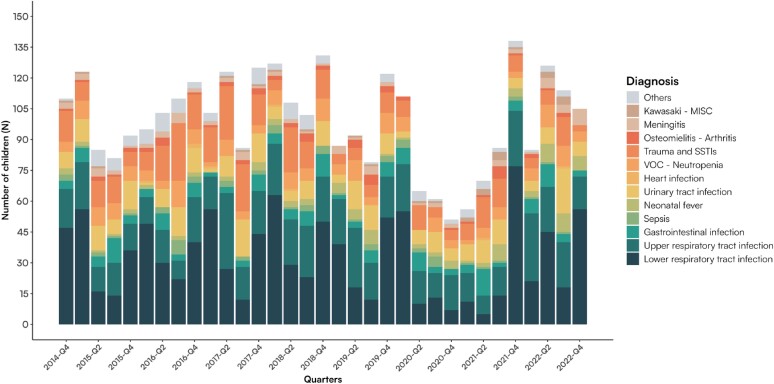
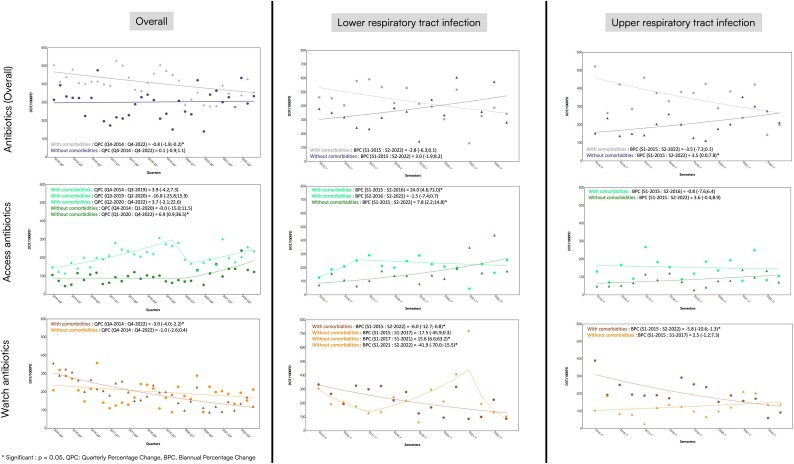
This quasi-experimental study was conducted between 2014 and 2022 in the paediatric acute care unit of Padua University Hospital. Demographic and clinical data were retrieved from the electronic clinical records. Daily prescriptions were collected and analysed based on the AWaRe classification and using days of therapy (DOT) out of 1000 patient days (DOT/1000PDs). The primary outcome was to assess the change in overall antibiotic consumption and of access and watch antibiotics, stratifying patients with and without comorbidities. Trends in antibiotic consumption (DOTs/1000PD) were assessed using joinpoint regression analysis.
A total of 3118 children were included. Total antibiotic consumption remained stable and low in patients without comorbidities, ∼300 DOT/1000PDs, whereas a statistically significant constant reduction was observed in children with comorbidities, from almost 500 DOT/1000PPDs to <400 DOT/1000PDs. Access consumption increased in both groups of patients, whereas watch consumption constantly decreased, although statistically significant only in children with comorbidities.
Implementing a multistep ASP has proven feasible and sustainable in improving antibiotic prescriptions for previously healthy and fragile children. All the implemented interventions were low cost, and with efficient use of resources, ensuring an ASP that was effective, practical, and easily replicable and implementable in various healthcare settings.
抗生素是全球范围内给儿童开具最多的药物,但过度使用和滥用导致了抗生素耐药性的增加。抗菌药物管理计划(ASPs)已被证明在减少不适当的抗菌药物使用方面是可行的。该研究旨在评估一项包含多种干预措施的抗菌药物管理计划在8年期间的影响和可持续性。
这项准实验研究于2014年至2022年在帕多瓦大学医院的儿科急性护理病房进行。人口统计学和临床数据从电子临床记录中获取。根据世界卫生组织基本药物标准清单(AWaRe)分类收集每日处方,并以每1000个患者日的治疗天数(DOT)进行分析(DOT/1000PDs)。主要结果是评估总体抗生素消耗量以及获取类和观察类抗生素的变化情况,对有无合并症的患者进行分层。使用连接点回归分析评估抗生素消耗(DOTs/1000PD)的趋势。
共纳入3118名儿童。无合并症患者的总抗生素消耗量保持稳定且较低,约为300 DOT/1000PDs,而有合并症的儿童中观察到统计学上显著的持续下降,从近500 DOT/1000PPDs降至<400 DOT/1000PDs。两组患者的获取类抗生素消耗量均增加,而观察类抗生素消耗量持续下降,尽管仅在有合并症的儿童中具有统计学意义。
实施多步骤抗菌药物管理计划已被证明在改善先前健康和脆弱儿童的抗生素处方方面是可行且可持续的。所有实施的干预措施成本低廉,资源利用高效,确保了一个在各种医疗环境中有效、实用且易于复制和实施的抗菌药物管理计划。