Saarinen Ilmari, Strandberg Marjatta, Hurme Saija, Grönroos Sofia, Juuti Anne, Helmiö Mika, Salminen Paulina
University of Turku, Turku, Finland.
Satasairaala Central Hospital, Pori, Finland.
Obes Surg. 2024 Dec;34(12):4378-4384. doi: 10.1007/s11695-024-07567-w. Epub 2024 Nov 7.
Severe obesity is associated with a low-grade chronic inflammation, and high-sensitivity C-reactive protein (hs-CRP) is a marker that can be used to evaluate chronic inflammation status. Metabolic bariatric surgery (MBS) is shown to decrease hs-CRP level, but long-term results are scarce, and association with weight loss outcomes is undetermined. This study aims to evaluate chronic inflammation in patients with obesity using hs-CRP, and its association with long-term weight loss outcomes after laparoscopic sleeve gastrectomy (LSG) and laparoscopic Roux-en-Y gastric bypass (LRYGB).
The long-term follow-up data of SLEEVEPASS (ClinicalTrials.gov NCT00793143) randomized clinical trial (RCT) was used. Hs-CRP was measured at baseline, and at 6 months, 1, 3, 5, 7, and 10 years after surgery, and the association with weight and weight loss outcomes were analyzed.
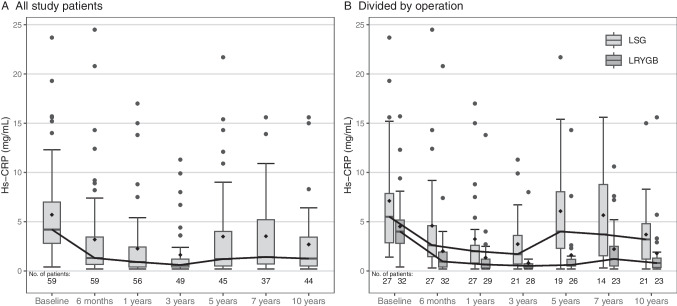
Hs-CRP at baseline was available for 59 out of 240 (24.6%) patients. In the whole study population, the nadir hs-CRP (mean estimate 1.14 mg/ml, 95% CI 0.87-1.49) was achieved at 3 years after surgery with a statistically significant difference to baseline (p = 0.003). No statistically significant difference was seen between LSG and LRYGB in hs-CRP change over time (operation*time interaction p = 0.540). Higher hs-CRP correlated with higher BMI at baseline (Spearman correlation 0.282, p = 0.030) and at 10 years (Spearman correlation 0.490, p = 0.001). At 10 years, a greater percentage total weight loss (%TWL) correlated with lower hs-CRP level (Spearman correlation - 0.558, p < 0.001). Baseline hs-CRP (Spearman correlation - 0.152, p = 0.299) and hs-CRP change in first 6 months postoperatively (Spearman correlation 0.167, p = 0.254) did not correlate statistically significantly with %TWL at 10 years.
MBS decreases hs-CRP also at long-term follow-up with weight loss as the driving force. Neither baseline hs-CRP nor hs-CRP change at 6 months were feasible as a predictive marker for long-term outcomes.
重度肥胖与低度慢性炎症相关,高敏C反应蛋白(hs-CRP)是一种可用于评估慢性炎症状态的标志物。代谢性减肥手术(MBS)已显示可降低hs-CRP水平,但长期结果较少,且与体重减轻结果的关联尚不确定。本研究旨在使用hs-CRP评估肥胖患者的慢性炎症,及其与腹腔镜袖状胃切除术(LSG)和腹腔镜Roux-en-Y胃旁路术(LRYGB)后长期体重减轻结果的关联。
使用SLEEVEPASS(ClinicalTrials.gov NCT00793143)随机临床试验(RCT)的长期随访数据。在基线时以及术后6个月、1年、3年、5年、7年和10年测量hs-CRP,并分析其与体重和体重减轻结果的关联。
240例患者中有59例(24.6%)有基线hs-CRP数据。在整个研究人群中,术后3年达到hs-CRP最低点(平均估计值1.14mg/ml,95%CI 0.87-1.49),与基线相比有统计学显著差异(p=0.003)。在hs-CRP随时间的变化方面,LSG和LRYGB之间未见统计学显著差异(手术*时间交互作用p=0.540)。较高的hs-CRP与基线时较高的BMI相关(Spearman相关性0.282,p=0.030)以及10年时较高的BMI相关(Spearman相关性0.490,p=0.001)。在10年时,更大的总体重减轻百分比(%TWL)与较低的hs-CRP水平相关(Spearman相关性-0.558,p<0.001)。基线hs-CRP(Spearman相关性-0.152,p=0.299)和术后前6个月的hs-CRP变化(Spearman相关性0.167,p=0.254)与10年时的%TWL无统计学显著相关性。
在长期随访中,MBS也会降低hs-CRP,体重减轻是其驱动因素。基线hs-CRP和6个月时的hs-CRP变化均不能作为长期结果的可行预测标志物。