Brain Development Imaging Laboratories, Department of Psychology, San Diego State University, CA, United States.
Spatio-Temporal Brain Imaging Laboratory, Department of Psychology, San Diego State University, CA, United States.
Neuroimage Clin. 2024;44:103694. doi: 10.1016/j.nicl.2024.103694. Epub 2024 Oct 28.
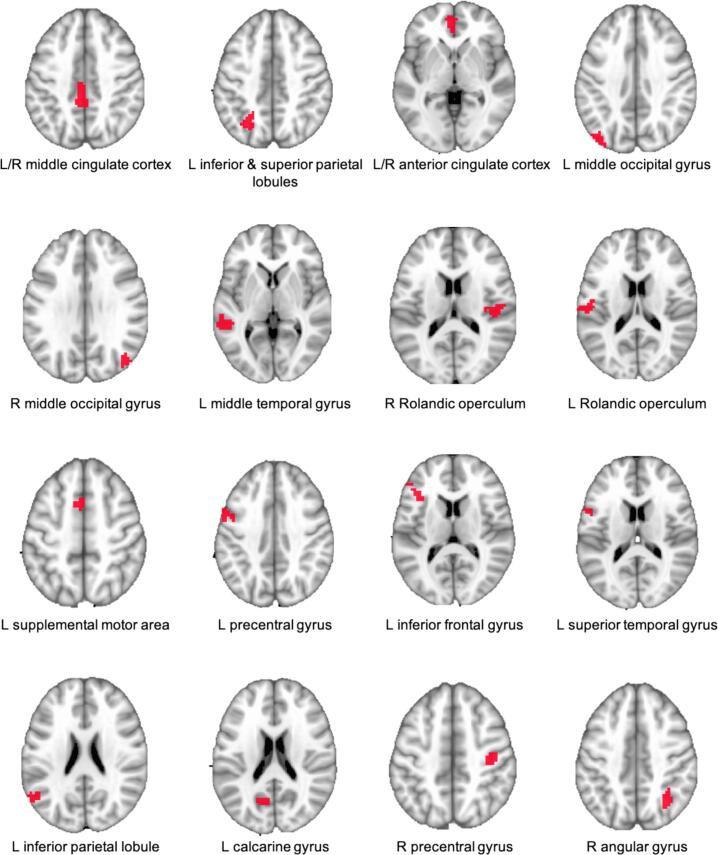
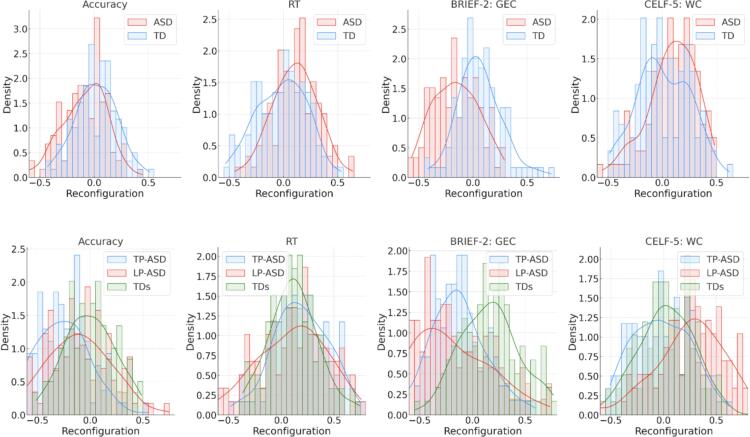
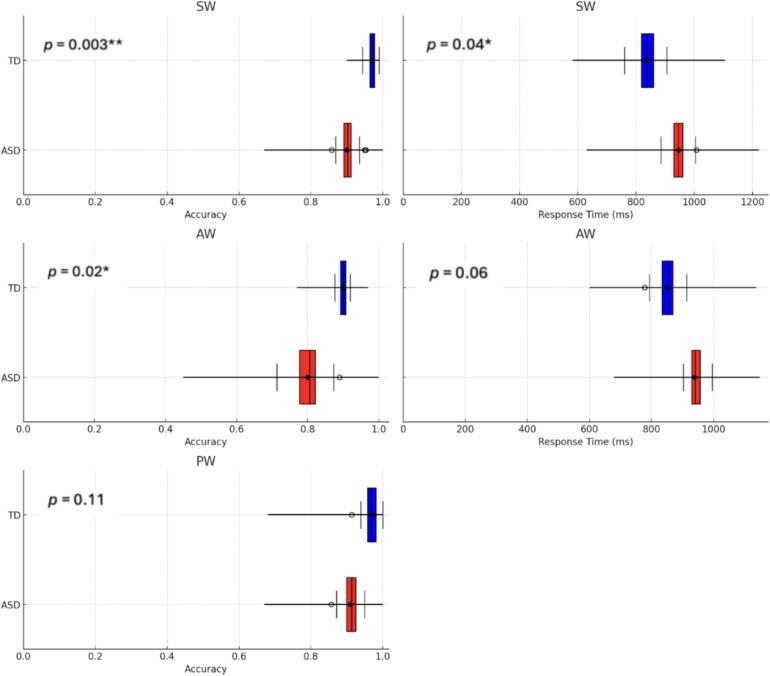
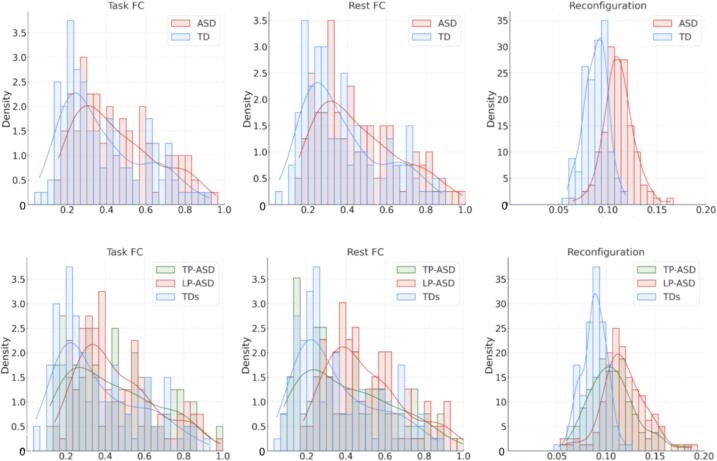
Autism spectrum disorder (ASD) is highly heterogeneous in etiology and clinical presentation. Findings on intrinsic functional connectivity (FC) or task-induced FC in ASD have been inconsistent including both over- and underconnectivity and diverse regional patterns. As FC patterns change across different cognitive demands, a novel and more comprehensive approach to network architecture in ASD is to examine the change in FC patterns between rest and task states, referred to as reconfiguration. This approach is suitable for investigating inefficient network connectivity that may underlie impaired behavioral functioning in clinical disorders. We used functional magnetic resonance imaging (fMRI) to examine FC reconfiguration during lexical processing, which is often affected in ASD, with additional focus on interindividual variability. Thirty adolescents with ASD and a matched group of 23 typically developing (TD) participants completed a lexicosemantic decision task during fMRI, using multiecho-multiband pulse sequences with advanced BOLD signal sensitivity and artifact removal. Regions of interest (ROIs) were selected based on task-related activation across both groups, and FC and reconfiguration were compared between groups. The ASD group showed increased interindividual variability and overall greater reconfiguration than the TD group. An ASD subgroup with typical performance accuracy (at the level of TD participants) showed reduced similarity and typicality of FC during the task. In this ASD subgroup, greater FC reconfiguration was associated with increased language skills. Findings suggest that intrinsic functional networks in ASD may be inefficiently organized for lexicosemantic decisions and may require greater reconfiguration during task processing, with high performance levels in some individuals being achieved through idiosyncratic mechanisms.
自闭症谱系障碍(ASD)在病因学和临床表现上具有高度异质性。ASD 内在功能连接(FC)或任务诱发 FC 的研究结果一直不一致,包括过度连接和连接不足以及不同的区域模式。由于 FC 模式随不同的认知需求而变化,因此检查静息状态和任务状态之间 FC 模式的变化(称为重新配置)是一种研究 ASD 中网络结构的新的、更全面的方法。这种方法适用于研究可能导致临床障碍中行为功能受损的低效网络连接。我们使用功能磁共振成像(fMRI)来检查词汇处理过程中的 FC 重新配置,该过程在 ASD 中经常受到影响,并特别关注个体间的可变性。30 名 ASD 青少年和 23 名匹配的典型发育(TD)参与者在 fMRI 期间完成了词汇语义决策任务,使用多回波-多带脉冲序列,具有先进的 BOLD 信号灵敏度和伪影去除。基于两组的任务相关激活,选择了感兴趣区域(ROI),并比较了组间的 FC 和重新配置。与 TD 组相比,ASD 组表现出更高的个体间变异性和整体更大的重新配置。在 ASD 亚组中,具有典型表现准确性(与 TD 参与者水平相当)的 ASD 亚组在任务期间显示出 FC 的相似性和典型性降低。在这个 ASD 亚组中,更大的 FC 重新配置与语言技能的提高有关。研究结果表明,ASD 中的内在功能网络可能在词汇语义决策方面组织效率低下,并且可能需要在任务处理过程中进行更大的重新配置,一些个体的高表现水平是通过特殊机制实现的。