Hsu Chin-Mu, Kao Shih-Yu, Yen Chia-Hung, Hsiao Chi-En, Cho Shih-Feng, Wang Hui-Ching, Yeh Tsung-Jang, Du Jeng-Shiun, Wang Min-Hong, Hsieh Tzu-Yu, Hsiao Samuel Yien, Tsai Yuhsin, Hung Li-Chuan, Liu Yi-Chang, Chang Kung-Chao, Hsiao Hui-Hua
Division of Hematology and Oncology, Department of Internal Medicine, Kaohsiung Medical University Hospital, Kaohsiung 807377, Taiwan, R.O.C.
Cancer Center, Kaohsiung Medical University Hospital, Kaohsiung 807377, Taiwan, R.O.C.
Oncol Lett. 2024 Oct 25;29(1):30. doi: 10.3892/ol.2024.14776. eCollection 2025 Jan.
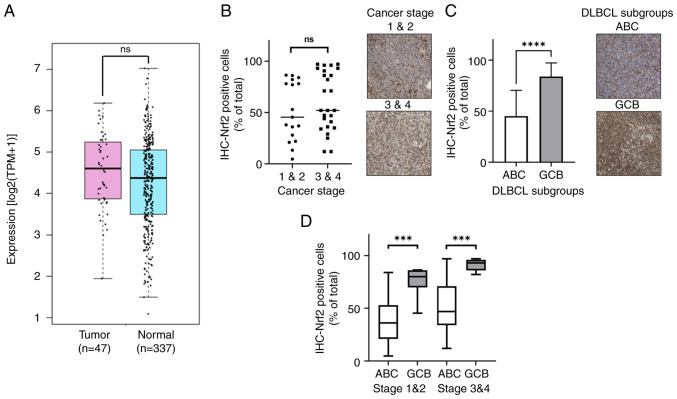
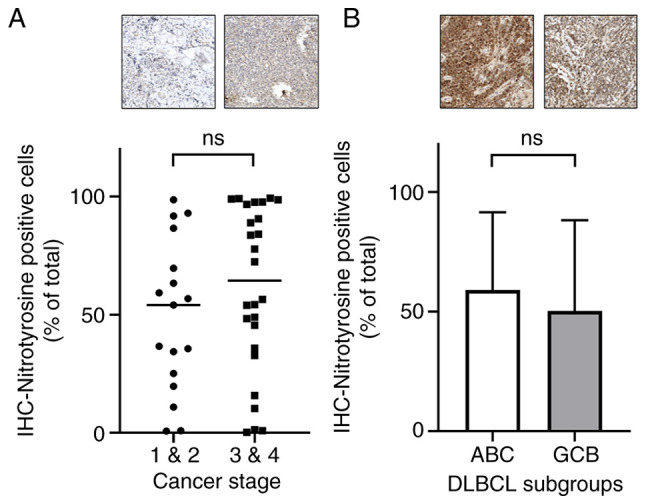
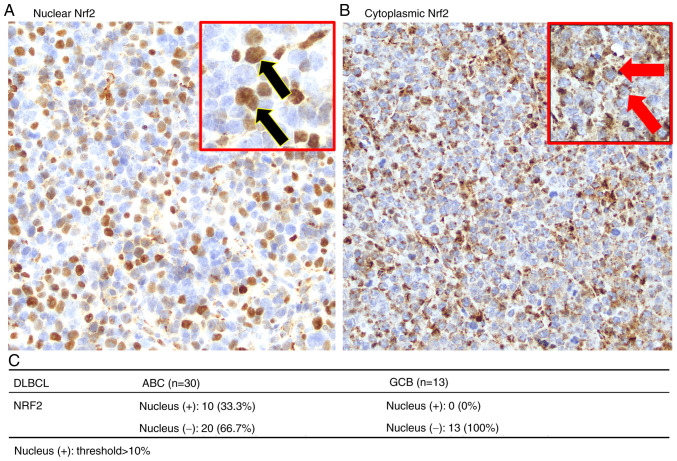
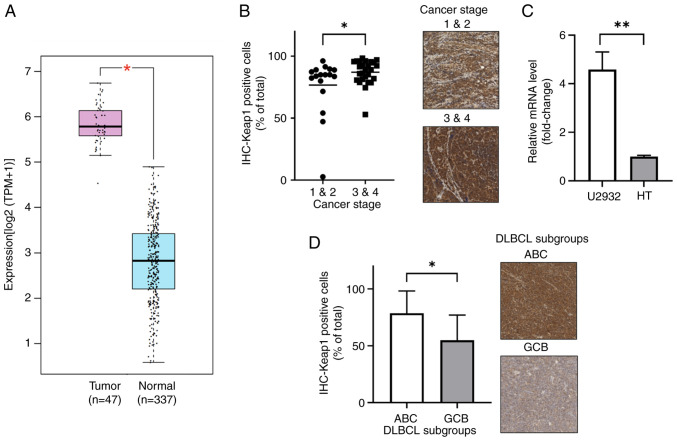
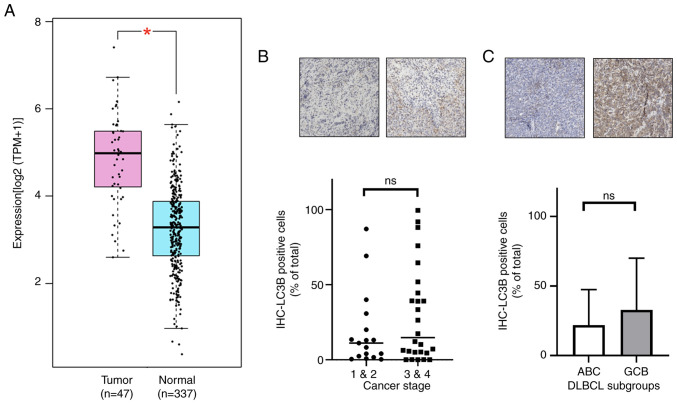
Diffuse large B-cell lymphoma (DLBCL) is an aggressive B-cell lymphoma characterized by distinct subtypes and heterogeneous treatment outcomes. Oxidative stress and the dysregulation of related regulatory genes are prevalent in DLBCL, prompting an investigation into the nuclear factor erythroid 2-related factor 2 (Nrf2)-kelch-like ECH-associated protein 1 (Keap1) signaling pathway and associated genes. The present study assessed pathological specimens and clinical data from 43 newly diagnosed patients with DLBCL, comparing the associations and correlations between the expression of Nrf2, Keap1, microtubule-associated protein 1 light chain 3β (LC3B) and nitrotyrosine and the activated B-cell (ABC) and germinal center B-cell (GCB) subtypes of DLBCL using immunohistochemistry and digital image analysis software. Nuclear Nrf2 activation was observed in 33.3% of patients with DLBCL ABC, demonstrating a higher prevalence of hepatitis B surface antigen positivity, calcium ions and significant body weight loss (P<0.05). Total Nrf2 expression was associated with the DLBCL GCB subtype and inversely correlated with Keap1 expression in the DLBCL ABC subtype. Furthermore, a positive correlation was demonstrated between Nrf2 and LC3, indicating that total Nrf2 is inhibited by Keap1 and regulates LC3 expression. The ABC subtype was also associated with lower white blood cell counts and more frequent chemotherapy courses than the GCB subtype. These findings suggest that nuclear Nrf2 could be a biomarker for DLBCL clinical diagnosis.
弥漫性大B细胞淋巴瘤(DLBCL)是一种侵袭性B细胞淋巴瘤,具有不同的亚型和异质性的治疗结果。氧化应激和相关调控基因的失调在DLBCL中普遍存在,这促使人们对核因子红细胞2相关因子2(Nrf2)-kelch样ECH相关蛋白1(Keap1)信号通路及相关基因进行研究。本研究评估了43例新诊断的DLBCL患者的病理标本和临床数据,采用免疫组织化学和数字图像分析软件,比较了Nrf2、Keap1、微管相关蛋白1轻链3β(LC3B)和硝基酪氨酸的表达与DLBCL的活化B细胞(ABC)和生发中心B细胞(GCB)亚型之间的关联和相关性。在33.3%的DLBCL ABC患者中观察到核Nrf2激活,表明乙肝表面抗原阳性、钙离子和显著体重减轻的发生率更高(P<0.05)。总Nrf2表达与DLBCL GCB亚型相关,与DLBCL ABC亚型中的Keap1表达呈负相关。此外,Nrf2与LC3之间呈正相关,表明总Nrf2受Keap1抑制并调节LC3表达。与GCB亚型相比,ABC亚型还与较低的白细胞计数和更频繁的化疗疗程相关。这些发现表明,核Nrf2可能是DLBCL临床诊断的一个生物标志物。