Cadenas-Garrido Paula, Schonvandt-Alarcos Ailén, Herrera-Quintana Lourdes, Vázquez-Lorente Héctor, Santamaría-Quiles Alicia, Ruiz de Francisco Jon, Moya-Escudero Marina, Martín-Oliva David, Martín-Guerrero Sandra M, Rodríguez-Santana César, Aragón-Vela Jerónimo, Plaza-Diaz Julio
Research and Advances in Molecular and Cellular Immunology, Center of Biomedical Research, University of Granada, Avda, del Conocimiento s/n, 18016 Armilla, Spain.
Department of Physiology, Schools of Pharmacy and Medicine, University of Granada, 18071 Granada, Spain.
Antioxidants (Basel). 2024 Jan 20;13(1):127. doi: 10.3390/antiox13010127.
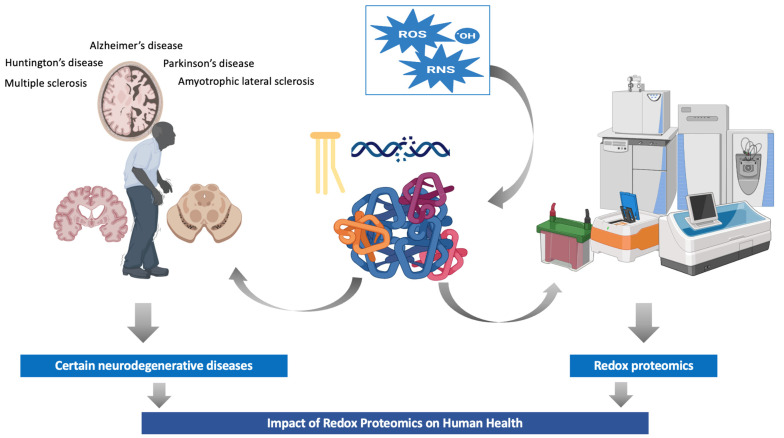
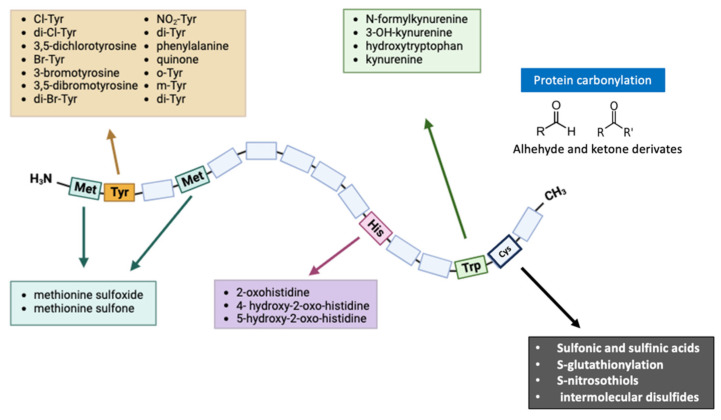
Antioxidant defenses in biological systems ensure redox homeostasis, regulating baseline levels of reactive oxygen and nitrogen species (ROS and RNS). Oxidative stress (OS), characterized by a lack of antioxidant defenses or an elevation in ROS and RNS, may cause a modification of biomolecules, ROS being primarily absorbed by proteins. As a result of both genome and environment interactions, proteomics provides complete information about a cell's proteome, which changes continuously. Besides measuring protein expression levels, proteomics can also be used to identify protein modifications, localizations, the effects of added agents, and the interactions between proteins. Several oxidative processes are frequently used to modify proteins post-translationally, including carbonylation, oxidation of amino acid side chains, glycation, or lipid peroxidation, which produces highly reactive alkenals. Reactive alkenals, such as 4-hydroxy-2-nonenal, are added to cysteine (Cys), lysine (Lys), or histidine (His) residues by a Michael addition, and tyrosine (Tyr) residues are nitrated and Cys residues are nitrosylated by a Michael addition. Oxidative and nitrosative stress have been implicated in many neurodegenerative diseases as a result of oxidative damage to the brain, which may be especially vulnerable due to the large consumption of dioxygen. Therefore, the current methods applied for the detection, identification, and quantification in redox proteomics are of great interest. This review describes the main protein modifications classified as chemical reactions. Finally, we discuss the importance of redox proteomics to health and describe the analytical methods used in redox proteomics.
生物系统中的抗氧化防御机制确保氧化还原稳态,调节活性氧和氮物种(ROS和RNS)的基线水平。氧化应激(OS)的特征是缺乏抗氧化防御机制或ROS和RNS升高,可能导致生物分子的修饰,ROS主要被蛋白质吸收。由于基因组与环境的相互作用,蛋白质组学提供了有关细胞蛋白质组的完整信息,而蛋白质组会不断变化。除了测量蛋白质表达水平外,蛋白质组学还可用于鉴定蛋白质修饰、定位、添加试剂的作用以及蛋白质之间的相互作用。几种氧化过程经常用于翻译后修饰蛋白质,包括羰基化、氨基酸侧链氧化、糖基化或脂质过氧化,后者会产生高反应性烯醛。反应性烯醛,如4-羟基-2-壬烯醛,通过迈克尔加成反应添加到半胱氨酸(Cys)、赖氨酸(Lys)或组氨酸(His)残基上,酪氨酸(Tyr)残基会被硝化,Cys残基会通过迈克尔加成反应被亚硝化。氧化应激和亚硝化应激由于对大脑的氧化损伤而与许多神经退行性疾病有关,由于大脑对氧气的大量消耗,大脑可能特别脆弱。因此,目前用于氧化还原蛋白质组学检测、鉴定和定量的方法备受关注。本综述描述了归类为化学反应的主要蛋白质修饰。最后,我们讨论了氧化还原蛋白质组学对健康的重要性,并描述了氧化还原蛋白质组学中使用的分析方法。