Schuck Sabrina E B, Zeiler Cassie N, Stehli Annamarie, Steinhoff Lydia A, Stokes Rachel Y, Jeffrey Sara E, Granger Douglas Alan
Pediatrics, University of California, Irvine, Irvine, CA, United States.
Pediatrics & Institute for Interdisciplinary Salivary Bioscience, University of California, Irvine, Irvine, CA, United States.
Front Psychiatry. 2024 Oct 24;15:1476522. doi: 10.3389/fpsyt.2024.1476522. eCollection 2024.
Children with Attention Deficit/Hyperactivity Disorder (ADHD) participated in a randomized clinical trial comparing animal-assisted intervention (AAI) to psychosocial treatment as usual (TAU). This brief report describes effects of AAI on acute HPA axis reactivity and regulation. Saliva was collected before, during, and after psychosocial intervention sessions with and without therapy dogs and later assayed for cortisol (ug/dL).
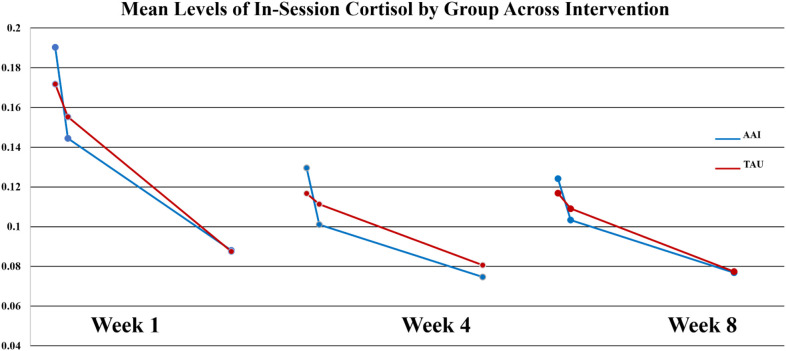
Thirty-nine participants (n = 39) with ADHD, aged 7-9 years (79% male) provided saliva at 3 points during 90-minute sessions; () upon arrival, () +20 minutes, and () 15 minutes prior to departure, on 3 occasions across an 8-week intervention (weeks 1, 4, and 8). Cortisol slopes calculated within each session were compared across the intervention weeks to determine within subject and between group effect sizes. Spearman's correlations between baseline individual neurodevelopmental symptoms and in-session acute cortisol responses were also evaluated.
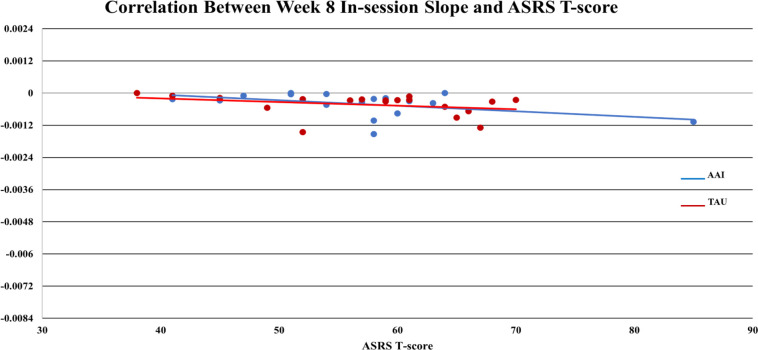
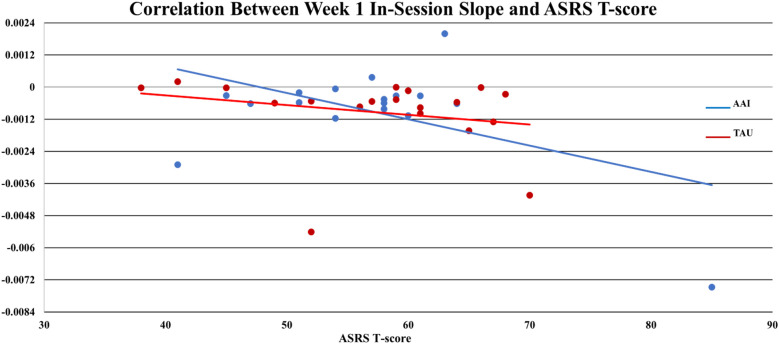
No significant between group differences were observed in cortisol responsiveness at week-1. By week-4, in-session changes in cortisol were evident, with significantly greater decreases in the AAI group (Cohen's = -.40). This pattern was also observed at week-8, with an even stronger effect-size ( = -0.60). Concurrent symptoms of autism were associated with the in-session acute cortisol response. Specifically, higher parent-reported symptom scores were associated with steeper decreases in cortisol across the session at week 1 ( = -0.42, .01) and week-8 ( = -0.34 = .05). At week-8 this association was stronger in the AAI group ( = -0.53) versus TAU ( = -0.25), with Cohen's = 0.413).
AAI may influence acute HPA reactivity and regulation for children with ADHD. Concurrent symptoms of ADHD and autism may be related to individual differences in the nature of the effect. Implications of these findings for AAI as an alternative, or complementary intervention for ADHD are discussed.
ClinicalTrials.gov, identifier NCT05102344.
患有注意力缺陷/多动障碍(ADHD)的儿童参与了一项随机临床试验,该试验将动物辅助干预(AAI)与常规心理社会治疗(TAU)进行了比较。本简要报告描述了AAI对急性下丘脑-垂体-肾上腺(HPA)轴反应性和调节的影响。在有和没有治疗犬参与的心理社会干预 session 之前、期间和之后收集唾液,随后检测唾液中的皮质醇(微克/分升)。
39名7至9岁的ADHD参与者(n = 39,79%为男性)在90分钟的session期间的3个时间点提供唾液;()到达时,()+20分钟时,以及()离开前15分钟时,在为期8周的干预(第1、4和8周)中的3个场合下进行。比较各session内计算出的皮质醇斜率在干预各周之间的差异,以确定个体内和组间的效应大小。还评估了基线个体神经发育症状与session内急性皮质醇反应之间的斯皮尔曼相关性。
在第1周,两组之间在皮质醇反应性方面未观察到显著差异。到第4周时,session内皮质醇的变化很明显,AAI组的下降幅度显著更大(科恩效应量 = -0.40)。在第8周也观察到了这种模式,效应量更强( = -0.60)。自闭症的并发症状与session内急性皮质醇反应相关。具体而言,在第1周( = -0.42,p =.01)和第8周( = -0.34,p =.05),家长报告的症状得分越高,整个session期间皮质醇下降越陡峭。在第8周,这种关联在AAI组( = -0.53)比TAU组( = -0.25)更强,科恩效应量 = 0.413)。
AAI可能会影响ADHD儿童的急性HPA反应性和调节。ADHD和自闭症的并发症状可能与效应性质的个体差异有关。讨论了这些发现对AAI作为ADHD的替代或补充干预措施的意义。
ClinicalTrials.gov,标识符NCT05102344。