Matsui Kenji, Yagishita Shigehiro, Hamada Akinobu
Division of Bioethics and Healthcare Law, National Cancer Center Institute for Cancer Control, Tokyo, Japan.
Division of Molecular Pharmacology, National Cancer Center Research Institute, Tokyo, Japan.
JMA J. 2024 Oct 15;7(4):605-609. doi: 10.31662/jmaj.2023-0199. Epub 2024 Aug 9.
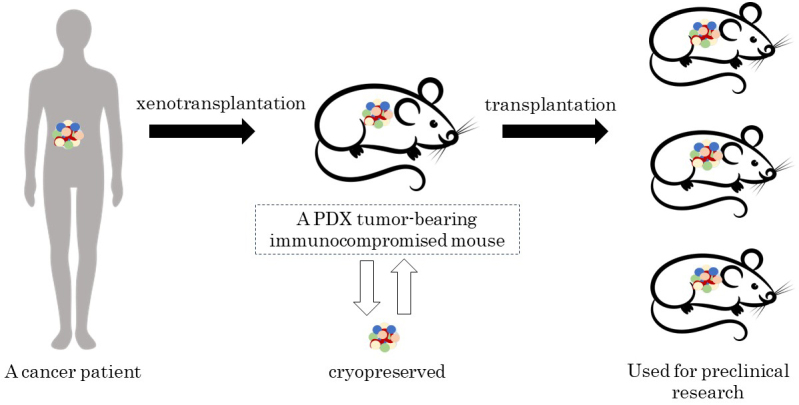
Patient-derived xenograft (PDX) models, in which tumor tissues resected from cancer patients are transplanted into immunocompromised mice, have been recently considered the most reliable preclinical models that quite accurately stimulate the real-world characteristics and microenvironments of tumors in patients. The ethical uniqueness of the PDX model, which lies in the fact that it is a hybrid of living human tumor tissue and a carrier mouse, raises several ethical concerns. This study presents four ethical points for consideration and a model ethical governance policy for the implementation and use of PDX models for research. First, PDX models carrying living tumor tissues originating from individual patients with dignity must be treated ethically as materials and data in compliance with the principle of respect for persons. Second, although PDX models themselves are patentable and can be commercialized, it is a standard view, as represented by the Oviedo Convention by the Council of Europe, that those living tumor tissues carried by PDX models shall not give rise to financial gain since those tissues are human body parts; therefore, they should be treated according to a recent ethical approach with the as the trust property of patients of origin and shall not be subjected directly to monetary transactions. Third, PDX models must be treated with due care in an ethical manner in line with experimental animal ethics. Finally, the implementation and use of PDX models for research purposes must comply with national and international regulations on both animal experimentation and human subject research. These four points should be carefully examined and properly institutionalized as an ethical governance policy in each institution that plans on utilizing or implementing PDX models for research.
患者来源的异种移植(PDX)模型是将癌症患者切除的肿瘤组织移植到免疫缺陷小鼠体内,最近被认为是最可靠的临床前模型,能够相当准确地模拟患者肿瘤的真实特征和微环境。PDX模型的伦理独特性在于它是活的人类肿瘤组织与载体小鼠的混合体,这引发了一些伦理问题。本研究提出了四个需要考虑的伦理要点以及一个用于PDX模型研究实施和使用的伦理治理政策模型。首先,携带源自具有尊严的个体患者的活肿瘤组织的PDX模型,必须按照尊重人的原则,将其作为材料和数据进行伦理对待。其次,虽然PDX模型本身可获得专利并可商业化,但正如欧洲委员会的《奥维耶多公约》所代表的标准观点那样,PDX模型携带的那些活肿瘤组织不应产生经济收益,因为这些组织是人体部分;因此,应根据最近的伦理方法将其作为原患者的信托财产来对待,并且不应直接进行货币交易。第三,必须按照实验动物伦理,以符合伦理的方式谨慎对待PDX模型。最后,用于研究目的的PDX模型的实施和使用必须遵守关于动物实验和人体研究对象的国家和国际法规。这四点应在每个计划利用或实施PDX模型进行研究的机构中作为伦理治理政策进行仔细审查并适当制度化。