
在可见光区域具有强烈吸收和发射的共轭二苯胺-薁共聚物。
Conjugated Diphenylaniline-Azulene Co-Oligomers with Intense Absorption and Emission in the Visible Region.
作者信息
Merkhatuly Nurlan, Iskanderov Amantay, Abeuova Saltanat, Iskanderov Ablaykhan, Zhokizhanova Saltanat
机构信息
Laboratory of Organic Semiconductor Chemistry, Karaganda Buketov University, Karaganda 100028, Kazakhstan.
The Higher School of Natural Sciences, Astana International University, Astana 020000, Kazakhstan.
出版信息
Molecules. 2024 Oct 25;29(21):5041. doi: 10.3390/molecules29215041.
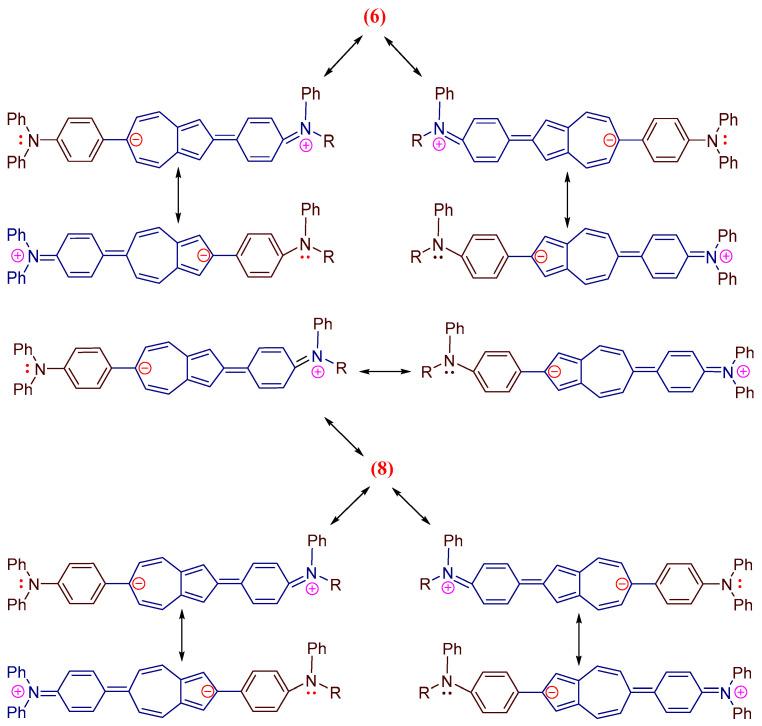
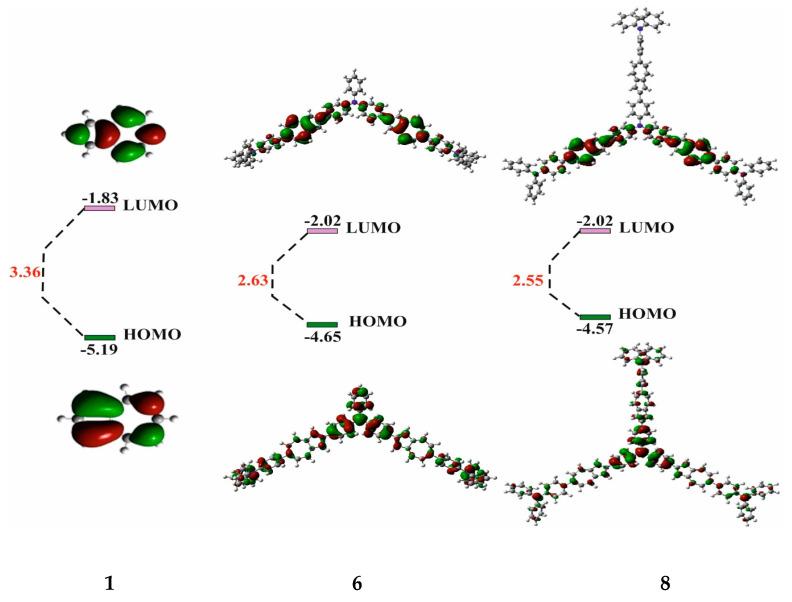
New conjugated 2,6-diphenylaniline-azulene co-oligomers of linear and branched structure were synthesized by the interaction of borylazulenes with diphenylaniline bromides under Suzuki-Miyaura cross-coupling conditions. The obtained diphenylaniline-azulene co-oligomers intensively absorb and emit visible light (410-700 nm region); in particular, they exhibit strong emissions in the green, as well as orange, range, with maxima of 510/590 nm. It is shown that such properties appear as a result of the positive resonance exposure to aniline fragments significantly rearranging the electronic structure of azulene, in particular, the levels and energy gaps of frontal HOMO-LUMO orbitals.
通过硼基薁与二苯胺溴化物在铃木-宫浦交叉偶联条件下的相互作用,合成了具有线性和支化结构的新型共轭2,6-二苯胺-薁共低聚物。所得到的二苯胺-薁共低聚物在可见光区域(410 - 700 nm)有强烈的吸收和发射;特别是,它们在绿色以及橙色范围内表现出强烈发射,最大值分别为510/590 nm。结果表明,这些性质是由于苯胺片段的正共振作用显著重排了薁的电子结构,特别是前线HOMO-LUMO轨道的能级和能隙所致。



 Zotero 插件