Alemu Solomon Seyife, Jarso Mohammedamin Hajure, Gejo Negeso Gebeyehu, Hebo Habtemu Jarso, Bedecha Daniel Yohannes, Bekele Firomsa, Gezimu Wubishet, Demsash Addisalem Workie, Teferi Sheleme Mengistu, Kitil Gemeda Wakgari, Dube Geleta Nenko, Yimer Awol Arega, Negese Kebede Berhanu, Bekele Gemechu Gelan, Wedajo Lema Fikadu
Department of Midwifery, College of Health Science, Madda Walabu University, Shashemene, Ethiopia.
Department of Psychiatry, College of Health Science, Madda Walabu University, Shashemene, Ethiopia.
Front Psychiatry. 2024 Oct 28;15:1470819. doi: 10.3389/fpsyt.2024.1470819. eCollection 2024.
Up to one-third of women globally experience giving birth as traumatic, which can lead to postpartum post-traumatic stress disorder. Postpartum post-traumatic stress disorders have significant health consequences for the mother, child, and other family members. Although it has tragic health impacts, little is known about this problem in the study area.
The study aimed to assess the prevalence of postpartum posttraumatic stress disorder and associated factors among postnatal mothers.
A community-based cross-sectional study was employed among 635 mothers in the first year after childbirth by using simple random sampling techniques from March 20 to April 20, 2024 in West Arsi zone, Ethiopia. Face-to-face interviewers administered structured questionnaires that were used to collect the data. The collected data were cleaned, coded, and entered into Epidata and exported to Statistical Package for Social Sciences for further analysis. Both bivariate and multivariable analyses were done by using binary logistic regression.
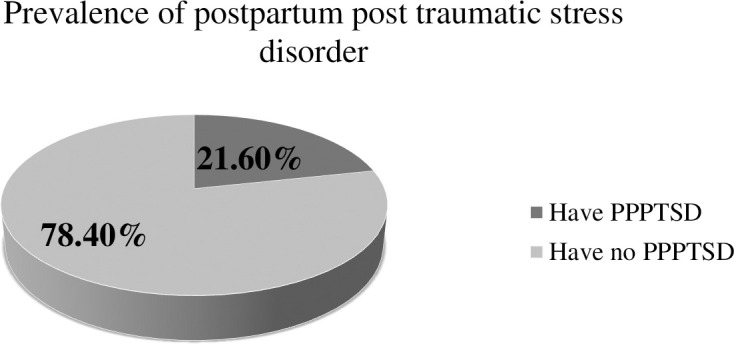
Out of 635, 624 postnatal mothers participated in the study, for a response rate of 98.27%. The prevalence of postpartum post-traumatic stress disorder was 21.60% (95% CI: 18.40%, 24.87%). Primiparous mothers (AOR = 2.26, 95% CI: 1.38, 3.70), have no antenatal care follow-up (AOR = 2.48, 95% CI: 1.47, 4.20), cesarean section delivery (AOR = 2.86, 95% CI: 1.50, 5.61), instrumental delivery (AOR = 3.06, 95% CI: 1.75, 5.34), maternal morbidity (AOR = 2.94, 95% CI: 1.71, 5.05), and postpartum intimate partner violence (AOR = 7.43, 95% CI: 4.53, 12.20) were the identified factors.
As identified, one out of five mothers had postpartum posttraumatic stress disorder. Thus, healthcare providers should focus on identified factors like cesarean section and instrumental deliveries while counseling, as this enhances the mothers' psychological readiness. In addition, the West Arsi Zonal Health Office should develop effective strategies to alleviate the problem by focusing on the identified factors.
全球多达三分之一的女性经历过创伤性分娩,这可能导致产后创伤后应激障碍。产后创伤后应激障碍对母亲、孩子和其他家庭成员有着重大的健康影响。尽管其对健康有悲惨影响,但在该研究地区对这个问题了解甚少。
本研究旨在评估产后母亲中创伤后应激障碍的患病率及相关因素。
2024年3月20日至4月20日,在埃塞俄比亚西部阿尔西地区采用简单随机抽样技术,对635名产后第一年的母亲进行了一项基于社区的横断面研究。面对面访谈者使用结构化问卷收集数据。收集到的数据进行清理、编码,并录入Epidata,然后导出到社会科学统计软件包进行进一步分析。采用二元逻辑回归进行双变量和多变量分析。
635名中,624名产后母亲参与了研究,应答率为98.27%。产后创伤后应激障碍的患病率为21.60%(95%置信区间:18.40%,24.87%)。经产妇(调整后比值比[AOR]=2.26,95%置信区间:1.38,3.70)、未进行产前检查随访(AOR=2.48,95%置信区间:1.47,4.20)、剖宫产分娩(AOR=2.86,95%置信区间:1.50,5.61)、器械助产(AOR=3.06,95%置信区间:1.75,5.34)、产妇发病(AOR=2.94,95%置信区间:1.71,5.05)以及产后亲密伴侣暴力(AOR=7.43,95%置信区间:4.53,12.20)为已确定的因素。
如所确定的,五分之一的母亲患有产后创伤后应激障碍。因此,医疗保健提供者在咨询时应关注如剖宫产和器械助产等已确定的因素,因为这能增强母亲的心理准备。此外,西部阿尔西地区卫生办公室应通过关注已确定的因素制定有效的策略来缓解这一问题。