Carter Michela, Linton Samuel C, Zeineddin Suhail, Pitt J Benjamin, De Boer Christopher, Figueroa Angie, Gosain Ankush, Lanning David, Lesher Aaron, Islam Saleem, Sathya Chethan, Holl Jane L, Ghomrawi Hassan Mk, Abdullah Fizan
Division of Pediatric Surgery, Department of Surgery, Ann and Robert H Lurie Children's Hospital of Chicago, Northwestern University Feinberg School of Medicine, Chicago, IL, United States.
Division of Pediatric Surgery, Department of Surgery, Children's Hospital Colorado, University of Colorado School of Medicine, Aurora, CO, United States.
JMIR Perioper Med. 2024 Nov 12;7:e58663. doi: 10.2196/58663.
At present, parents lack objective methods to evaluate their child's postoperative recovery following discharge from the hospital. As a result, clinicians are dependent upon a parent's subjective assessment of the child's health status and the child's ability to communicate their symptoms. This subjective nature of home monitoring contributes to unnecessary emergency department (ED) use as well as delays in treatment. However, the integration of data remotely collected using a consumer wearable device has the potential to provide clinicians with objective metrics for postoperative patients to facilitate informed longitudinal, remote assessment.
This multi-institutional study aimed to evaluate the impact of adding actual and simulated objective recovery data that were collected remotely using a consumer wearable device to simulated postoperative telephone encounters on clinicians' management.
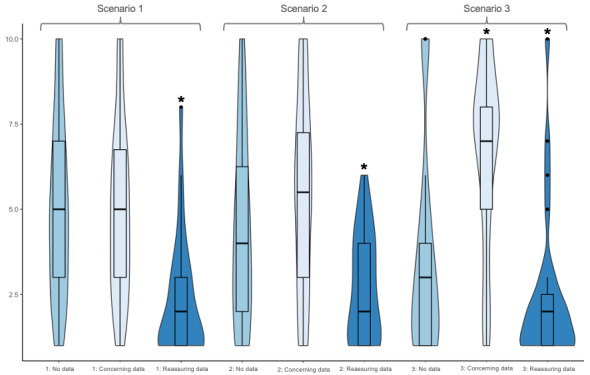
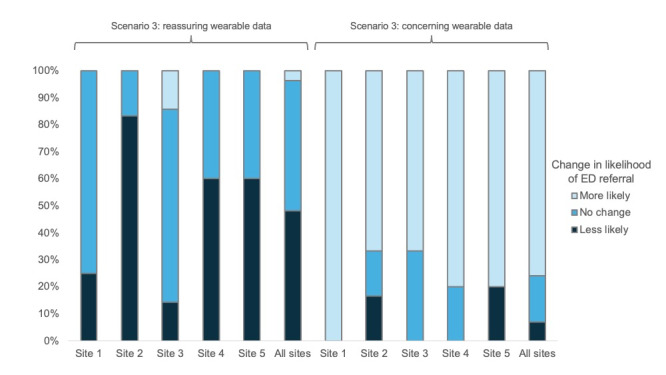
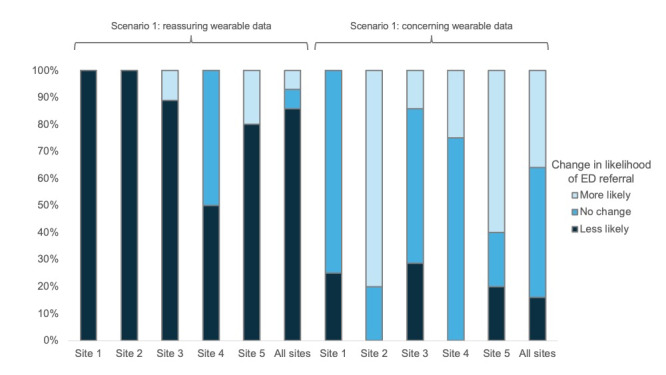
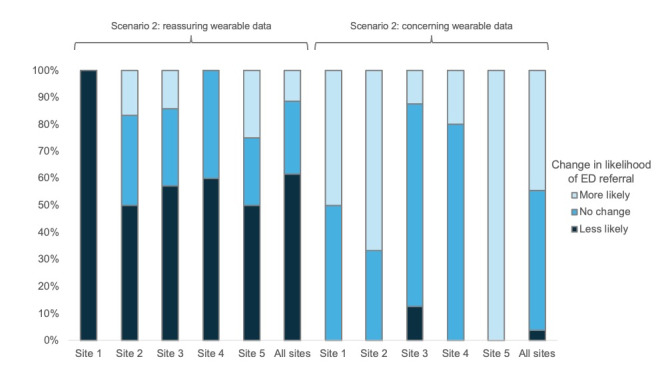
In total, 3 simulated telephone scenarios of patients after an appendectomy were presented to clinicians at 5 children's hospitals. Each scenario was then supplemented with wearable data concerning or reassuring against a postoperative complication. Clinicians rated their likelihood of ED referral before and after the addition of wearable data to evaluate if it changed their recommendation. Clinicians reported confidence in their decision-making.
In total, 34 clinicians participated. Compared with the scenario alone, the addition of reassuring wearable data resulted in a decreased likelihood of ED referral for all 3 scenarios (P<.01). When presented with concerning wearable data, there was an increased likelihood of ED referral for 1 of 3 scenarios (P=.72, P=.17, and P<.001). At the institutional level, there was no difference between the 5 institutions in how the wearable data changed the likelihood of ED referral for all 3 scenarios. With the addition of wearable data, 76% (19/25) to 88% (21/24 and 22/25) of clinicians reported increased confidence in their recommendations.
The addition of wearable data to simulated telephone scenarios for postdischarge patients who underwent pediatric surgery impacted clinicians' remote patient management at 5 pediatric institutions and increased clinician confidence. Wearable devices are capable of providing real-time measures of recovery, which can be used as a postoperative monitoring tool to reduce delays in care and avoidable health care use.
目前,家长缺乏客观方法来评估孩子出院后的术后恢复情况。因此,临床医生依赖家长对孩子健康状况的主观评估以及孩子表达症状的能力。家庭监测的这种主观性导致了不必要的急诊科(ED)就诊以及治疗延误。然而,使用消费级可穿戴设备远程收集的数据整合有潜力为临床医生提供术后患者的客观指标,以促进明智的纵向远程评估。
这项多机构研究旨在评估将使用消费级可穿戴设备远程收集的实际和模拟客观恢复数据添加到模拟术后电话会诊中对临床医生管理的影响。
在5家儿童医院向临床医生展示了总共3个阑尾切除术后患者的模拟电话场景。然后,每个场景都补充了有关或排除术后并发症的可穿戴数据。临床医生在添加可穿戴数据前后对急诊科转诊的可能性进行评分,以评估这是否改变了他们的建议。临床医生报告了他们对决策的信心。
共有34名临床医生参与。与仅场景相比,添加令人安心的可穿戴数据导致所有3个场景中急诊科转诊的可能性降低(P<.01)。当呈现令人担忧的可穿戴数据时,3个场景中的1个场景急诊科转诊的可能性增加(P=.72,P=.17,P<.001)。在机构层面,5家机构在可穿戴数据如何改变所有3个场景中急诊科转诊的可能性方面没有差异。随着可穿戴数据的添加,76%(19/25)至88%(21/24和22/25)的临床医生报告对他们的建议更有信心。
对于接受小儿手术的出院后患者,在模拟电话场景中添加可穿戴数据影响了5家儿科机构临床医生的远程患者管理,并增强了临床医生的信心。可穿戴设备能够提供恢复的实时测量,可作为术后监测工具以减少护理延误和避免不必要的医疗保健使用。