Laboratory of Immune and Neural Networks, Feinstein Institutes for Medical Research, 350 Community Drive, Manhasset, NY, 11030, USA.
Elmezzi Graduate School of Molecular Medicine at Northwell Health, 350 Community Drive, Manhasset, NY, 11030, USA.
Sci Rep. 2024 Nov 12;14(1):27747. doi: 10.1038/s41598-024-79259-5.
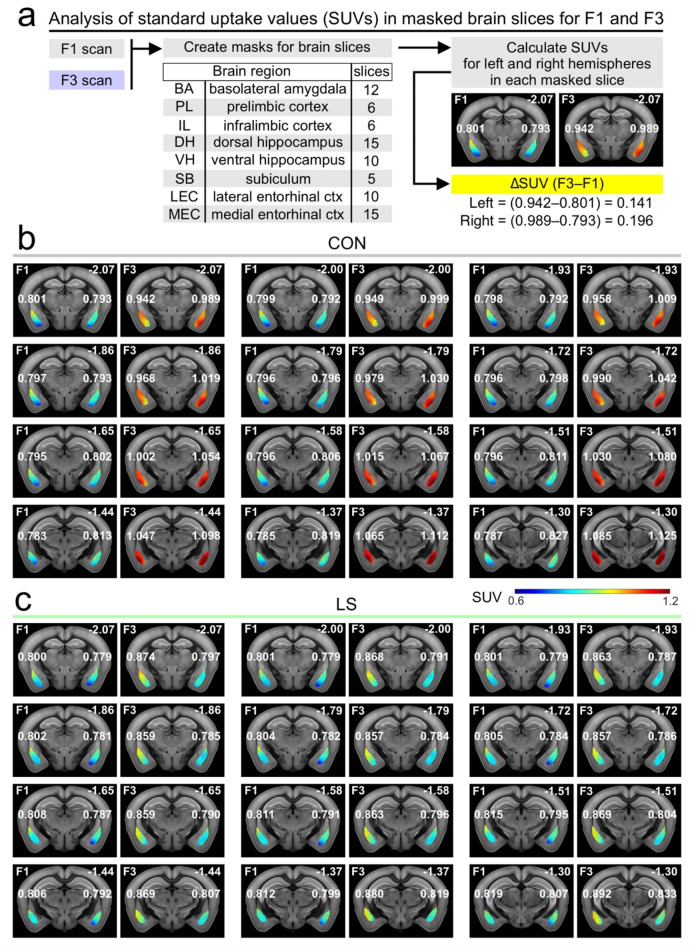
Positron emission tomography (PET) utilizes radiotracers like [F]fluorodeoxyglucose (FDG) to measure brain activity in health and disease. Performing behavioral tasks between the FDG injection and the PET scan allows the FDG signal to reflect task-related brain networks. Building on this principle, we introduce an approach called behavioral task-associated PET (beta-PET) consisting of two scans: the first after a mouse is familiarized with a conditioning chamber, and the second upon recall of contextual threat. Associative threat conditioning occurs between scans. Beta-PET focuses on brain regions encoding threat memory (e.g., amygdala, prefrontal cortex) and contextual aspects (e.g., hippocampus, subiculum, entorhinal cortex). Our results show that beta-PET identifies a biologically defined network encoding contextual threat memory and its uncoupling in a mouse model of long sepsis. Moreover, machine learning algorithms (linear logistic regression) and ordinal trends analysis demonstrate that beta-PET robustly predicts the behavioral defense response and its breakdown during long sepsis.
正电子发射断层扫描(PET)利用放射性示踪剂(如[F]氟脱氧葡萄糖(FDG))来测量健康和疾病中的大脑活动。在 FDG 注射和 PET 扫描之间进行行为任务可以使 FDG 信号反映与任务相关的大脑网络。在此基础上,我们引入了一种称为行为任务相关 PET(beta-PET)的方法,该方法由两次扫描组成:第一次是在老鼠熟悉 Conditioning 室后进行,第二次是在回忆上下文威胁时进行。在扫描之间发生关联威胁条件反射。beta-PET 关注编码威胁记忆(例如杏仁核、前额叶皮层)和上下文方面(例如海马体、下托、内嗅皮层)的大脑区域。我们的结果表明,beta-PET 可识别编码上下文威胁记忆的生物学定义网络,并在长脓毒症的小鼠模型中对其进行解耦。此外,机器学习算法(线性逻辑回归)和有序趋势分析表明,beta-PET 可稳健地预测长脓毒症期间的行为防御反应及其崩溃。