Megalla Martinus, Hahn Alexander K, Bauer Jordan A, Windsor Jordan T, Grace Zachary T, Gedman Marissa A, Arciero Robert A
University of Connecticut, Farmington, Connecticut, U.S.A.
Hackensack Meridian School of Medicine, Nutley, New Jersey, U.S.A.
Arthrosc Sports Med Rehabil. 2024 Jun 25;6(5):100963. doi: 10.1016/j.asmr.2024.100963. eCollection 2024 Oct.
To assess the differences in frequently asked questions (FAQs) and responses related to rotator cuff surgery between Google and ChatGPT.
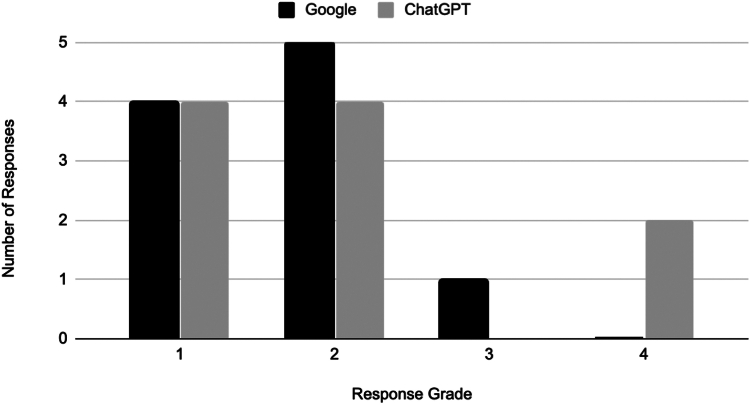
Both Google and ChatGPT (version 3.5) were queried for the top 10 FAQs using the search term "rotator cuff repair." Questions were categorized according to Rothwell's classification. In addition to questions and answers for each website, the source that the answer was pulled from was noted and assigned a category (academic, medical practice, etc). Responses were also graded as "excellent response not requiring clarification" (1), "satisfactory requiring minimal clarification" (2), "satisfactory requiring moderate clarification" (3), or "unsatisfactory requiring substantial clarification" (4).
Overall, 30% of questions were similar between what Google and ChatGPT deemed to be the most FAQs. For questions from Google web search, most answers came from medical practices (40%). For ChatGPT, most answers were provided by academic sources (90%). For numerical questions, ChatGPT and Google provided similar responses for 30% of questions. For most of the questions, both Google and ChatGPT responses were either "excellent" or "satisfactory requiring minimal clarification." Google had 1 response rated as satisfactory requiring moderate clarification, whereas ChatGPT had 2 responses rated as unsatisfactory.
Both Google and ChatGPT offer mostly excellent or satisfactory responses to the most FAQs regarding rotator cuff repair. However, ChatGPT may provide inaccurate or even fabricated answers and associated citations.
In general, the quality of online medical content is low. As artificial intelligence develops and becomes more widely used, it is important to assess the quality of the information patients are receiving from this technology.
评估谷歌和ChatGPT之间与肩袖手术相关的常见问题(FAQ)及回答的差异。
使用搜索词“肩袖修复”查询谷歌和ChatGPT(3.5版本)的前10个常见问题。问题根据罗斯韦尔分类法进行分类。除了每个网站的问题和答案外,还记录了答案的来源并分配了一个类别(学术、医疗实践等)。回答也被评为“无需澄清的优秀回答”(1)、“需要最少澄清的满意回答”(2)、“需要适度澄清的满意回答”(3)或“需要大量澄清的不满意回答”(4)。
总体而言,谷歌和ChatGPT认为的最常见问题中有30%是相似的。对于谷歌网络搜索的问题,大多数答案来自医疗实践(40%)。对于ChatGPT,大多数答案由学术来源提供(90%)。对于数值问题,ChatGPT和谷歌对30%的问题提供了相似的回答。对于大多数问题,谷歌和ChatGPT的回答要么是“优秀”,要么是“需要最少澄清的满意回答”。谷歌有1个回答被评为需要适度澄清的满意回答,而ChatGPT有2个回答被评为不满意回答。
谷歌和ChatGPT对于肩袖修复的大多数常见问题大多提供了优秀或满意的回答。然而,ChatGPT可能会提供不准确甚至编造的答案及相关引用。
一般来说,在线医疗内容质量较低。随着人工智能的发展和更广泛的应用,评估患者从这项技术获得的信息质量很重要。