Hodakowski Alexander J, McCormick Johnathon R, Damodar Dhanur, Cohn Matthew R, Carey Kyle D, Verma Nikhil N, Nicholson Gregory, Garrigues Grant E
Department of Orthopedic Surgery, Rush University Medical Center, Chicago, IL, USA.
Clin Shoulder Elb. 2023 Mar;26(1):25-31. doi: 10.5397/cise.2022.01235. Epub 2023 Feb 23.
This study analyzed questions searched by rotator cuff patients and determined types and quality of websites providing information.
Three strings related to rotator cuff repair were explored by Google Search. Result pages were collected under the "People also ask" function for frequent questions and associated webpages. Questions were categorized using Rothwell classification and topical subcategorization. Webpages were evaluated by Journal of the American Medical Association (JAMA) benchmark criteria for source quality.
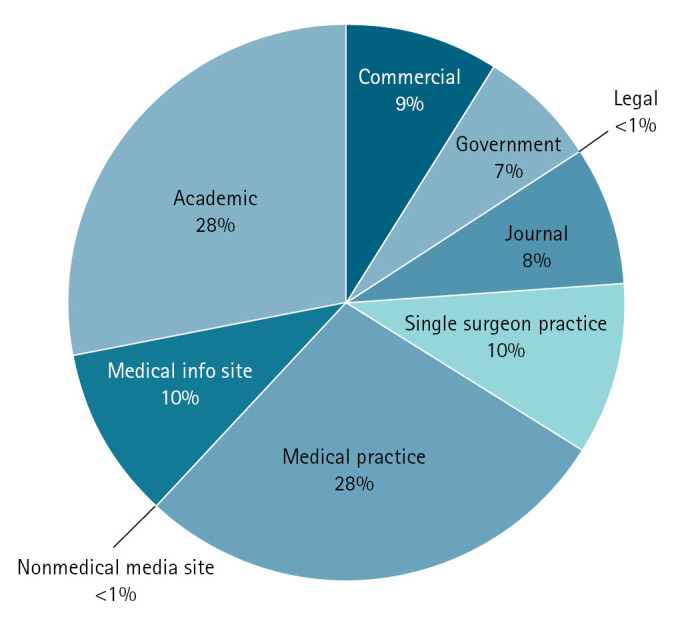
One hundred twenty "People also ask" questions were collected with associated webpages. Using the Rothwell classification of questions, queries were organized into fact (41.7%), value (31.7%), and policy (26.7%). The most common webpage categories were academic (28.3%) and medical practice (27.5%). The most common question subcategories were timeline of recovery (21.7%), indications/ management (21.7%), and pain (18.3%). Average JAMA score for all 120 webpages was 1.50. Journal articles had the highest average JAMA score (3.77), while commercial websites had the lowest JAMA score (0.91). The most commonly suggested question for rotator cuff repair/ surgery was, "Is rotator cuff surgery worth having?," while the most commonly suggested question for rotator cuff repair pain was, "What happens if a rotator cuff is not repaired?"
The most commonly asked questions pertaining to rotator cuff repair evaluate management options and relate to timeline of recovery and pain management. Most information is provided by medical practice, academic, and medical information websites, which have highly variable reliability. By understanding questions their patients search online, surgeons can tailor preoperative education to patient concerns and improve postoperative outcomes.
本研究分析了肩袖损伤患者搜索的问题,并确定了提供信息的网站类型和质量。
通过谷歌搜索探索了与肩袖修复相关的三个关键词。在“人们也问”功能下收集结果页面中的常见问题及相关网页。问题采用罗斯韦尔分类法和主题子分类法进行分类。网页根据美国医学会(JAMA)的来源质量基准标准进行评估。
收集了120个“人们也问”的问题及相关网页。根据罗斯韦尔问题分类法,问题分为事实类(41.7%)、价值类(31.7%)和政策类(26.7%)。最常见的网页类别是学术类(28.3%)和医疗实践类(27.5%)。最常见的问题子类别是恢复时间线(21.7%)、适应症/管理(21.7%)和疼痛(18.3%)。所有120个网页的平均JAMA评分为1.50。期刊文章的平均JAMA评分最高(3.77),而商业网站的JAMA评分最低(0.91)。肩袖修复/手术最常被提及的问题是“肩袖手术值得做吗?”,而肩袖修复疼痛最常被提及的问题是“如果肩袖不修复会怎样?”
与肩袖修复相关的最常见问题是评估管理方案,并与恢复时间线和疼痛管理有关。大多数信息由医疗实践、学术和医学信息网站提供,其可靠性差异很大。通过了解患者在网上搜索的问题,外科医生可以根据患者的关注点调整术前教育,改善术后结果。