Xu Zhangyu, Zhang Fan, Xie Erxuan, Hou Chao, Yin Liting, Liu Hanqing, Yin Mengfei, Yin Lang, Liu Xuejun, Huang YongAn
State Key Laboratory of Intelligent Manufacturing Equipment and Technology, Huazhong University of Science and Technology, Wuhan 430074, China.
Flexible Electronics Research Center, Huazhong University of Science and Technology, Wuhan 430074, China.
Research (Wash D C). 2024 Nov 13;7:0497. doi: 10.34133/research.0497. eCollection 2024.
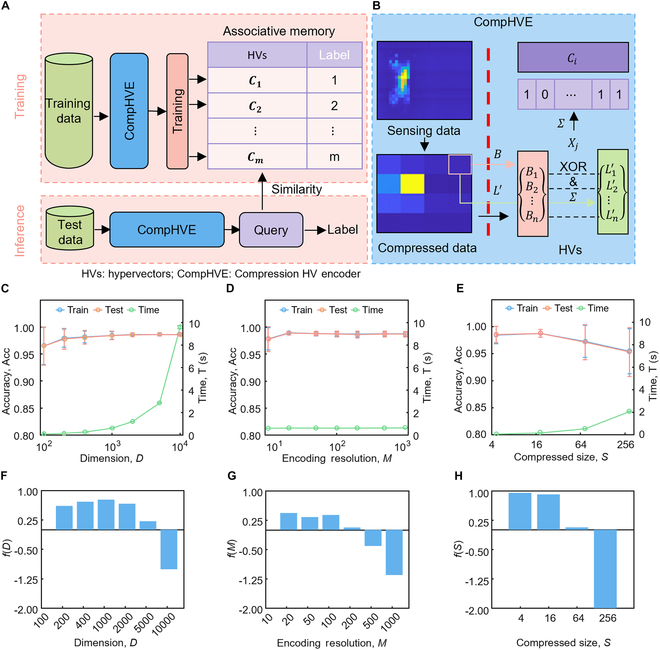
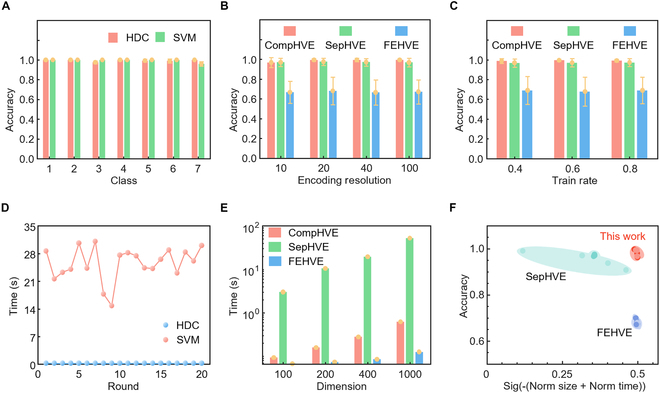
Artificial intelligence of things systems equipped with flexible sensors can autonomously and intelligently detect the condition of the surroundings. However, current intelligent monitoring systems always rely on an external computer with the capability of machine learning rather than integrating it into the sensing device. The computer-assisted intelligent system is hampered by energy inefficiencies, privacy issues, and bandwidth restrictions. Here, a flexible, large-scale sensing array with the capability of low-power in-sensor intelligence based on a compression hypervector encoder is proposed for real-time recognition. The system with in-sensor intelligence can accommodate different individuals and learn new postures without additional computer processing. Both the communication bandwidth requirement and energy consumption of this system are significantly reduced by 1,024 and 500 times, respectively. The capability for in-sensor inference and learning eliminates the necessity to transmit raw data externally, thereby effectively addressing privacy concerns. Furthermore, the system possesses a rapid recognition speed (a few hundred milliseconds) and a high recognition accuracy (about 99%), comparing with support vector machine and other hyperdimensional computing methods. The research holds marked potential for applications in the integration of artificial intelligence of things and flexible electronics.
配备柔性传感器的物联网人工智能系统能够自主、智能地检测周围环境状况。然而,当前的智能监测系统总是依赖具有机器学习能力的外部计算机,而非将其集成到传感设备中。计算机辅助智能系统受到能源效率低下、隐私问题和带宽限制的阻碍。在此,提出了一种基于压缩超向量编码器的具有低功耗传感器内智能能力的柔性大规模传感阵列,用于实时识别。具有传感器内智能的系统能够适应不同个体并学习新姿势,无需额外的计算机处理。该系统的通信带宽需求和能耗分别显著降低了1024倍和500倍。传感器内推理和学习能力消除了外部传输原始数据的必要性,从而有效解决了隐私问题。此外,与支持向量机和其他超维计算方法相比,该系统具有快速的识别速度(几百毫秒)和较高的识别准确率(约99%)。该研究在物联网与柔性电子集成应用方面具有显著潜力。