Norouzi Somaye, Majd Fateme Arefi, Rostami Somaye, Mirzaee Moghadameh, Sistani Samane, Ahmadian Leila
Student Research Committee, Faculty of Management and Medical Information Sciences Kerman University of Medical Sciences Kerman Iran.
Social Insurance Organization Farabi Hospital Mashhad Iran.
Health Sci Rep. 2024 Nov 13;7(11):e70193. doi: 10.1002/hsr2.70193. eCollection 2024 Nov.
Patients find it difficult, during the pandemic, to receive appropriate nutrition services because of the limited access to health services. This study assessed the effectiveness of a tele-consulting nutrition intervention on the nutrition adherence of patients with diabetes and hypertension.
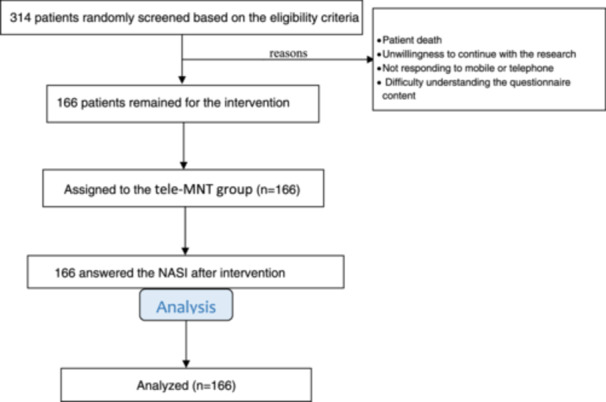
A tele-medical nutrition therapy (MNT) intervention was conducted as a one-group before-after trial. The estimated sample size was 314. Of these, 183 patients were selected from Hefdah-e-Shahrivar and 131 from Farabi Hospital. Patients were asked to complete an adapted version of the nutrition adherence self-reported instrument to compare nutrition adherence when they received face-to-face therapy versus tele MNT.
In total, 166 completed all phases of the study. The results showed that the nutrition adherence score significantly increased compared to before the intervention. Hedges's effect size also confirmed the high efficacy of telenutrition therapy. The magnitude of differences was within a high range (effect size 3.76 [CI: 3.40-4.12]).
The present findings showed that providing teleconsulting nutrition services to diabetic and hypertensive patients can positively affect their nutrition adherence. Telenutrition to promote a healthy diet can contribute to effectively controlling diseases in chronic patients during/after the pandemic with no gaps or failures.
This study was a tele-nutrition intervention. In this study, we provided consultation on regular food consumption and did not order any chemical substances or nutritional supplements. Furthermore, we did not perform any treatment or invasive intervention, we assumed that a registration number was unnecessary, so we did not apply for clinical trial registration.
在疫情期间,患者因获得医疗服务的机会有限,难以获得适当的营养服务。本研究评估了远程咨询营养干预对糖尿病和高血压患者营养依从性的有效性。
采用一组前后对照试验进行远程医疗营养治疗(MNT)干预。估计样本量为314例。其中,183例患者来自赫夫达-沙赫里瓦尔医院,131例来自法拉比医院。要求患者完成一份改编版的营养依从性自我报告工具,以比较他们接受面对面治疗和远程MNT时的营养依从性。
共有166例患者完成了研究的所有阶段。结果显示,与干预前相比,营养依从性得分显著提高。赫奇斯效应量也证实了远程营养治疗的高效性。差异幅度处于较高范围(效应量为3.76[CI:3.40-4.12])。
本研究结果表明,为糖尿病和高血压患者提供远程咨询营养服务可对其营养依从性产生积极影响。在疫情期间/之后,通过远程营养促进健康饮食有助于有效控制慢性病患者的疾病,且无任何差距或失误。
本研究为远程营养干预。在本研究中,我们提供了关于常规食物消费的咨询,未订购任何化学物质或营养补充剂。此外,我们未进行任何治疗或侵入性干预。我们认为无需注册编号,因此未申请临床试验注册。