
卷积神经网络中信心与准确性的类似人类的分离。
Human-like dissociations between confidence and accuracy in convolutional neural networks.
机构信息
School of Psychology, Georgia Institute of Technology, Atlanta, Georgia, United States of America.
出版信息
PLoS Comput Biol. 2024 Nov 14;20(11):e1012578. doi: 10.1371/journal.pcbi.1012578. eCollection 2024 Nov.
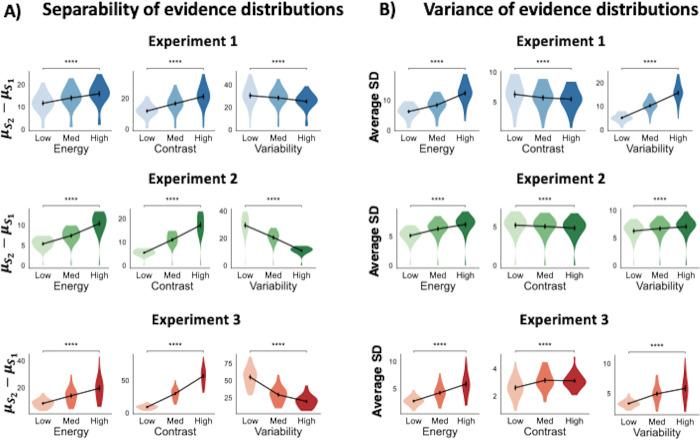
Prior research has shown that manipulating stimulus energy by changing both stimulus contrast and variability results in confidence-accuracy dissociations in humans. Specifically, even when performance is matched, higher stimulus energy leads to higher confidence. The most common explanation for this effect, derived from cognitive modeling, is the positive evidence heuristic where confidence neglects evidence that disconfirms the choice. However, an alternative explanation is the signal-and-variance-increase hypothesis, according to which these dissociations arise from changes in the separation and variance of perceptual representations. Because artificial neural networks lack built-in confidence heuristics, they can serve as a test for the necessity of confidence heuristics in explaining confidence-accuracy dissociations. Therefore, we tested whether confidence-accuracy dissociations induced by stimulus energy manipulations emerge naturally in convolutional neural networks (CNNs). We found that, across three different energy manipulations, CNNs produced confidence-accuracy dissociations similar to those found in humans. This effect was present for a range of CNN architectures from shallow 4-layer networks to very deep ones, such as VGG-19 and ResNet-50 pretrained on ImageNet. Further, we traced back the reason for the confidence-accuracy dissociations in all CNNs to the same signal-and-variance increase that has been proposed for humans: higher stimulus energy increased the separation and variance of evidence distributions in the CNNs' output layer leading to higher confidence even for matched accuracy. These findings cast doubt on the necessity of the positive evidence heuristic to explain human confidence and establish CNNs as promising models for testing cognitive theories of human behavior.
先前的研究表明,通过改变刺激对比度和变异性来操纵刺激能量,会导致人类在信心和准确性之间产生分离。具体来说,即使表现匹配,更高的刺激能量也会导致更高的信心。这种效应的最常见解释来自认知建模,即积极证据启发式,其中信心忽略了与选择不符的证据。然而,另一种解释是信号和方差增加假说,根据该假说,这些分离源于感知表示的分离和方差的变化。由于人工神经网络缺乏内置的信心启发式,因此它们可以作为解释信心准确性分离是否需要信心启发式的测试。因此,我们测试了卷积神经网络(CNN)是否会自然产生由刺激能量操作引起的信心准确性分离。我们发现,在三种不同的能量操作中,CNN 产生了与人类相似的信心准确性分离。这种效应存在于各种 CNN 架构中,从浅层的 4 层网络到非常深的网络,例如在 ImageNet 上预训练的 VGG-19 和 ResNet-50。此外,我们追溯了所有 CNN 中信心准确性分离的原因,发现都归因于相同的信号和方差增加,这与人类提出的信号和方差增加假说一致:更高的刺激能量增加了 CNN 输出层中证据分布的分离和方差,从而导致即使准确性匹配,信心也会更高。这些发现对解释人类信心的积极证据启发式的必要性提出了质疑,并确立了 CNN 作为测试人类行为认知理论的有前途的模型。



 Zotero 插件