Valkiūnas Gediminas, Iezhova Tatjana A, Duc Mélanie, Dunn Jenny C, Bensch Staffan
P. B. Šivickis Laboratory of Parasitology, Nature Research Centre, Vilnius, Lithuania.
School of Life Sciences, Huxley Building, Keele University, Newcastle-under-Lyme, Staffordshire, UK.
Parasitology. 2024 Sep;151(10):1163-1173. doi: 10.1017/S0031182024000878. Epub 2024 Nov 15.
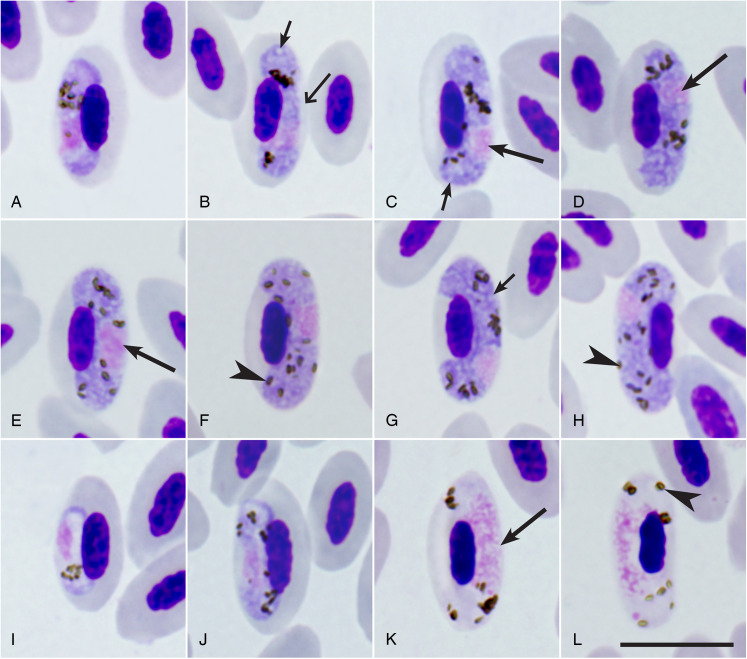
sp. nov. (Haemosporida, Haemoproteidae) was found in the dunnock and represents the first blood parasite described in accentor birds of the Prunellidae. The description is based on the morphology of blood stages and includes information about a barcoding segment of the mitochondrial cytochrome gene (lineage hDUNNO01) and the full mitochondrial genome, which can be used for identification and diagnosis of this infection. The new parasite can be readily distinguished from described species of haemoproteids parasitizing passeriform birds due to markedly variable position of nuclei in advanced and fully grown macrogametocytes. Illustrations of blood stages of the new species are given, and phylogenetic analyses based on partial mitochondrial cytochrome gene sequences and the full mitochondrial genome identified the closely related lineages. DNA haplotype networks showed that transmission occurs in Europe and North America. This parasite was found in the dunnock in Europe and several species of the Passerellidae in North America. It is probably of Holarctic distribution, with the highest reported prevalence in the UK. The parasite distribution seems to be geographically patchy, with preference for areas of relatively cool climates. Phylogenetic analysis suggests that sp. nov. belongs to the subgenus and is probably transmitted by biting midges belonging to (Ceratopogonidae). The available data on molecular occurrence indicate that this pathogen is prone to abortive development, so worth attention in regard of consequences for bird health.
新种(血孢子虫纲,血变科)在鹪鹩中被发现,是首次在雀形目岩鹨科鸟类中描述的血液寄生虫。该描述基于血液阶段的形态学,并包括线粒体细胞色素基因条形码片段(谱系hDUNNO01)和完整线粒体基因组的信息,可用于该感染的鉴定和诊断。由于成熟和完全成熟的大配子细胞核位置明显可变,这种新寄生虫可轻易与寄生于雀形目鸟类的已描述血变科物种区分开来。给出了新物种血液阶段的图示,基于线粒体细胞色素基因部分序列和完整线粒体基因组的系统发育分析确定了密切相关的谱系。DNA单倍型网络显示,传播发生在欧洲和北美。这种寄生虫在欧洲的鹪鹩以及北美的几种雀科鸟类中被发现。它可能分布于全北区,在英国报告的患病率最高。寄生虫的分布似乎在地理上呈斑块状,偏好气候相对凉爽的地区。系统发育分析表明,新种属于亚属,可能由蠓科的蠓传播。关于分子发生的现有数据表明,这种病原体容易出现发育不全,因此在对鸟类健康的影响方面值得关注。