
实验性膝关节疼痛位置对步态运动学的影响。
Effect of experimental knee pain location on gait kinematics.
作者信息
Gallina Alessio, Adamo Paola, Marino Giorgia, Cescon Corrado, Bolzoni Francesco, Barbero Marco, Temporiti Federico, Gatti Roberto
机构信息
School of Sport, Exercise and Rehabilitation Sciences, College of Life and Environmental Sciences, University of Birmingham, Birmingham, UK.
Physiotherapy Unit, IRCCS Humanitas Research Hospital, Rozzano, Italy.
出版信息
Eur J Appl Physiol. 2025 Apr;125(4):977-987. doi: 10.1007/s00421-024-05648-3. Epub 2024 Nov 14.
PURPOSE
In this study, we investigated whether experimental knee pain alters lower limb kinematics and knee arthrokinematics during gait, and if this motor adaptation depends on the spatial characteristics of the painful stimulus.
METHODS
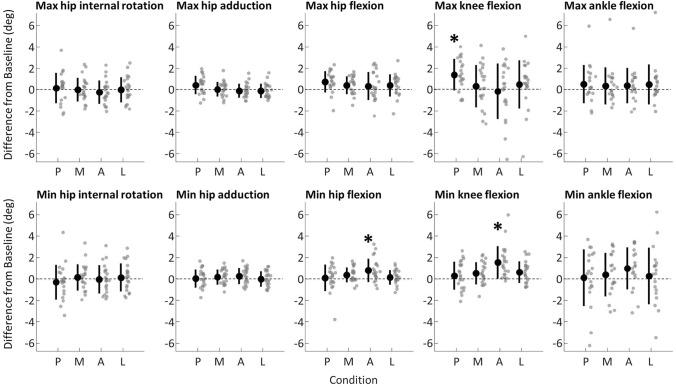
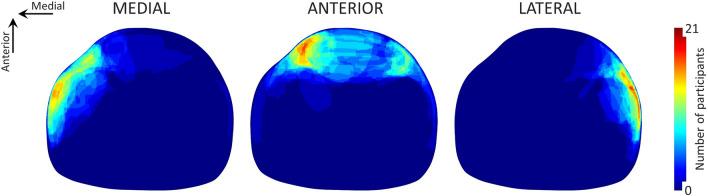
Twenty-one participants walked on a treadmill for 60-s trials, either without stimulation or while experiencing painful electrical stimulation in the medial, lateral or anterior region of the knee. Perceived pain location was analyzed using pain drawing. Gait spatiotemporal parameters, lower limb kinematics, and dispersion of the knee helical axes on the sagittal plane were quantified for each trial and compared between conditions using ANOVAs with repeated measures or Friedman tests.
RESULTS
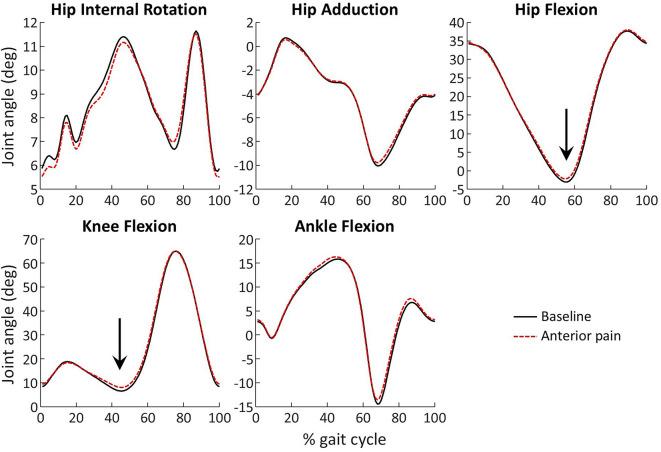
Pain perception was localized in the area the stimulation was applied to. Compared to walking without pain, participants demonstrated reduced knee extension (1.5 ± 1.5 degrees, p = 0.002) and reduced hip extension (0.8 ± 1.1 degrees, p = 0.037) when pain was induced in the anterior region, but not medially or laterally. Anterior knee pain increased the mean distance of the helical axes during late stance (0.7 [0.3, 1.4], p = 0.010), while medial pain increased both mean distance (0.3 [0.1, 0.5], p = 0.037) and mean angle (1.2 ± 1.4, p = 0.010) during early swing.
CONCLUSION
Acute, experimental knee pain alters gait kinematics and increases the dispersion of the helical axis. These adaptations depend on the spatial characteristics of the painful stimulus. These adaptations may reflect an attempt of the central nervous system to protect the painful tissue while searching for a less painful movement strategy.
目的
在本研究中,我们调查了实验性膝关节疼痛是否会改变步态期间的下肢运动学和膝关节关节运动学,以及这种运动适应是否取决于疼痛刺激的空间特征。
方法
21名参与者在跑步机上进行60秒的试验,试验过程中要么无刺激,要么在膝关节内侧、外侧或前部区域接受疼痛性电刺激。使用疼痛图分析疼痛感知位置。对每次试验的步态时空参数、下肢运动学以及矢状面上膝关节螺旋轴的离散度进行量化,并使用重复测量方差分析或弗里德曼检验比较不同条件下的结果。
结果
疼痛感知位于施加刺激的区域。与无痛行走相比,在前部区域诱发疼痛时,参与者的膝关节伸展减少(1.5±1.5度,p = 0.002),髋关节伸展减少(0.8±1.1度,p = 0.037),而在内侧或外侧诱发疼痛时则不然。膝关节前部疼痛在站立后期增加了螺旋轴的平均距离(0.7[0.3, 1.4],p = 0.010),而膝关节内侧疼痛在摆动前期增加了平均距离(0.3[0.1, 0.5],p = 0.037)和平均角度(1.2±1.4,p = 0.010)。
结论
急性实验性膝关节疼痛会改变步态运动学并增加螺旋轴的离散度。这些适应取决于疼痛刺激的空间特征。这些适应可能反映了中枢神经系统在寻找疼痛较轻的运动策略时保护疼痛组织的一种尝试。

 Zotero 插件