Oikawa Kenichi, Matsumoto Yoshihiro, Watanabe Kenichi, Sato Hirotaka, Parker Joseph Don, Shinohara Takenao, Kiyanagi Yoshiaki
J-PARC Center, Japan Atomic Energy Agency, 2-4 Shirakata, Tokai, Ibaraki, 319-1195, Japan.
Comprehensive Research Organization for Science and Society, Neutron Science and Technology Center, 162-1 Shirakata, Tokai, Ibaraki, Japan.
Sci Rep. 2024 Nov 14;14(1):27990. doi: 10.1038/s41598-024-79436-6.
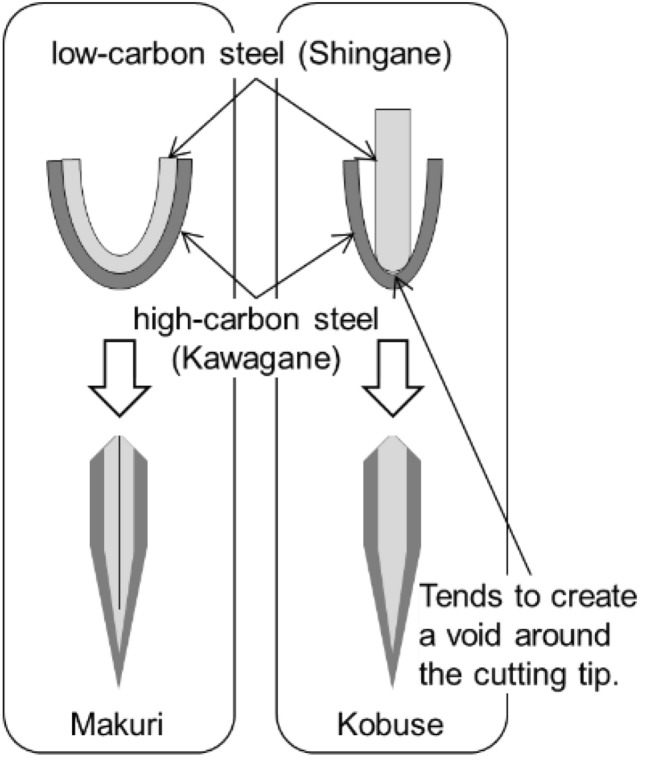
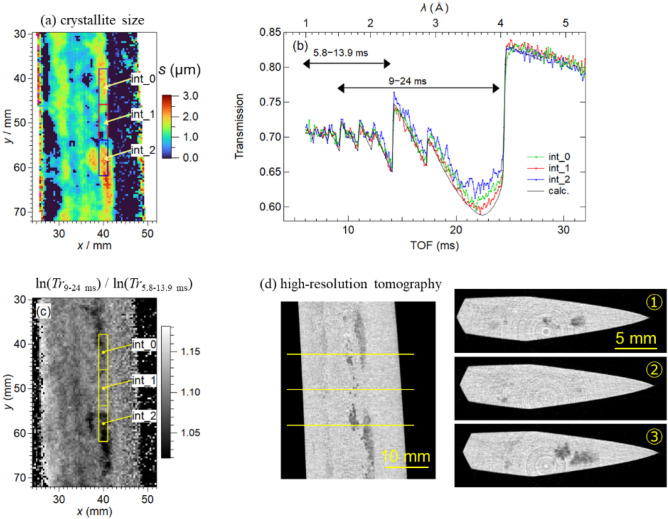
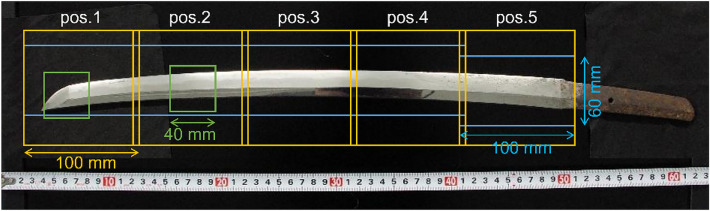
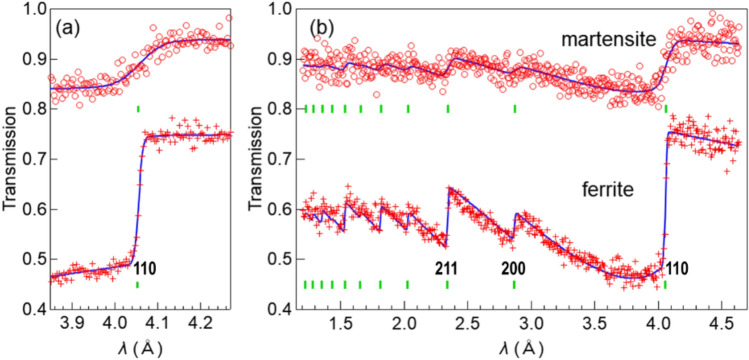
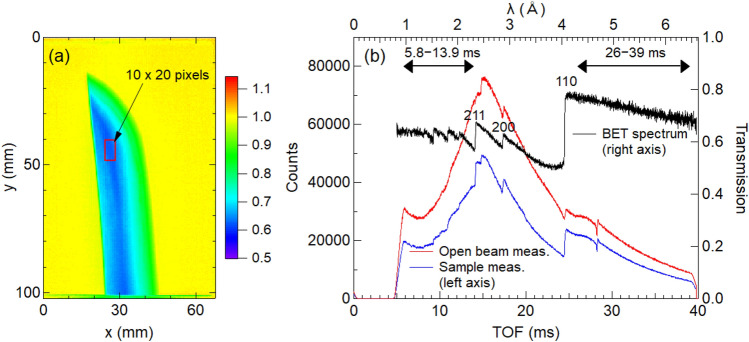
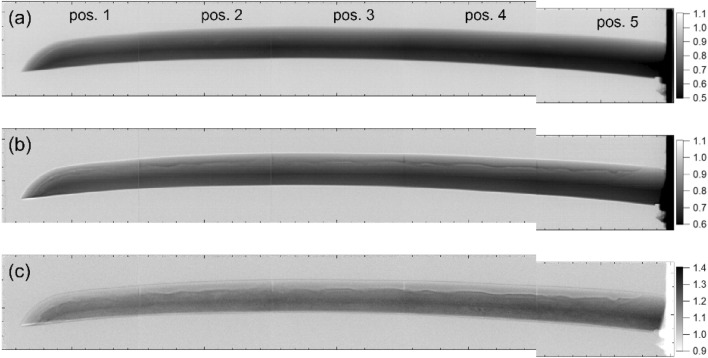
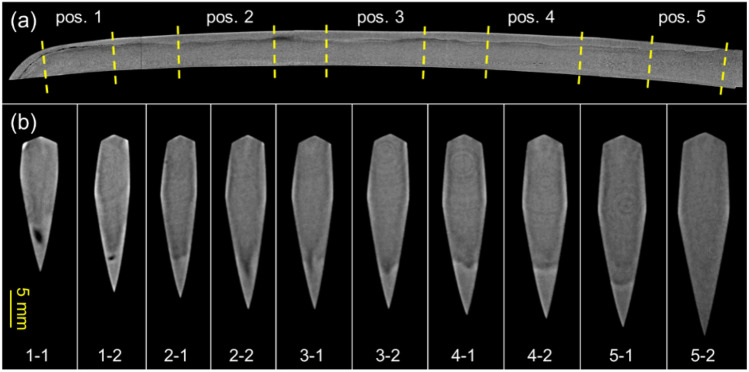
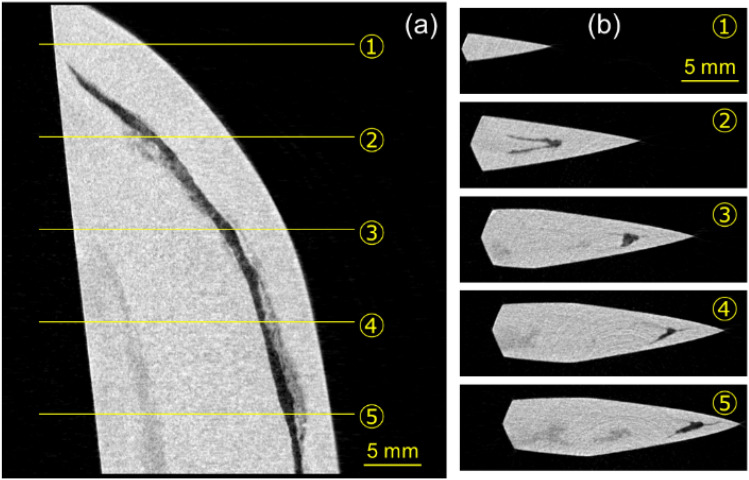
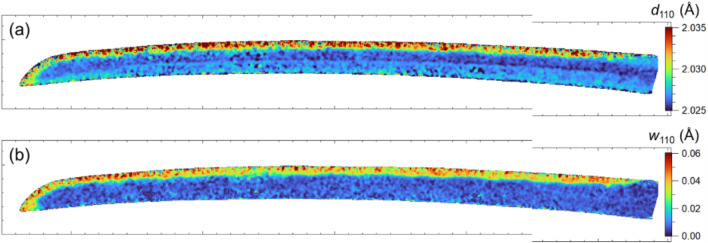
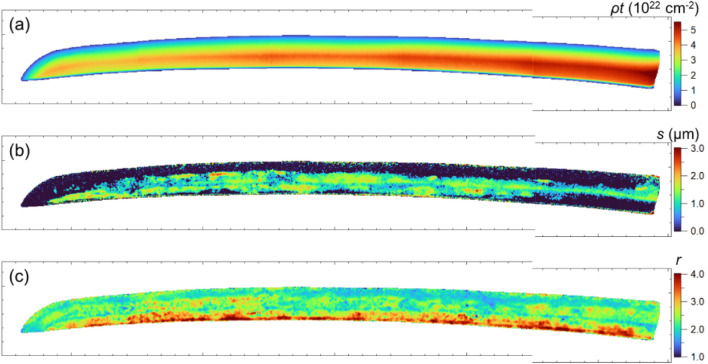
Our research focuses on elucidating the crystallographic structure of Japanese swords in a nondestructive manner using the neutron imaging instrument RADEN at the Materials and Life Science Experimental Facility of the Japan Proton Accelerator Research Complex (J-PARC). We developed an analysis method combining wavelength-resolved Bragg-edge imaging and wavelength-selective neutron tomography with a new strategy and applied it to an approximately 45-cm blade length Japanese sword signed by Bishu Osafune Norimitsu. Computed tomography was performed, and the three-dimensional analysis captured the characteristic internal structure of Kobuse. Kobuse is the most famous steel-combining structure of Japanese swords, where an outer steel with high-carbon content (Kawagane) covers a core steel with low-carbon content (Shingane). The crystallite size distribution obtained through Bragg-edge analysis could consistently explain the internal structure of two steels observed in neutron tomograms. Our nondestructive imaging revealed deep hardening, forming a wavy pattern more than 5 mm from the cutting edge.
我们的研究重点是,利用日本质子加速器研究中心(J-PARC)材料与生命科学实验设施的中子成像仪器RADEN,以非破坏性方式阐明日本刀的晶体结构。我们开发了一种将波长分辨布拉格边缘成像和波长选择性中子断层扫描相结合的分析方法,并采用了一种新策略,将其应用于一把由备前长船守光签名的、刀身长度约45厘米的日本刀。进行了计算机断层扫描,三维分析捕捉到了甲伏锻的特征内部结构。甲伏锻是日本刀最著名的钢材组合结构,其中高碳含量的外层钢材(河合钢)覆盖低碳含量的核心钢材(芯铁)。通过布拉格边缘分析获得的微晶尺寸分布能够始终如一地解释在中子断层图像中观察到的两种钢材的内部结构。我们的非破坏性成像揭示了深度硬化,在距刀刃超过5毫米处形成了波浪状图案。