Department of Nursing, College of Health Sciences, Makerere University, P.O. Box 7072, Kampala, Uganda.
Department of Nursing, China-Uganda Friendship Hospital, Naguru. P.O Box 20145, Nakawa, Uganda.
BMC Pregnancy Childbirth. 2024 Nov 14;24(1):753. doi: 10.1186/s12884-024-06915-z.
Preeclampsia is the second leading cause of maternal death in Uganda. WHO recommends using magnesium sulphate (MgSO4) to prevent and treat preeclampsia with severe features (PEC) and eclampsia. MgSO4 is used to prevent eclampsia and treat women who experience an eclamptic convulsion to avoid severe maternal/infant illnesses and death. We set out to assess MgSO4 administration patterns in women with PEC or eclampsia and the immediate newborn outcomes of neonates.
This was an analytical observational cohort study at Kawempe National Referral Hospital in Uganda. Two hundred ten pregnant mothers with PEC or eclampsia were recruited in the study after receiving the loading dose of MgSO4 and then followed through labour and delivery to observe MgSO4 administration patterns and immediate newborn outcomes using Apgar and Thompson scores. SPSS version 23 was used to analyse data, and both bivariate and multivariate logistic regressions were used to determine factors associated with the low Apgar score at five minutes.
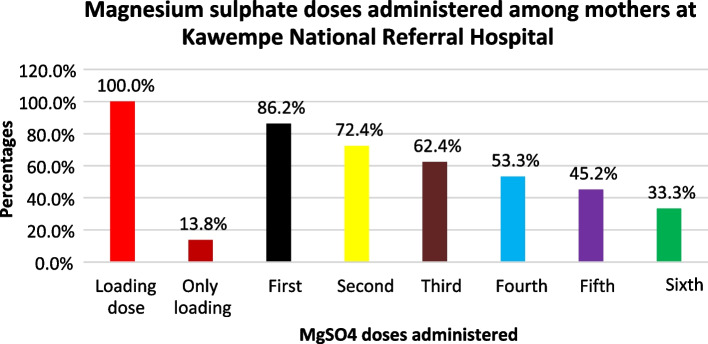
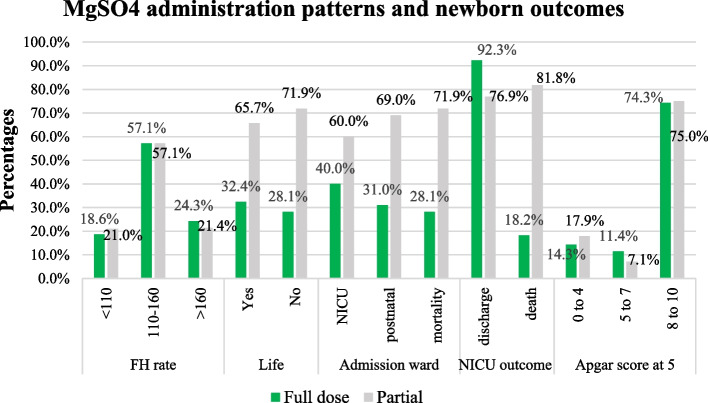
Overall, majority of the patients received more than one dose with 33.3% received a sixth dose of MgSO4. The majority, 84.8%, of the mothers delivered live babies, 31.0% babies had complications, and were admitted to the neonatal intensive care unit (NICU). NICU admissions were mostly due to respiratory distress21.4%, preterm delivery21.0%, and 5.5% died within seven days. Majority 93.3% of the newborns had an Apgar score of seven and above at five minutes, of the newborns who were Thompson scored, 70.4% scored between 1 to 10 which is mild HIE. Initiation of MgSO4 treatment within one hour from prescription (AOR = 0.49, CI: 0.01-1.94), 4-hourly timing of the first maintenance dose (AOR = 0.22, CI: 0.06-0.79) and having complete doses of MgSO4 treatment (AOR = 0.89, CI: 0.03-3.05) decreased the likelihood of having low Apgar scores at five minutes.
Timely administration of the first maintenance dose of MgSO4 decreases the likelihood of low Apgar score at 5 min and NICU admission in newborns, and most NICU admissions were due to respiratory distress and preterm delivery.
子痫前期是乌干达产妇死亡的第二大主要原因。世界卫生组织(WHO)建议使用硫酸镁(MgSO4)预防和治疗有严重特征的子痫前期(PEC)和子痫。MgSO4 用于预防子痫和治疗经历子痫抽搐的妇女,以避免严重的母婴/婴儿疾病和死亡。我们着手评估患有 PEC 或子痫的妇女使用硫酸镁的管理模式以及新生儿的即时新生儿结局。
这是乌干达卡温佩国家转诊医院的一项分析性观察队列研究。在接受硫酸镁负荷剂量后,招募了 210 名患有 PEC 或子痫的孕妇,并对其进行分娩和分娩监测,以使用阿普加(Apgar)和汤普森(Thompson)评分观察硫酸镁的使用模式和新生儿的即时结局。使用 SPSS 版本 23 分析数据,使用单变量和多变量逻辑回归来确定与 5 分钟时低 Apgar 评分相关的因素。
总体而言,大多数患者接受了不止一剂,33.3%的患者接受了第六剂硫酸镁。84.8%的母亲分娩出活产婴儿,31.0%的婴儿出现并发症并被收入新生儿重症监护病房(NICU)。NICU 入院主要是由于呼吸窘迫 21.4%、早产 21.0%和 5.5%的婴儿在七天内死亡。93.3%的新生儿在 5 分钟时的 Apgar 评分为 7 分及以上,在接受汤普森评分的新生儿中,70.4%的新生儿评分为 1 至 10 分,即轻度 HIE。硫酸镁治疗的起始时间从处方开始的 1 小时内(AOR=0.49,CI:0.01-1.94)、首次维持剂量的 4 小时时间间隔(AOR=0.22,CI:0.06-0.79)和完成硫酸镁治疗的剂量(AOR=0.89,CI:0.03-3.05)降低了 5 分钟时 Apgar 评分低的可能性。
及时给予硫酸镁的首次维持剂量可降低新生儿 5 分钟时 Apgar 评分低和新生儿 NICU 入院的可能性,大多数 NICU 入院是由于呼吸窘迫和早产。