Centre for Actuarial Studies, Faculty of Business and Economics, The University of Melbourne, Level 3, Building 105, 111 Barry Street, Melbourne, VIC, 3010, Australia.
Nossal Institute for Global Health, Melbourne School of Population and Global Health, The University of Melbourne, Level 2, 32 Lincoln Square North, Melbourne, VIC, 3010, Australia.
BMC Med. 2024 Nov 14;22(1):533. doi: 10.1186/s12916-024-03752-x.
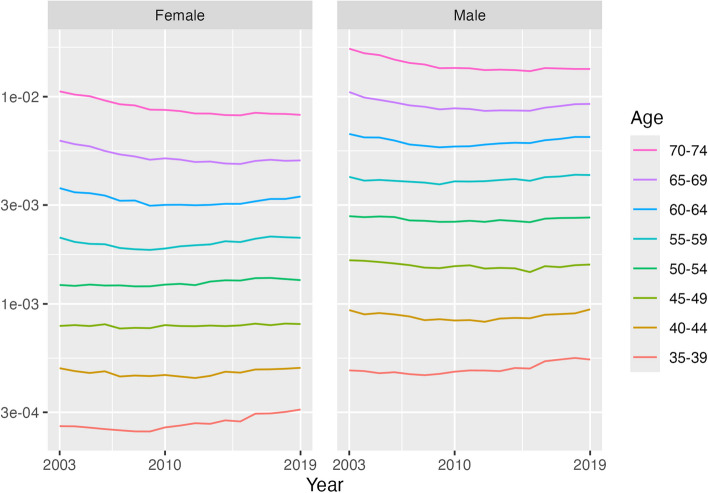
In the United States (US), premature cardiovascular disease (CVD) mortality rates (35-74 years) have exhibited increases in recent years, particularly in younger adults, and large differentials by educational attainment. This trend has occurred concurrently with high and increasing obesity prevalence, which also show significant differences by education. This study aims to jointly model premature CVD mortality trends in the US according to obesity status and educational attainment.
We used multiple cause of death data from the National Center for Health Statistics, obesity prevalence data from the National Health and Nutrition Examination Survey (NHANES), and educational attainment data from the American Community Survey and NHANES. We applied Bayes' theorem to these data to calculate the conditional probability of premature CVD mortality given obesity status and educational attainment for 2003-2019. We then projected this conditional probability for 2020-2029 using the Lee-Carter model.
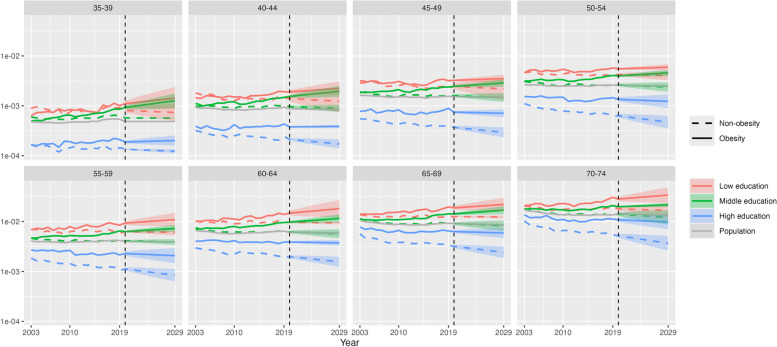
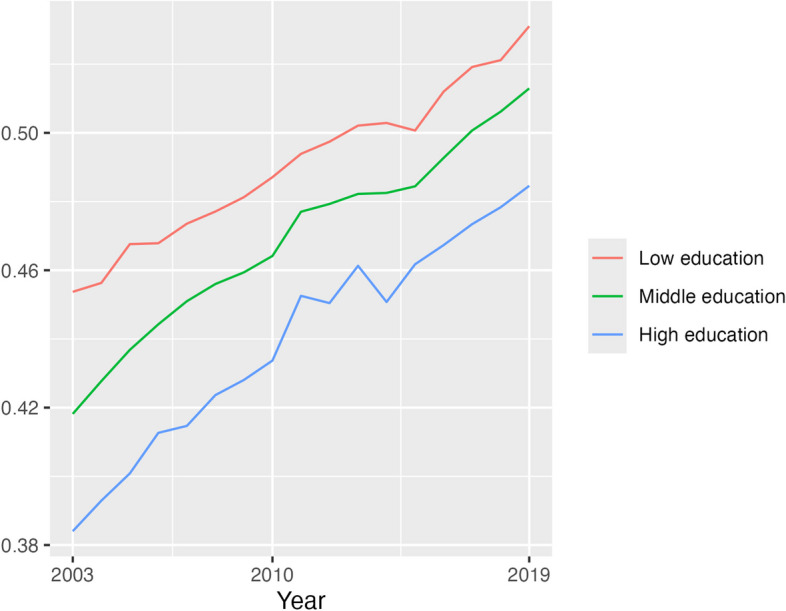
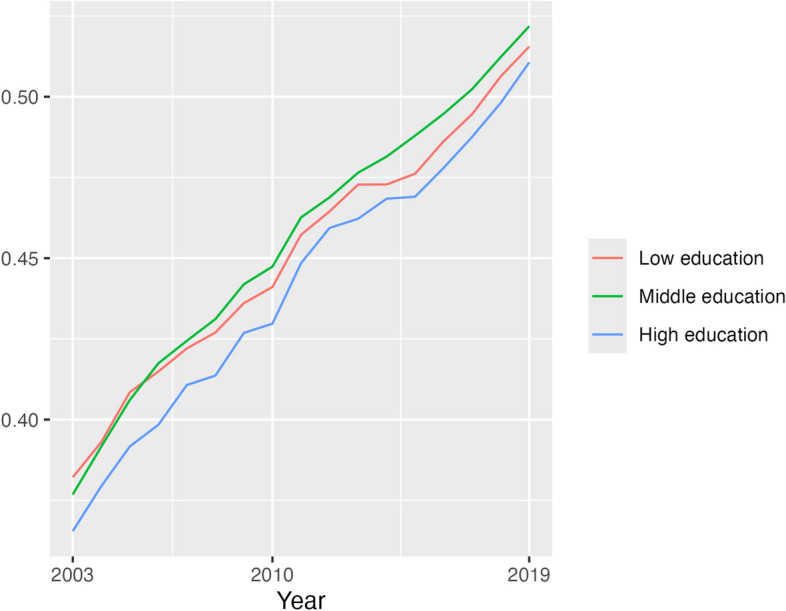
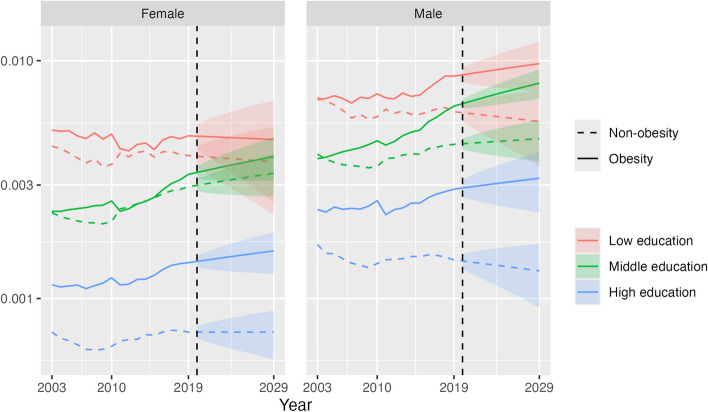
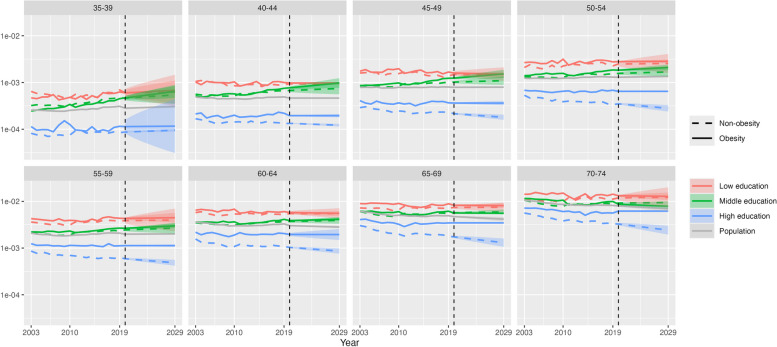
The probability of premature CVD mortality was greatest for obesity and low education (not graduated high school) and was substantially higher (females 6.7 times higher, males 5.9) compared with non-obesity and high education (Bachelor's degree or higher) in 2019. There was a widening of the gap in premature CVD mortality from 2003 to 2019 between the obese and non-obese populations, which occurred at each education level and was projected to continue in 2020-2029, especially for males. The conditional probability of premature CVD death for obesity and middle education (finished high school but no Bachelor's degree) increased substantially and was projected to surpass the level for non-obesity and low education in coming years for males and in younger age groups. At high education, the conditional probability of premature CVD death for the obese population was projected to increase to 2029, while for non-obesity it was projected to remain steady for females and fall for males; this projected widening is greatest at older age groups.
The findings demonstrate the public health challenge to reduce premature US CVD mortality posed by continued high obesity prevalence, especially for younger ages, lower education groups and males. The relative importance of obesity in influencing premature CVD mortality trends has risen partly due to the decline in CVD mortality attributable to other risk factors.
近年来,美国(US)的心血管疾病(CVD)早逝率(35-74 岁)有所上升,尤其是在年轻人中,并且与教育程度存在较大差异。这种趋势与肥胖率的居高不下且不断上升同时发生,肥胖率在教育程度方面也存在显著差异。本研究旨在根据肥胖状况和教育程度联合建模美国的 CVD 早逝趋势。
我们使用了来自国家卫生统计中心的多死因数据、来自国家健康和营养调查(NHANES)的肥胖流行率数据,以及来自美国社区调查和 NHANES 的教育程度数据。我们应用贝叶斯定理来计算 2003-2019 年肥胖状况和教育程度与 CVD 早逝之间的条件概率。然后,我们使用 Lee-Carter 模型来预测 2020-2029 年的条件概率。
2019 年,肥胖且未完成高中学业的人群发生 CVD 早逝的概率最高,女性高出 6.7 倍,男性高出 5.9 倍,与非肥胖且具有高等教育程度(拥有学士及以上学位)的人群相比。从 2003 年到 2019 年,肥胖和非肥胖人群之间的 CVD 早逝差距不断扩大,这种情况在每个教育水平上都存在,并预计在 2020-2029 年期间继续存在,尤其是在男性中。肥胖且中等教育程度(完成高中学业但未获得学士学位)的人群发生 CVD 早逝的条件概率显著增加,并预计在未来几年内超过非肥胖且低教育程度的人群,尤其是在男性和年轻年龄段。在高等教育程度方面,预计肥胖人群的 CVD 早逝条件概率将增加到 2029 年,而非肥胖人群的这一概率预计将在女性中保持稳定,在男性中下降;这种预计的扩大在老年人群中最大。
这些发现表明,由于肥胖率居高不下,特别是在年轻人、教育程度较低的群体和男性中,美国 CVD 早逝率居高不下,这对公共卫生构成了挑战。肥胖对影响 CVD 早逝趋势的相对重要性有所上升,部分原因是归因于其他风险因素的 CVD 早逝率下降。