School of rehabilitation, Faculty of medicine, Université de Montréal, PO Box 6128, Centre-Ville, Montreal, QC, H3C 3J7, Canada.
Centre for Interdisciplinary Research in Rehabilitation of Greater Montreal (CRIR), Institut universitaire sur la réadaptation en déficience physique de Montréal (IURDPM), Centre intégré universitaire de santé et de services sociaux du Centre-Sud-de-l'Ile-de- Montréal (CCSMTL), Montreal, QC, Canada.
BMC Health Serv Res. 2024 Nov 14;24(1):1401. doi: 10.1186/s12913-024-11805-3.
Physiotherapy is effective to reduce pain and improve the quality of life of people living with chronic pain. To offer high-quality physiotherapy services, these services must be patient-centred and respond to patients' needs. However, few studies seem to target patients' perceived needs, whereas more studies tend to focus on needs assessed by healthcare experts, which are not always in line with patients' perceived needs. In addition, people living with chronic pain are often faced with several health inequities and may have varied perceived needs depending on their personal conditions. To offer services that truly meet patients' needs, it is therefore crucial to understand these needs. This scoping review aims to identify and map the perceived needs of people living with chronic pain towards physiotherapy services.
To conduct this review, we followed the six stages framework proposed by Arksey and O'Malley. We searched four databases (Medline, Embase, CINHAL and APA PsycINFO) as well as the grey literature. We included all studies describing the needs, demands, preferences or expectations of adults living with chronic pain towards physiotherapy. We then performed an inductive thematic analysis of the results and discussion sections of these studies to identify the perceived needs. Once those needs were identified, we mapped them into the seven dimensions of the patient-centred healthcare delivery framework.
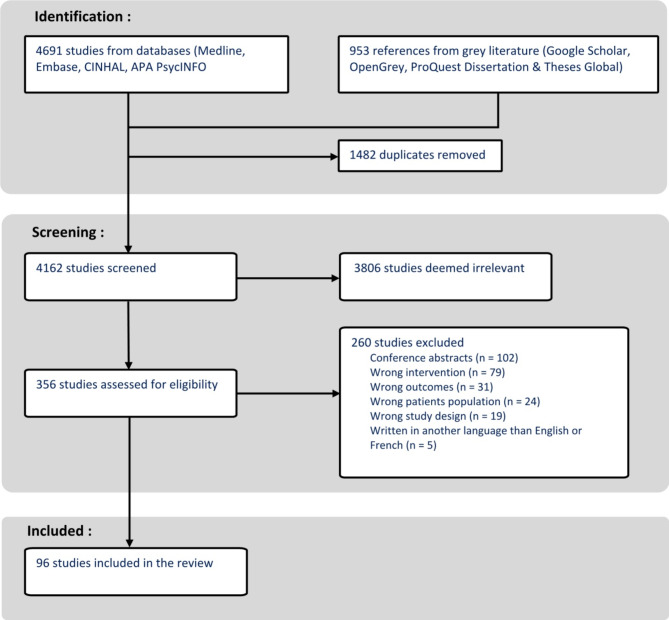
Our review included 96 studies. Various perceived needs were identified through the thematic analysis, such as the needs for an empathetic relationship; for a clear, adapted and supervised exercise program; and for personalized treatment. Our mapping into the patient-centred healthcare delivery framework showed that most studies reported needs associated with the dimensions of interpersonal care, individualized healthcare and professional care. Needs associated with the other dimensions of the framework (access; coordination and continuity; services and facilities; data and information) were less frequently mentioned.
The results of this review have enabled us to identify and better understand multiple needs perceived by people living with chronic pain regarding physiotherapy services. The perceived needs identified through this scoping review were mapped within the seven dimensions of the Patient-centred healthcare delivery framework.
物理疗法可有效减轻疼痛并提高慢性疼痛患者的生活质量。为提供高质量的物理疗法服务,这些服务必须以患者为中心并满足患者的需求。然而,很少有研究针对患者的感知需求,而更多的研究倾向于关注医疗保健专家评估的需求,这些需求并不总是与患者的感知需求一致。此外,慢性疼痛患者通常面临多种健康不平等问题,并且根据个人情况,他们的感知需求可能有所不同。为了提供真正满足患者需求的服务,因此了解这些需求至关重要。本范围综述旨在确定和绘制慢性疼痛患者对物理疗法服务的感知需求。
为了进行这项综述,我们遵循了 Arksey 和 O'Malley 提出的六个阶段框架。我们在四个数据库(Medline、Embase、CINHAL 和 APA PsycINFO)以及灰色文献中进行了检索。我们纳入了所有描述成年慢性疼痛患者对物理疗法的需求、要求、偏好或期望的研究。然后,我们对这些研究的结果和讨论部分进行了归纳主题分析,以确定感知需求。确定这些需求后,我们将其映射到以患者为中心的医疗保健提供框架的七个维度中。
我们的综述纳入了 96 项研究。通过主题分析确定了各种感知需求,例如对同理心关系的需求;对清晰、适应和监督的锻炼计划的需求;以及对个性化治疗的需求。我们将其映射到以患者为中心的医疗保健提供框架中表明,大多数研究报告了与人际关怀、个性化医疗保健和专业医疗保健相关的需求。与框架的其他维度(可及性;协调和连续性;服务和设施;数据和信息)相关的需求较少被提及。
本综述的结果使我们能够确定并更好地理解慢性疼痛患者对物理疗法服务的多种感知需求。通过本范围综述确定的感知需求已映射到以患者为中心的医疗保健提供框架的七个维度中。