Department of Restorative Dentistry and Endodontics, Semmelweis University, Budapest, Hungary.
Department of Anatomy, Histology and Embryology (Oral Morphology Group), Semmelweis University, Budapest, Hungary.
BMC Oral Health. 2024 Nov 14;24(1):1381. doi: 10.1186/s12903-024-05162-0.
This study aims to validate a machine learning algorithm previously developed in a training population on a different randomly chosen population (i.e., test set). The discrimination potential of the palatal intraoral scan-based geometric and superimposition methods was evaluated.
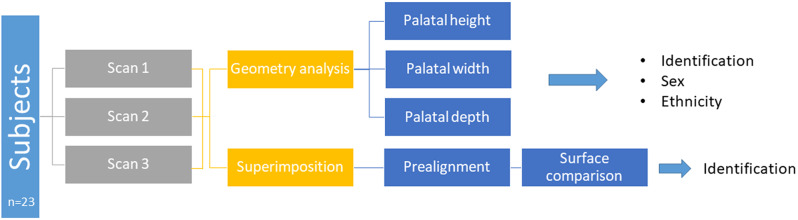
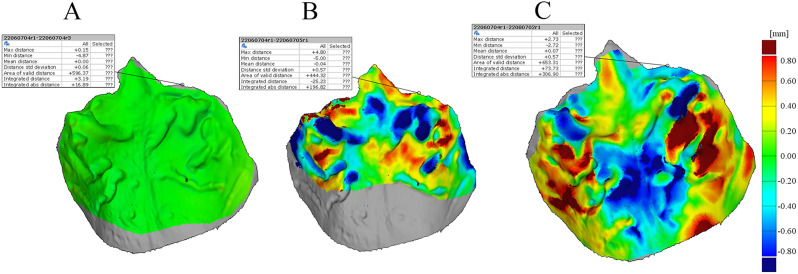
A total of 23 participants (16 females and seven males) from different countries underwent palatal scans using the Emerald intraoral scanner. Geometric-based identification involved measuring the height, width, and depth of the palatal vault in each scan. These parameters were then input into Fisher's linear discriminant equations with coefficients determined previously on a training set. Sensitivity and specificity were calculated. For the superimposition method, scan repeatability was compared to between-subjects differences, calculating mean absolute differences (MAD) between aligned scans. Multiple linear regression analysis determined the effects of sex, longitude, and latitude of country of origin on concordance.
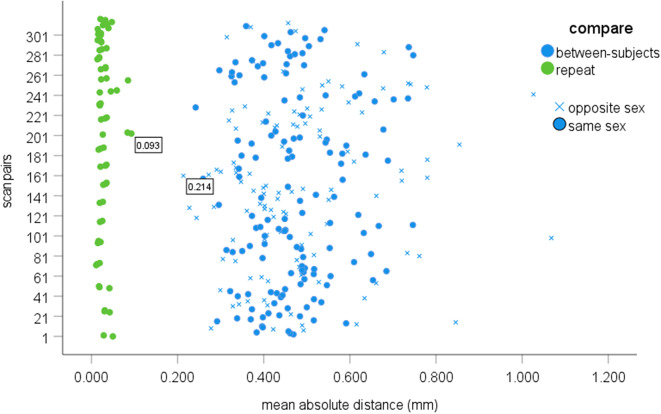
The geometric-based method achieved 91.2% sensitivity and 97.1% specificity, consistent with the results from the training set, showing no significant difference. Latitude and longitude did not significantly affect geometric-based matches. In the superimposition method, the between-subjects MAD range (1.068-0.214 mm) and the repeatability range (0.011-0.093 mm) did not overlap. MAD was minimally affected by longitude and not influenced by latitude. The sex determination function recognized females over males with 69.0% sensitivity, similar to the training set. However, the specificity (62.5%) decreased.
The assessment of geometric and superimposition discrimination has unequivocally demonstrated its robust reliability, remaining impervious to population. In contrast, the distinction between sexes carries only moderate reliability. The significant correlation observed among longitude, latitude, and palatal height suggests the feasibility of a comprehensive large-scale study to determine one's country of origin.
Portable intraoral scanners can aid forensic investigations as adjunct identification methods by applying the proposed discriminant function to palatal geometry without population restrictions.
The Clinicatrial.gov registration number is NCT05349942 (27/04/2022).
本研究旨在验证先前在训练人群中开发的机器学习算法在不同随机选择人群(即测试集)上的有效性。评估基于腭内口扫的几何和叠加方法的鉴别潜力。
来自不同国家的 23 名参与者(16 名女性和 7 名男性)使用 Emerald 口内扫描仪进行腭扫描。基于几何的识别涉及测量每个扫描中的腭穹窿的高度、宽度和深度。然后,这些参数被输入到先前在训练集上确定的 Fisher 线性判别方程中。计算敏感性和特异性。对于叠加方法,比较扫描的可重复性与个体间差异,计算对齐扫描之间的平均绝对差异(MAD)。多元线性回归分析确定了性别、原产国的经度和纬度对一致性的影响。
基于几何的方法实现了 91.2%的敏感性和 97.1%的特异性,与训练集的结果一致,没有显著差异。纬度和经度对基于几何的匹配没有显著影响。在叠加方法中,个体间 MAD 范围(1.068-0.214 毫米)和重复性范围(0.011-0.093 毫米)不重叠。MAD 受经度的影响较小,不受纬度的影响。性别确定功能识别女性的敏感性为 69.0%,与训练集相似,但特异性(62.5%)下降。
对几何和叠加区分的评估明确证明了其可靠的可靠性,不受人群影响。相比之下,性别之间的区别只有中等可靠性。观察到经度、纬度和腭高度之间的显著相关性表明,有可能进行一项全面的大规模研究,以确定一个人的原籍国。
便携式口内扫描仪可以通过将提出的判别函数应用于腭几何形状,无需人群限制,作为辅助识别方法来协助法医调查。
Clinicaltrials.gov 注册号为 NCT05349942(2022 年 4 月 27 日)。