Kim Kwanghee, Alam Syed M, Kuo Fengshen, Chen Ziyu, Yip Wesley, Katims Andrew B, Chu Carissa, Lenis Andrew T, Hu Wenhuo, Gokturk Ozcan Gamze, Chen Jie-Fu, Firouzi Sanaz, Elhanati Yuval, Clinton Timothy N, Aulitzky Andreas, Almassi Nima, Fujii Yoich, Tracey Andrew T, Reisz Peter A, Budhu Sadna, Vuong Lynda, Eichholz Jordan, Woo Hyung Jun, Nogueira Lucas, Gao Sizhi P, Scherz Avigdor, Aggen David H, Rosenberg Jonathan E, Pietzak Eugene J, Seshan Venkatraman, Greenbaum Benjamin, Becker Anton, Akin Oguz, Iyer Gopa, Al-Ahmadie Hikmat, Hakimi A Ari, Merghoub Taha, Solit David B, Coleman Jonathan A
Department of Surgery, Memorial Sloan Kettering Cancer Center, New York, NY, USA.
Urology Service, Department of Surgery, Memorial Sloan Kettering Cancer Center, New York, NY, USA.
Eur Urol. 2025 Mar;87(3):342-354. doi: 10.1016/j.eururo.2024.10.024. Epub 2024 Nov 16.
Molecular classification of upper tract urothelial carcinoma (UTUC) can provide insight into divergent clinical outcomes and provide a biological rationale for clinical decision-making. As such, we performed multi-omic analysis of UTUC tumors to identify molecular features associated with disease recurrence and response to immune checkpoint blockade (ICB).
Targeted DNA and whole transcriptome RNA sequencing was performed on 100 UTUC tumors collected from patients undergoing nephroureterectomy. Consensus non-negative matrix factorization was used to identify molecular clusters associated with clinical outcomes. Gene set enrichment and immune deconvolution analyses were performed. Weighted gene co-expression network analysis was employed for unsupervised identification of gene networks in each cluster.
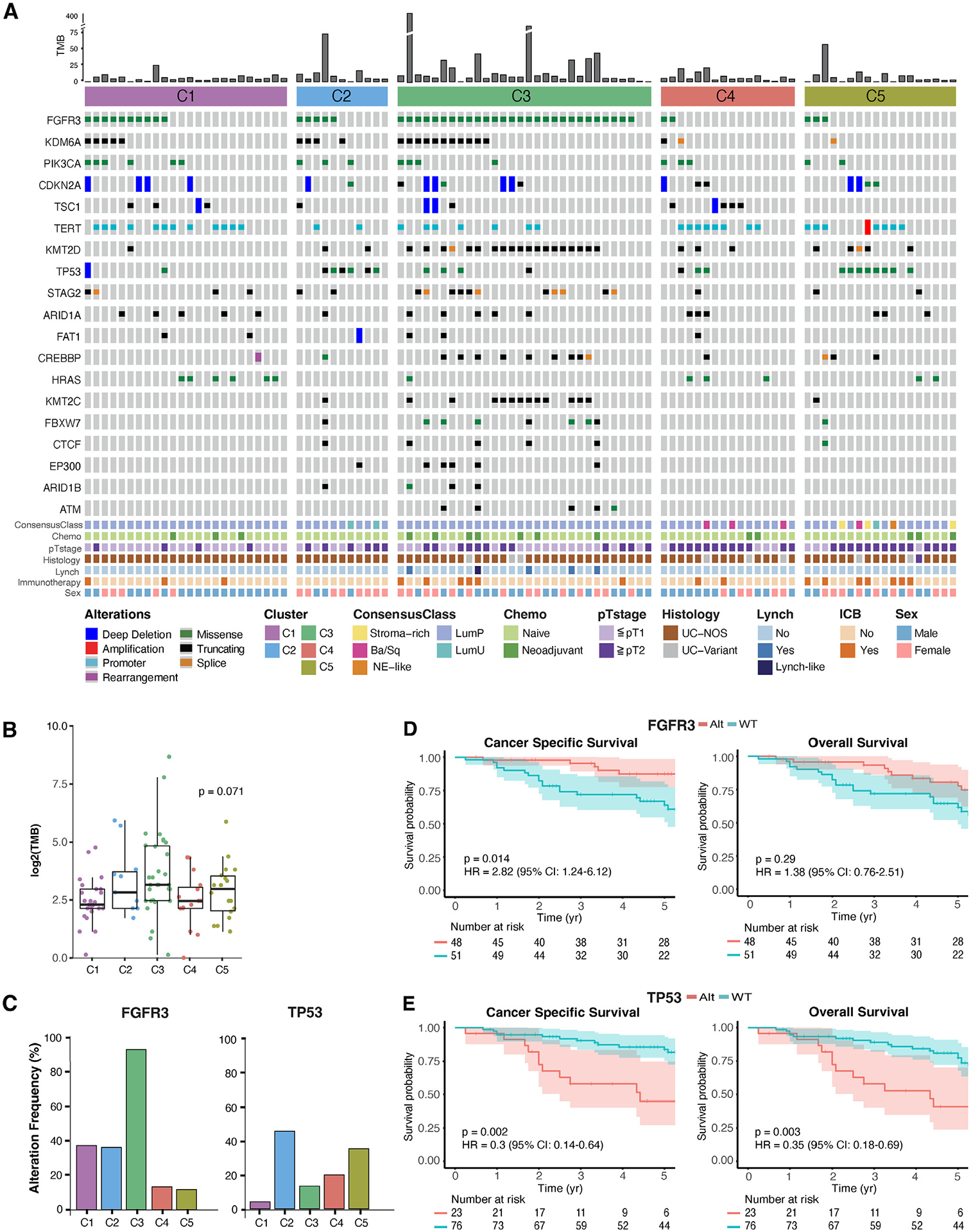
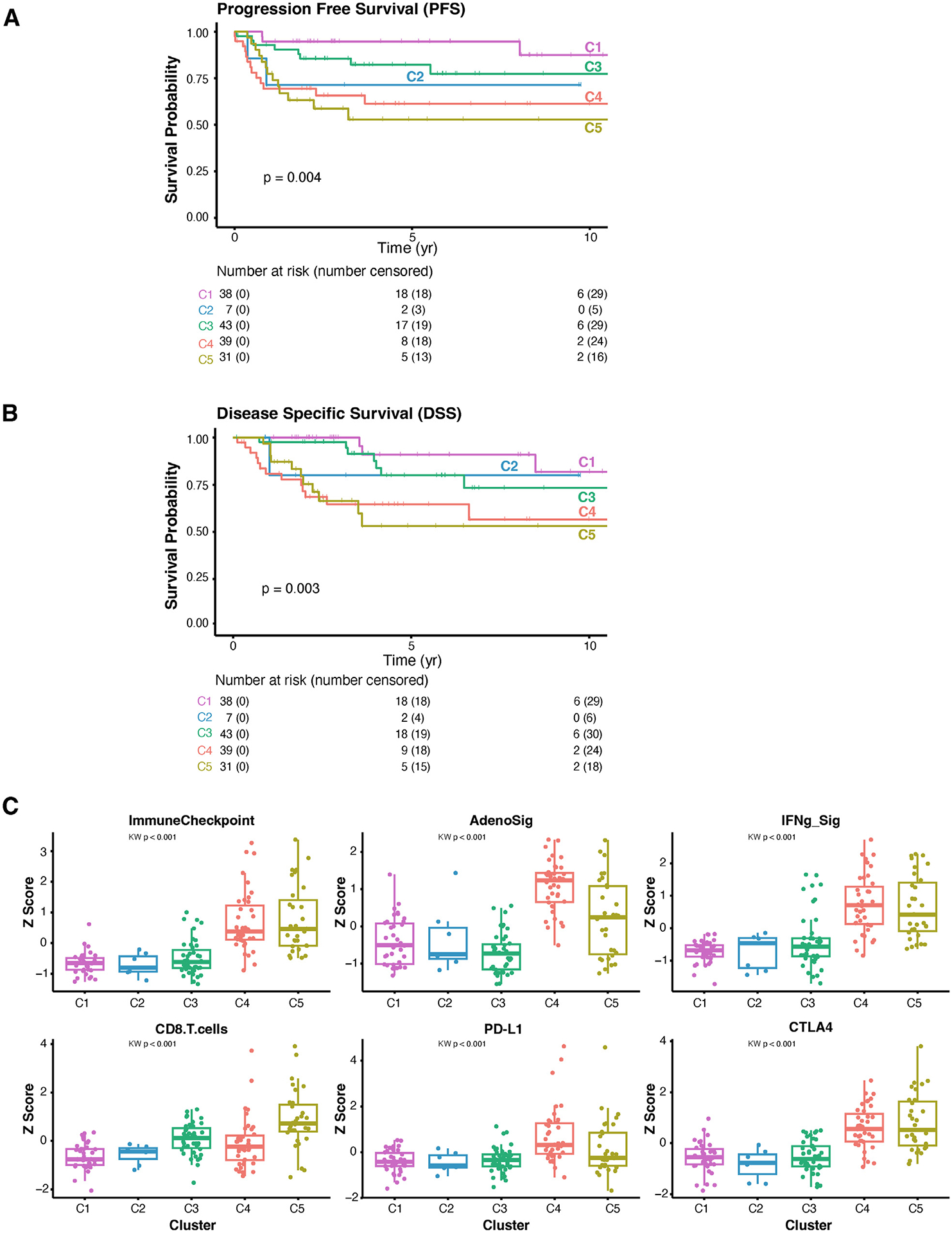
Five molecular clusters with distinct clinical outcomes were identified. Favorable subtypes (C1 and C2) were characterized by a luminal-like signature and an immunologically depleted tumor microenvironment (TME). Subtype C3 was characterized by FGFR3 alterations and a higher tumor mutational burden, and included all tumors with microsatellite instability. Despite higher rates of recurrence and inferior survival, subtypes C4 and C5 harbored an immunologically rich TME favoring response to ICB. Limitations include extrapolation of molecular features of tumors from the primary site to determine response to systemic immunotherapy and the limited resolution of bulk sequencing to distinguish gene expression in the tumor, stroma, and immune compartments.
RNA sequencing identified previously underappreciated UTUC molecular heterogeneity and suggests that UTUC patients at the highest risk of metastatic recurrence following surgery include those most likely to benefit from perioperative ICB.
上尿路尿路上皮癌(UTUC)的分子分类有助于深入了解不同的临床结局,并为临床决策提供生物学依据。因此,我们对UTUC肿瘤进行了多组学分析,以确定与疾病复发和免疫检查点阻断(ICB)反应相关的分子特征。
对100例接受肾输尿管切除术患者的UTUC肿瘤进行靶向DNA和全转录组RNA测序。采用共识非负矩阵分解法确定与临床结局相关的分子簇。进行基因集富集分析和免疫反卷积分析。采用加权基因共表达网络分析对每个簇中的基因网络进行无监督识别。
确定了五个具有不同临床结局的分子簇。有利亚型(C1和C2)的特征是具有管腔样特征和免疫耗竭的肿瘤微环境(TME)。C3亚型的特征是FGFR3改变和较高的肿瘤突变负荷,包括所有具有微卫星不稳定性的肿瘤。尽管复发率较高且生存率较低,但C4和C5亚型具有免疫丰富的TME,有利于对ICB产生反应。局限性包括从原发部位推断肿瘤的分子特征以确定对全身免疫治疗的反应,以及批量测序区分肿瘤、基质和免疫区室中基因表达的分辨率有限。
RNA测序发现了此前未被充分认识的UTUC分子异质性,并表明术后发生转移性复发风险最高的UTUC患者包括那些最有可能从围手术期ICB中获益的患者。