Yu Chia-Hui, Wu Pei-Ling, Pai Hsiang-Chu
Department of Public Relations, Chung-Shan Medical University Hospital, Taichung, Taiwan.
Department of Nursing, Chung-Shan Medical University College of Medicine, Chung-Shan Medical University Hospital, Taichung, Taiwan.
Florence Nightingale J Nurs. 2024 Feb 28;32(1):10-16. doi: 10.5152/FNJN.2024.23101.
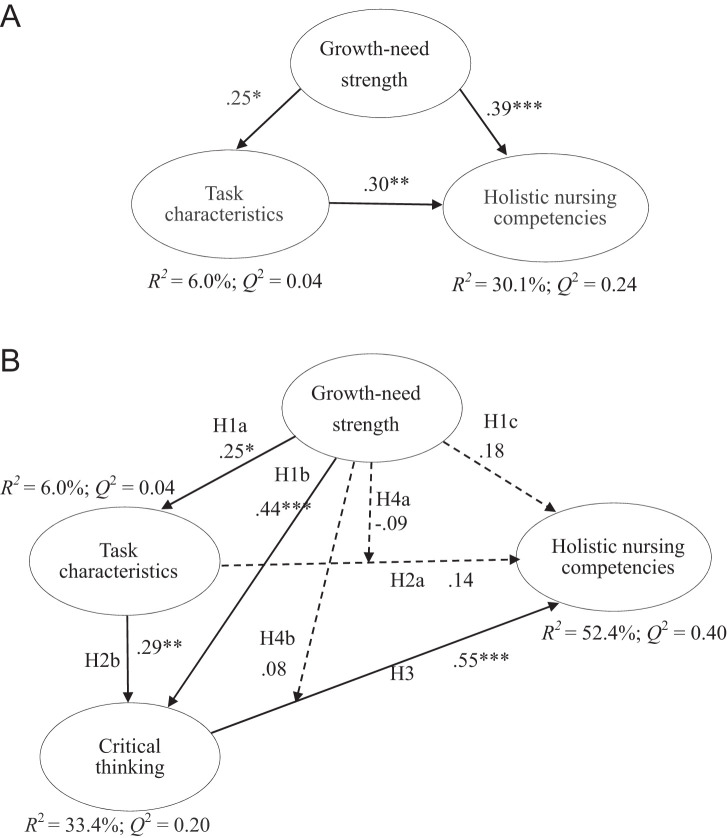
The study aimed to examine the relationship among professional growth-need strength, care-task characteristics, critical thinking, and holistic nursing competencies after a care-task design and clinical reasoning program intervention in nursing students. This study used a longitudinal study design. The study was conducted from August 12, 2019 to July 30, 2020. Participants were thirdyear nursing students of a medical university. Data were collected by questionnaires at three time points. Structural equation modeling was used to examine the relationship among all measures variables. A total of 91 students participated in the study. The results show that growth-need strength had a significant positive effect on caretask characteristic and critical thinking and a nonsignificant effect on holistic nursing competencies. Care-task characteristics, however, had a significant positive effect on critical thinking, resulting in improvement in holistic nursing competencies. It is worth noting that the moderating effect of growth-need strength on care-task characteristics and nursing competence relationships could not be established. Our findings suggest the importance of improving students' perceived care-task characteristics through an objective structured clinical examination and, at the same time, promoting students' critical thinking and improving their professional abilities.
本研究旨在探讨在对护理专业学生进行护理任务设计与临床推理程序干预后,专业成长需求强度、护理任务特征、批判性思维和整体护理能力之间的关系。本研究采用纵向研究设计。研究于2019年8月12日至2020年7月30日进行。参与者为某医科大学三年级护理专业学生。在三个时间点通过问卷调查收集数据。采用结构方程模型来检验所有测量变量之间的关系。共有91名学生参与了本研究。结果表明,成长需求强度对护理任务特征和批判性思维有显著的正向影响,而对整体护理能力的影响不显著。然而,护理任务特征对批判性思维有显著的正向影响,从而使整体护理能力得到提高。值得注意的是,成长需求强度对护理任务特征与护理能力关系的调节作用未能确立。我们的研究结果表明,通过客观结构化临床考试提高学生对护理任务特征的认知具有重要意义,同时促进学生的批判性思维并提高他们的专业能力。