Naylon Sarah H, Richaud Alexis D, Zhao Guangkuan, Bui Linda, Dufresne Craig P, Wu Chunjing J, Wangpaichitr Medhi, Savaraj Niramol, Roche Stéphane P
Department of Chemistry and Biochemistry, Florida Atlantic University Boca Raton Florida 33431 USA
Thermo Fisher Scientific West Palm Beach Florida 33407 USA.
RSC Chem Biol. 2024 Nov 4;5(12):1259-70. doi: 10.1039/d4cb00174e.
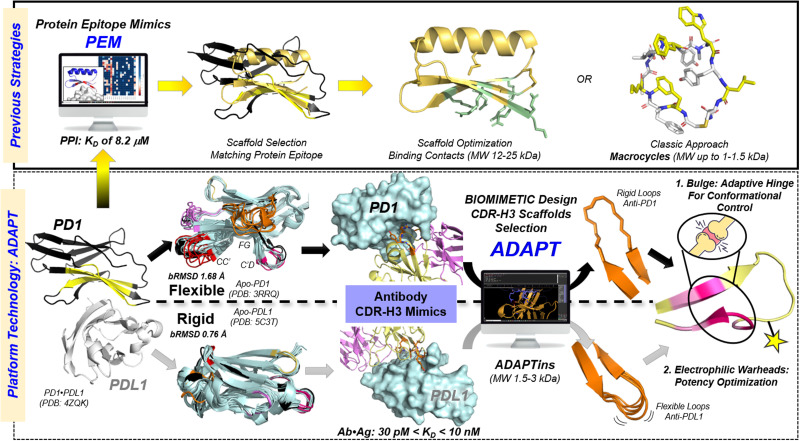
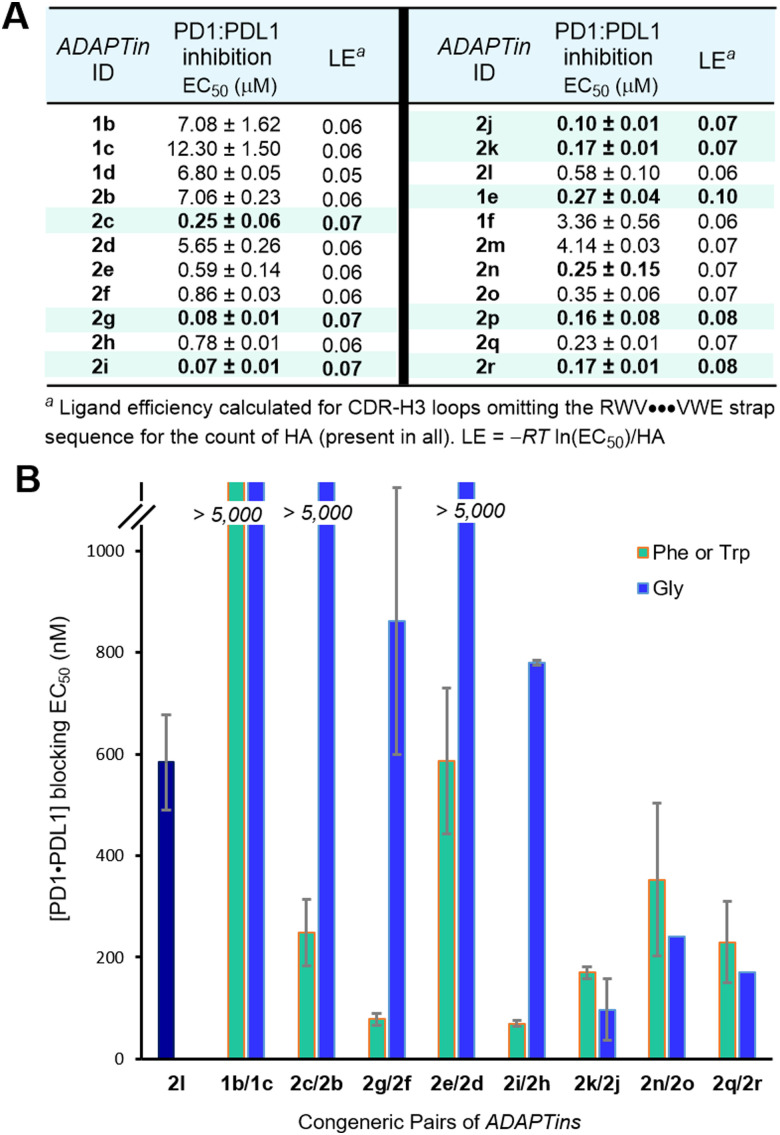
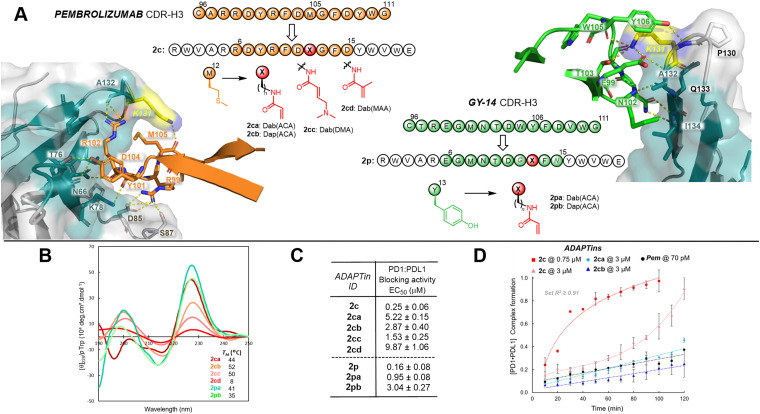
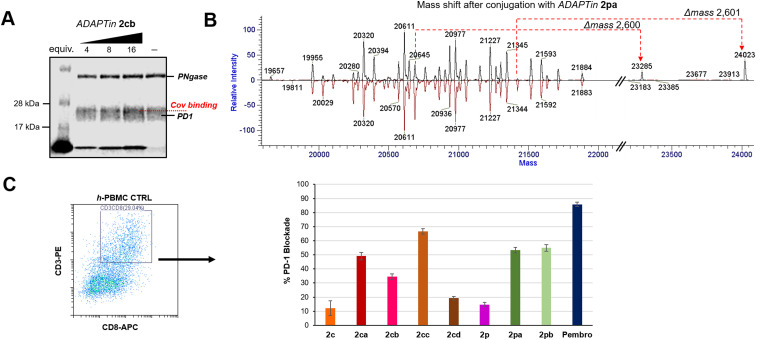
Aberrant and dysregulated protein-protein interactions (PPIs) drive a significant number of human diseases, which is why they represent a major class of targets in drug discovery. Although a number of high-affinity antibody-based drugs have emerged in this therapeutic space, the discovery of smaller PPI inhibitors is lagging far behind, underscoring the need for novel scaffold modalities. To bridge this gap, we introduce a biomimetic platform technology - adaptive design of antibody paratopes into therapeutics () - that enables the paratope-forming binding loops of antibodies to be crafted into large β-hairpin scaffolds (). In this study, we describe a novel strategy for engineering native CDR-H3 "hot loops" with varying sequences, lengths, and rigidity into , ultimately transforming these compounds into irreversible covalent inhibitors. A proof-of-concept was established by creating a series of blockers of the PD1:PDL1 immune checkpoint PPI (blocking activity EC < 0.3 μM) which were subsequently modified into potent covalent PD1 inhibitors. The compelling rate of stable and folded above physiological temperature (21 out of 29) obtained across six different scaffolds suggests that the platform technology could provide a novel opportunity for high-quality peptide display and biological screening.
异常和失调的蛋白质-蛋白质相互作用(PPI)引发了大量人类疾病,这就是为什么它们在药物研发中是一类主要的靶点。尽管在这个治疗领域已经出现了许多基于高亲和力抗体的药物,但更小的PPI抑制剂的发现却远远滞后,这凸显了对新型支架模式的需求。为了弥补这一差距,我们引入了一种仿生平台技术——将抗体互补决定区设计成治疗性药物(),该技术能使抗体形成互补决定区的结合环构建成大的β-发夹支架()。在本研究中,我们描述了一种新策略,即将具有不同序列、长度和刚性的天然互补决定区重链3(CDR-H3)“热环”工程化到 中,最终将这些化合物转化为不可逆的共价抑制剂。通过创建一系列PD1:PDL1免疫检查点PPI的阻断剂(阻断活性EC<0.3μM)建立了概念验证,随后将其修饰为有效的共价PD1抑制剂。在六种不同支架上获得的高于生理温度的稳定折叠的 的令人信服的比例(29个中有21个)表明,该平台技术可为高质量肽展示和生物筛选提供新机会。