Oue Kana, Yamawaki Yosuke, Ouhara Kazuhisa, Imado Eiji, Tamura Tetsuya, Doi Mitsuru, Shimizu Yoshitaka, Yoshida Mitsuhiro, Mizuno Noriyoshi, Morioka Norimitsu, Kanematsu Takashi, Irifune Masahiro, Ago Yukio
Department of Dental Anesthesiology, Division of Oral and Maxillofacial Surgery and Oral Medicine, Hiroshima University Hospital, Hiroshima, Japan.
Department of Advanced Pharmacology, Daiichi University of Pharmacy, Fukuoka, Japan.
J Oral Microbiol. 2024 Nov 14;16(1):2419155. doi: 10.1080/20002297.2024.2419155. eCollection 2024.
Both periodontal disease and obesity are risk factors for dementia, but their links to 1brain function remain unclear. In this study, we examined the effects of oral infection with a periodontal pathogen on cognitive function in a mouse model of obesity, focusing on the roles of microglia.
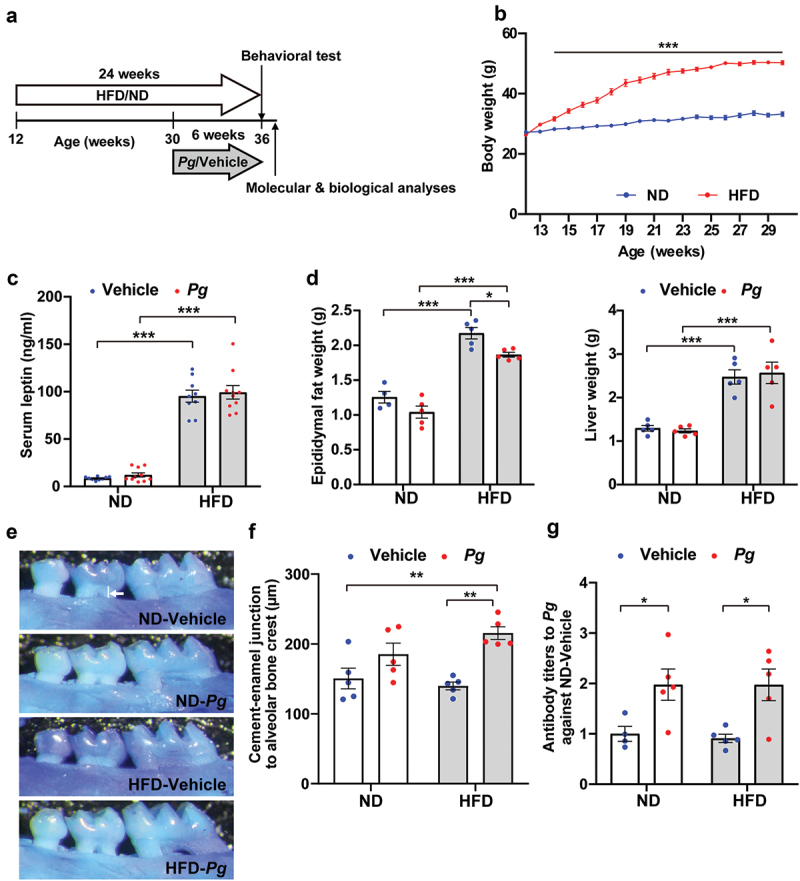
To create a mouse model of diet-induced obesity and periodontitis, male C57BL/6 J mice were first fed a high-fat diet containing 60% lipid calories for 18 weeks, beginning at 12 weeks of age, to achieve diet-induced obesity. Then, administration in the oral cavity twice weekly for 6 weeks was performed to induce periodontitis in obese mice.
Obese mice orally exposed to showed cognitive impairment in the novel object recognition test. Increased expression levels of inflammatory cytokines (e.g. interleukin-1β and tumor necrosis factor-α) were observed in the hippocampus of -treated obese mice. Immunohistochemical analysis revealed that microglia cell body size was increased in the hippocampus and prefrontal cortex of -treated obese mice, indicating microglial activation. Furthermore, depletion of microglia by PLX3397, a colony-stimulating factor 1 receptor inhibitor, ameliorated cognitive dysfunction.
These results suggest that microglia mediate periodontal infection-induced cognitive dysfunction in obesity.
牙周病和肥胖都是痴呆症的危险因素,但它们与脑功能的联系仍不清楚。在本研究中,我们在肥胖小鼠模型中研究了牙周病原体的口腔感染对认知功能的影响,重点关注小胶质细胞的作用。
为建立饮食诱导肥胖和牙周炎的小鼠模型,雄性C57BL/6 J小鼠在12周龄时开始喂食含60%脂肪热量的高脂饮食18周,以实现饮食诱导肥胖。然后,每周两次在口腔内给药6周,以诱导肥胖小鼠患牙周炎。
在新物体识别试验中,经口腔暴露于[此处原文缺失相关病原体信息]的肥胖小鼠出现认知障碍。在经[此处原文缺失相关病原体信息]处理的肥胖小鼠海马体中观察到炎性细胞因子(如白细胞介素-1β和肿瘤坏死因子-α)表达水平升高。免疫组织化学分析显示,经[此处原文缺失相关病原体信息]处理的肥胖小鼠海马体和前额叶皮质中小胶质细胞的胞体大小增加,表明小胶质细胞被激活。此外,集落刺激因子1受体抑制剂PLX3397使小胶质细胞耗竭,改善了认知功能障碍。
这些结果表明,小胶质细胞介导肥胖中牙周感染诱导的认知功能障碍。