Gallo Lucas, Kim Patrick, Churchill Isabella F, Gallo Matteo, Yuan Morgan, Voineskos Sophocles H, Thoma Achilles, Pusic Andrea L, Klassen Anne F, Cano Stefan J
Division of Plastic Surgery, McMaster University, Hamilton, ON, Canada.
Faculty of Medicine, University of Ottawa, Ottawa, ON, Canada.
Plast Surg (Oakv). 2024 Jan 23:22925503231225480. doi: 10.1177/22925503231225480.
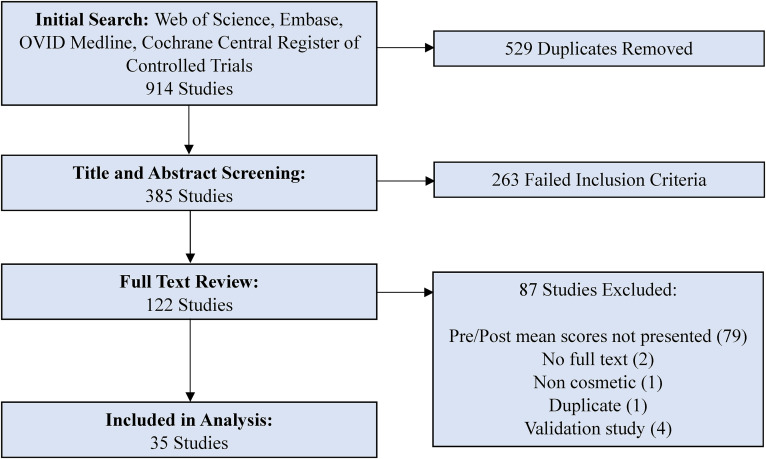
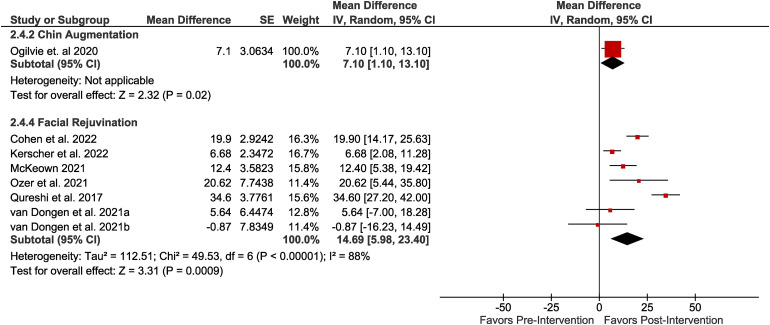
The FACE-Q Aesthetic module measures patient-important outcomes following surgical and non-surgical facial cosmetic procedures. The primary aim of this systematic review was to summarize the pre- to post-intervention mean differences of facial aesthetic interventions that evaluate outcomes using the FACE-Q Face Overall, Psychological, and Social scales. Ovid Medline, Embase, Cochrane, and Web of Science databases were searched on December 20, 2022 with the assistance of a health-research librarian (CRD42023404238). Studies that examined any surgical or non-surgical facial aesthetic intervention in adult patients and used FACE-Q Aesthetics Face Overall, Psychological, and/or Social scales to measure participants before and after treatment were included for analysis. Of 914 potential articles screened, 35 studies met the inclusion criteria. Most studies evaluated surgical (n = 22, 62.9%) versus non-surgical facial cosmetic interventions (n = 13, 37.1%). Rhinoplasty [37.0 points, 95% CI 24.7-49.3, < 0.01] demonstrated the largest weighted increase in Face Overall scores, whereas the largest increase in Psychological [67.1 points, 95% CI 62.9-71.3, < 0.01] and Social [63.9 points, 95% CI 53.2-74.6, < 0.01] scores was demonstrated by a single study evaluating surgical forehead lifts, respectively. This meta-analysis leverages FACE-Q Aesthetic module scoring to present the expected mean differences in Face Overall, Psychological, and Social scale scores for various surgical and non-surgical facial cosmetic interventions. The findings from this review may be used to indirectly compare interventions and contribute to sample size calculations when planning future studies.
面部美学质量问卷(FACE-Q)美学模块用于测量手术和非手术面部美容手术后对患者重要的结果。本系统评价的主要目的是总结面部美学干预措施在干预前后的平均差异,这些干预措施使用FACE-Q面部整体、心理和社会量表来评估结果。2022年12月20日,在一名健康研究馆员的协助下(CRD42023404238),对Ovid Medline、Embase、Cochrane和科学网数据库进行了检索。纳入分析的研究需满足:研究对象为成年患者,涉及任何手术或非手术面部美学干预,并使用FACE-Q美学面部整体、心理和/或社会量表对参与者进行治疗前后的测量。在筛选的914篇潜在文章中,有35项研究符合纳入标准。大多数研究评估了手术(n = 22,62.9%)与非手术面部美容干预(n = 13,37.1%)。隆鼻术[37.0分,95%CI 24.7 - 49.3,P < 0.01]在面部整体评分中显示出最大的加权增加,而在一项评估手术前额提升的单一研究中,心理评分[67.1分,95%CI 62.9 - 71.3,P < 0.01]和社会评分[63.9分,95%CI 53.2 - 74.6,P < 0.01]分别显示出最大的增加。这项荟萃分析利用FACE-Q美学模块评分,展示了各种手术和非手术面部美容干预在面部整体、心理和社会量表评分方面预期的平均差异。本综述的结果可用于间接比较干预措施,并为未来研究规划时的样本量计算提供参考。